



The Curious Leap
Imagine a dewdroplet on a quiet morning, serenely perched on a leaf, suddenly taking flight. No external force like wind or a tremor is apparent, yet the
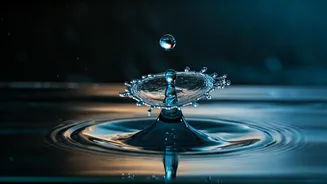
droplet detaches and ascends. Physicists have a name for this intriguing event: droplet jumping. Essentially, it's when a liquid droplet lifts itself off the surface it's resting upon. Even the upward rebound of a raindrop hitting a surface can be classified as this phenomenon. While it might seem like a minor observation in the realm of fluid behavior, the ability for droplets to separate from surfaces holds significant importance for numerous technological applications. For instance, when droplets dislodge from tainted surfaces, they can carry away unwanted particles, forming the basis of self-cleaning materials. In scenarios involving hot surfaces, departing droplets efficiently remove heat. Conversely, on cold surfaces, rapid droplet removal is crucial for preventing ice accumulation.
A Stubborn Limit Broken
For an extended period, the scientific community held a firm belief that a definitive upper boundary existed for the size of these self-propelled jumping droplets. However, a groundbreaking new study has now demonstrated that this long-standing limitation can be overcome, ingeniously facilitated by the presence of a bubble. This pivotal research was spearheaded by the laboratory at Virginia Tech, involving a collaborative effort with esteemed researchers from the University of Maryland and the Max Planck Institute. The core of the challenge lay in understanding the competing forces within a droplet: surface tension and gravity. Surface tension constantly strives to shape the droplet into a sphere, a form that minimizes its surface area and consequently its energy. In contrast, gravity exerts a downward pull, flattening the droplet against the surface. The precise equilibrium between these two forces defines what is known as the capillary length, which for water measures approximately 2.7 mm. Droplets smaller than this length are primarily governed by surface tension and are thus capable of propelling themselves upward. Beyond this length, however, gravity becomes the dominant force. This established balance has historically served as a fundamental obstacle in the pursuit of self-propelled droplet jumping, with most prior studies observing droplets no larger than about 3 mm achieving independent upward motion.
Nature's Gentle Nudge
The genesis of this innovative research can be traced back to keen observations made in the natural world. One of the lead researchers, recalling his childhood in rural South China, frequently noticed dew droplets adorning lotus leaves. These droplets often contained minuscule air bubbles. He observed that on occasion, when these tiny bubbles spontaneously burst, the droplets themselves would shift. This childhood memory sparked a profound question years later: could a bubble, concealed within a droplet, furnish the necessary extra energy required for it to jump? This curiosity became the driving force behind the experimental investigation, seeking to validate whether a naturally occurring phenomenon could be harnessed to overcome a long-standing scientific barrier. The inspiration drawn from simple, everyday observations in nature highlights how fundamental scientific breakthroughs can sometimes stem from attentive curiosity about the world around us.
Bubble's Explosive Launch
To rigorously test their hypothesis, the scientists devised an experiment. They carefully placed a water droplet onto a superhydrophobic surface, a material renowned for its extreme water-repelling properties. Subsequently, using a delicate, fine needle, they artfully injected air into the droplet, thereby creating a bubble nestled within the liquid. After a brief interval, the entrapped bubble underwent a bursting event. High-speed cameras were employed to meticulously document the subsequent events, capturing with remarkable clarity how the droplet cleanly detached itself from the surface. The researchers were astounded by the scale of the phenomenon they witnessed. Droplets measuring nearly 1 cm in width were observed to achieve liftoff, significantly exceeding the previously accepted capillary length limitation. The underlying mechanism involves the bubble's presence creating additional air-liquid interfaces within the droplet. This effectively enhances the system's stored surface energy without adding any substantial mass. Upon the bubble's collapse, this stored energy is rapidly unleashed in the form of capillary waves, which precisely focus momentum in an upward direction, propelling the droplet skyward.
Tiny Bubbles, Big Impact
The researchers further discovered that this novel droplet-propulsion mechanism is remarkably efficient. Astonishingly, it converts over 90% of the released energy directly into upward momentum, a figure substantially higher than many conventional methods used for droplet propulsion. The ramifications of this discovery extend far beyond the abstract principles of fundamental physics. This breakthrough holds the potential to significantly improve the performance of self-cleaning surfaces, enhance the efficiency of heat transfer systems, and bolster the effectiveness of anti-icing technologies. Moreover, the directional liquid jets generated by the bubble-bursting process could find valuable applications in microscale 3D printing and precise material deposition techniques. In essence, this study has unveiled an unexpected yet powerful capability: a single bursting bubble can launch a droplet of a much greater size than scientists had previously deemed possible, even extending to the centimeter scale.