




Instrument Silenced
In a significant maneuver to prolong its mission, NASA's Jet Propulsion Laboratory (JPL) recently issued commands to deactivate the Low-energy Charged
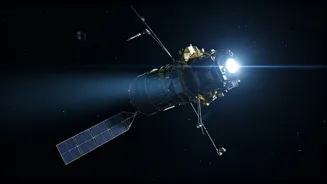
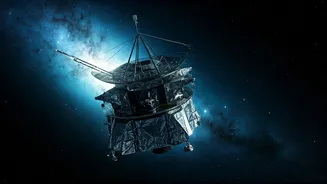
Particles (LECP) experiment aboard the Voyager 1 spacecraft. This particular instrument had been faithfully gathering data for nearly 49 years, having been operational since Voyager 1's launch in 1977. Its primary function was to measure low-energy charged particles, including ions, electrons, and cosmic rays originating from both within our solar system and the wider galaxy. The data collected by the LECP has been instrumental in understanding the interstellar medium, providing insights into phenomena like pressure waves and variations in particle density beyond the heliosphere. Notably, Voyager 1 and its twin, Voyager 2, are the only probes currently positioned to acquire such unique information, making the LECP's contribution invaluable to our cosmic understanding. The decision to power it down was made to optimize the spacecraft's remaining energy, a critical step for its continued operation in the extreme conditions of deep space.
Power Drain
The Voyager spacecraft, including Voyager 1, are powered by radioisotope thermoelectric generators (RTGs) that convert heat from the decay of plutonium into electrical energy. This power source, while robust, experiences a consistent decline, with each spacecraft losing approximately 4 watts of power annually. After nearly five decades of continuous operation in the harsh environment of space, the available energy has become a significant constraint. To manage this, engineers must meticulously reduce power consumption by deactivating non-essential components like heaters and instruments. This careful management is vital to prevent the spacecraft's fuel lines from freezing, ensuring its operational integrity. The urgency for such measures was highlighted when Voyager 1 experienced an unexpected power drop during a planned roll maneuver on February 27. Engineers recognized that any further decrease could trigger the spacecraft's undervoltage fault protection system, which would automatically shut down vital components, leading to a complex and potentially risky recovery process.
Strategic Shutdowns
The decision to power down the LECP was not an arbitrary one; it was guided by a long-established plan meticulously developed by scientists and engineers. This pre-determined strategy outlines the order in which various systems would be shut down, with the overarching goal of preserving as much scientific capability as possible for as long as possible. Originally equipped with 10 sets of instruments, each Voyager spacecraft has already seen seven of these instrument suites powered off. For Voyager 1, the LECP was the next logical system to be deactivated according to this plan. Coincidentally, the same instrument was similarly deactivated on Voyager 2 in March 2025. Given Voyager 1's immense distance from Earth—currently exceeding 15 billion miles (25 billion kilometers)—communication with the spacecraft is a protracted process. Commands sent from Earth take approximately 23 hours to reach Voyager 1, and the subsequent shutdown procedure for an instrument requires an additional three hours and 15 minutes. Interestingly, a small portion of the LECP, specifically a motor that rotates its sensor for scanning, will remain operational. This component consumes a minimal amount of power (0.5 watts) and its continued function offers the potential to reactivate the entire instrument in the future should additional power become available.
Future Longevity
By deactivating the LECP, engineers anticipate that Voyager 1 will gain approximately one additional year of operational time. During this extended period, the team is actively preparing for a more ambitious power-saving initiative known as 'the Big Bang.' This innovative strategy involves systematically replacing several power-intensive components with more energy-efficient alternatives. The aim is to conserve enough heat and maintain essential functionality for continued data collection. The 'Big Bang' approach will first be rigorously tested on Voyager 2, which possesses slightly more available power and is closer to Earth, making it a more manageable test subject. These crucial tests are slated for May and June of 2026. Should these tests prove successful, a similar strategy will be attempted on Voyager 1, no sooner than July. Remarkably, if this ambitious plan achieves its objectives, there is even a possibility that Voyager 1's LECP instrument could be reactivated in the future, underscoring the ongoing efforts to maximize the scientific return from this pioneering mission.