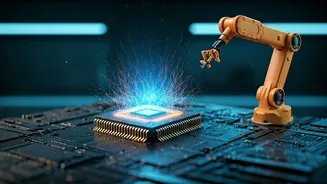








AI Chip Advancements
The realm of artificial intelligence is experiencing a significant leap forward with the introduction of new processing units designed to accelerate AI
workloads. These chips are engineered to handle complex computational tasks with greater efficiency, paving the way for more sophisticated AI applications across various industries. The focus is on enhancing processing power and optimizing performance for machine learning and deep learning algorithms, promising a future where AI can tackle even more challenging problems. This development signals a growing investment and innovation in dedicated AI hardware, moving beyond general-purpose processors to specialized solutions that can dramatically speed up AI development and deployment. The potential impact ranges from improved data analysis to more responsive AI-driven systems.
Unconventional USB Cable
A seemingly ordinary USB cable has revealed a hidden potential, transcending its typical role as a mere data and power conduit. This particular cable is designed with functionalities that extend into the domain of cybersecurity, capable of performing tasks that might be considered unconventional for standard peripherals. Its secret capabilities suggest a dual purpose, hinting at its utility for professionals who require advanced tools for network analysis or security testing. The innovation lies in integrating sophisticated hardware features into a familiar form factor, making advanced capabilities accessible and discreet. This twist on a ubiquitous accessory underscores the ongoing exploration of how everyday objects can be repurposed or enhanced for more specialized technological applications.
Unified Memory Impact
The significance of 192GB of unified memory is a crucial point of discussion for modern computing performance. Unified memory architecture aims to streamline data access by allowing both the CPU and GPU to share the same memory pool, eliminating the need to copy data between separate memory locations. This can lead to substantial improvements in speed and efficiency, particularly for demanding tasks like large-scale data processing, complex simulations, and high-resolution content creation. When dealing with such a large capacity, the benefits become even more pronounced, enabling systems to handle much larger datasets and more intricate workloads without performance bottlenecks. The implications for professional applications and future computing paradigms are considerable, as this architecture can fundamentally alter how systems manage and utilize memory resources.
Laptop Hardware Balance
A new laptop model is striking a compelling balance between portability and robust performance, especially with its integrated graphics capabilities. This device seems to occupy a sweet spot, offering a level of graphical power typically found in bulkier machines, yet within a more manageable and aesthetically pleasing form factor. The design challenges in achieving this balance are significant, requiring careful thermal management and component integration to ensure both thinness and effective cooling under load. The inclusion of advanced graphics processing units in such a chassis suggests a thoughtful engineering approach, aiming to cater to users who demand high-end performance for tasks like gaming, content creation, or professional visual work, without compromising on the device's overall portability and user experience.
Multi-Armed Robot Design
A specialized space robot has been designed with a distinctive four-armed configuration, a feature that might initially appear unusual. However, this unique physique is not merely aesthetic; it serves a specific functional purpose crucial for its operations in extraterrestrial environments. The multiple arms provide enhanced dexterity and capability, allowing the robot to perform a wider range of complex tasks, such as manipulation of delicate equipment, sample collection, or intricate assembly in zero-gravity or challenging terrains. This design choice reflects a thoughtful approach to robotic engineering, prioritizing task completion and operational efficiency in the demanding context of space exploration. The purposeful design highlights how form follows function, even in visually striking ways, to overcome the unique challenges of working beyond Earth.
Next-Gen Laptop Processors
Anticipation is building for a new generation of laptop processors that are poised to redefine mobile computing power. These upcoming chips are expected to bring significant performance uplifts, enhanced power efficiency, and advanced features tailored for the demands of modern laptops. The focus is likely on improving multi-core performance, integrating new AI acceleration capabilities, and offering more robust graphics processing options. Such advancements are critical for supporting increasingly complex software applications, from immersive gaming experiences to demanding professional creative workflows. The evolution of these processors is a key indicator of the direction of portable technology, promising users more capable and versatile devices for both work and play.
Generational Hardware Shifts
Examining what has fundamentally changed from the previous generation of technology reveals key areas of evolution. Typically, such generational leaps involve improvements in processing speed, increased efficiency, and the integration of new features or architectural enhancements. This could manifest as faster clock speeds, more cores for parallel processing, improved power management for longer battery life, or the adoption of new manufacturing processes that allow for smaller, more powerful components. Understanding these shifts is vital for appreciating the progress in technological capabilities and for making informed decisions about hardware upgrades. Each new generation typically builds upon the successes of its predecessor while addressing existing limitations and introducing innovative solutions.
RAM Market Dynamics
Recent developments in the mainstream market indicate a notable shift in the sourcing of computer memory modules. One prominent manufacturer is incorporating memory components manufactured in China into their mainstream products. While this move might aim to address supply chain challenges or cost considerations, it is unlikely to fully resolve existing industry-wide shortages or price fluctuations. The global semiconductor market, including RAM production, is complex and influenced by numerous factors, such as manufacturing capacity, geopolitical events, and demand surges. Therefore, while this strategic sourcing decision is significant, it represents one piece of a larger puzzle in the ongoing effort to stabilize and improve the availability and affordability of essential computer hardware components like RAM.