




Dark Matter Unveiled
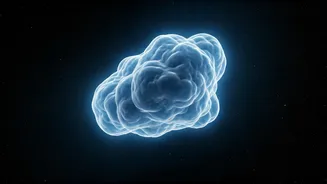
Astronomers, utilizing the Hubble Space Telescope, have made a remarkable discovery, identifying a starless dark matter cloud named Cloud 9. This finding
is particularly significant because it opens a window into the dark universe, offering a unique opportunity to study dark matter. Dark matter, which does not interact with light, is typically difficult to observe. The detection of Cloud 9 represents a major breakthrough, giving scientists access to study this mysterious substance more closely. This discovery enhances the understanding of cosmic structures, offering a means of investigating the nature and behavior of dark matter in ways previously unimaginable. The cloud's presence and characteristics are also challenging existing theoretical models and encouraging further research.
Betelgeuse's Hidden Partner
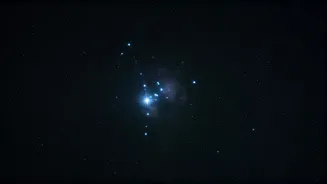
Further enhancing its legacy of groundbreaking revelations, Hubble also detected the wake of a hidden companion star to Betelgeuse, confirming a long-held theory. This investigation provides crucial evidence for the presence of the companion, confirming that Betelgeuse, the red supergiant star, has an unseen partner. This observation helps in understanding the star's lifecycle and its eventual transformation. The confirmation also supports existing theoretical models of stellar evolution, revealing the complex interactions within binary star systems. This finding provides critical insights into Betelgeuse's behavior, reinforcing its enigmatic nature and its potential for a spectacular supernova event. The revelation provides a new perspective on stellar interactions.
Implications and Future
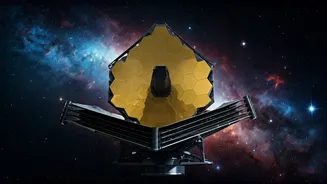
These discoveries, made by the Hubble Telescope, are pivotal in the ongoing quest to understand the universe. The discovery of Cloud 9 and the confirmation of Betelgeuse's companion are reshaping our understanding of dark matter, stellar evolution, and the structure of galaxies. These advancements also emphasize the importance of telescopes, such as Hubble, in pushing the boundaries of scientific knowledge. Further research will undoubtedly delve into the complexities of dark matter and binary star systems. These recent findings pave the way for future studies, providing invaluable data for astronomers to continue unraveling the enigmas of the cosmos. The ongoing observations are set to inspire future generations to explore the universe.