







Superior Purity Revealed
Lake Superior, the largest freshwater lake globally by surface area and the deepest of the Great Lakes, proudly holds the top spot with a perfect pollution
score of zero. Its exceptional cleanness is attributed to a remarkable water residence time of 191 years, coupled with a minimal ratio of land catchment area to its vast surface, which significantly restricts pollutant influx. The lake exhibits near-absent phosphorus levels and maintains a robust dissolved oxygen concentration of 10.45 milligrams per litre, indicative of a flourishing, unpolluted aquatic environment. This immense body of water is a testament to natural resilience and effective environmental stewardship, setting a benchmark for water quality across the United States.
Chelan's Glacial Gem
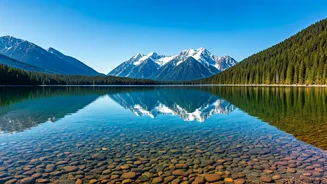
Nestled within Washington's North Cascades, Lake Chelan captivates with its impressive 50-mile length and a considerable depth of 1,486 feet. This stunning lake boasts the lowest total dissolved solids among the ranked bodies of water, measuring a mere 30.20 milligrams per litre. Its pristine clarity and cold temperature are maintained by glacial streams originating from the Okanogan-Wenatchee National Forest. These natural feeders introduce minimal minerals, creating an ideal habitat for native salmon and trout populations. The lake also supports vibrant aquatic life through its excellent dissolved oxygen levels, making it a thriving ecosystem.
Hartwell's Reservoir Charm
Lake Hartwell, a 56,000-acre reservoir straddling the Georgia-South Carolina border, stands out for its remarkable water clarity, a testament to its careful management since its completion in 1962 by the U.S. Army Corps of Engineers. It registers an impressively low turbidity level of just 1.9 NTU, a significant achievement for a reservoir of its scale. This body of water is not only a popular destination for anglers seeking bass and crappie but also serves as a vital habitat, supporting over 250 bird species and various mammals within its watershed. Its clear waters reflect a healthy, balanced ecosystem.
Ozarks' Environmental Comeback
The Lake of the Ozarks in Missouri, spanning 54,000 acres, has undergone a significant environmental transformation, largely due to the diligent efforts of local watershed groups. Once grappling with algal blooms and agricultural runoff, the lake now displays substantially improved water quality. Phosphorus levels have dramatically decreased to a mere 0.01 milligrams per litre, with negligible traces of lead and ammonia. Its consistent dissolved oxygen level of 7.5 milligrams per litre ensures a thriving environment for fish species like catfish and bass, showcasing a successful recovery of this popular reservoir.
Pend Oreille's Deep Purity
Known as 'pond oh-RAY,' Lake Pend Oreille is Idaho's largest lake and the fifth-deepest in the United States, renowned for its exceptionally clean waters. It records minimal ammonia at 0.02 milligrams per litre and phosphorus at 0.01 milligrams per litre. Fed by the Clark Fork River, its remote and densely forested watershed is instrumental in preventing high nutrient loads from entering the basin. This pristine condition supports a healthy population of native trout, including bull trout and westslope cutthroat trout, in its deep, cold expanses.
Winnibigoshish's Clarity
Contrary to its Ojibwe name meaning 'miserable water,' Minnesota's Lake Winnibigoshish, or Lake Winnie, is now lauded for its low nutrient and algae concentrations. The Mississippi River flows directly through this vast lake, which maintains a high dissolved oxygen content of 9.38 milligrams per litre. Despite potential regional issues with atmospheric mercury, the lake's water quality remains exceptionally clear. It is a prime summer destination, particularly favored for walleye fishing within the scenic Chippewa National Forest.
Kentucky Lake's Reservoir
As the largest artificial lake in the eastern United States, Kentucky Lake stretches an impressive 184 miles along the Tennessee River, forming the western boundary of the Land Between the Lakes National Recreation Area. This man-made reservoir demonstrates excellent water quality metrics, with a turbidity of 3.63 NTU and total dissolved solids of 84 milligrams per litre. Its pristine condition is crucial not only for generating hydroelectric power but also for sustaining a substantial recreational fishing industry, highlighting the ecological and economic importance of well-maintained artificial water bodies.
Norman's Cooling Waters
North Carolina's largest man-made lake, Lake Norman, serves a dual purpose: providing cooling water for local power plants and acting as a significant recreational center. Following a sewage spill in 2023, swift remediation and ongoing monitoring efforts have successfully restored its water quality. Currently, the lake exhibits a phosphorus level of 0.03 milligrams per litre and a turbidity of 2.34 NTU. While seasonal algal presence can occasionally create a milky appearance, the water is generally regarded as exceptionally clear for its region, demonstrating resilience and effective environmental management.
Mead's Drought Resilience
Lake Mead, impounded by the Hoover Dam, holds the distinction of being the largest reservoir in the US by water storage capacity and supplies essential water to 20 million people. Despite facing significant challenges from historic droughts, which have reduced its water levels, the lake's water quality remains comparatively clean, with a turbidity of 3.44 NTU. The dissolved oxygen content, at 4.93 milligrams per litre, is lower than some other lakes on this list, partly due to these reduced levels. Sedimentation in the upper Colorado River canyon areas helps maintain its clarity.
Flathead's Montana Majesty
Flathead Lake in Montana earns its place as the largest natural freshwater lake west of the Mississippi River in the contiguous United States, celebrated for its remarkable water clarity, often exceeding 20 feet of visibility in summer. This pristine condition is maintained by meltwater and glacial runoff from the surrounding mountains, which naturally limit nitrogen and phosphorus, thus inhibiting algal growth. The lake consistently boasts a high dissolved oxygen level of 9.68 milligrams per litre, supporting a vibrant ecosystem that includes diverse wildlife like wolves and elk, underscoring its ecological significance.