






Nature's Cooling Vessel
As summer's intense heat arrives, the desire for chilled water becomes paramount. Beyond the immediate relief it provides, drinking cool water actually
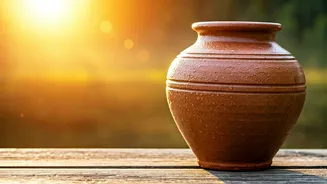
aids in lowering your body's core temperature by absorbing internal heat. Furthermore, temperature receptors in the mouth and throat signal the brain, creating a sensation of deep refreshment. While refrigerators offer a modern solution, the ancient clay pot, or 'matka,' has been a simple yet remarkably effective method for keeping water cool for centuries, all without consuming any energy.
Crafted from Earth
The secret to a clay pot's cooling ability lies in its very construction. These vessels are meticulously crafted from natural earthen clay, a material typically rich in fine mineral components like silica and alumina. Often sourced from riverbeds or fertile alluvial soil, this clay possesses a malleability that allows for easy shaping when wet. Once formed, the pots are allowed to air dry before being hardened in a kiln. Crucially, they are left unglazed, meaning their surfaces are not sealed. This unglazed state leaves the clay porous, creating countless microscopic holes, invisible to the naked eye, which are the key to its cooling properties.
The Evaporation Phenomenon
Observe a clay pot on a sweltering day, and you'll notice tiny droplets forming on its exterior, leaving the sides feeling damp. This isn't a leak, nor is it the pot absorbing external moisture; it's a masterful display of evaporative cooling. The microscopic pores in the unglazed clay allow small quantities of water to slowly seep to the pot's outer surface. As this surface water encounters the warm ambient air, it begins to evaporate. This transformation from liquid to vapor requires energy, which is drawn from the water remaining inside the pot. Consequently, the water within the pot loses heat and becomes cooler. Essentially, as the water on the surface evaporates, it carries heat away, leaving the interior cooler. If the pot were glazed, these pores would be sealed, preventing seepage and thus inhibiting the cooling process.
Optimal Conditions
The effectiveness of a clay pot's cooling is significantly influenced by the surrounding environment. These traditional vessels perform best in hot and dry climates. In contrast, when the air is humid, evaporation slows down considerably because the atmosphere is already saturated with moisture. This explains why 'matkas' are perceived as most effective during dry summer heatwaves, where the lower humidity allows for more rapid and efficient evaporation from the pot's surface. The natural design leverages the principle of evaporative cooling to its fullest potential under these specific atmospheric conditions.
Sustainable Cooling Design
The clay pot's rounded form is a clever design choice that maximizes its surface area, thereby facilitating a greater rate of evaporation. As air circulates around the pot, it further enhances this cooling process. Remarkably, this entire cooling mechanism operates without any reliance on electricity, artificial chemicals, or plastic materials. Long before the invention of refrigerators, ancient civilizations harnessed the fundamental principles of physics to devise simple yet effective ways to stay cool. In today's world, dominated by complex machinery and high energy consumption, the clay pot stands as a quiet testament to the power of simple, sustainable technology.