




Challenging the Ice Giant Theory
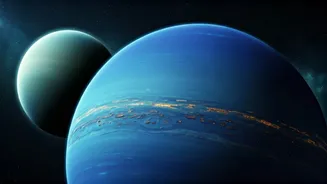
For decades, Uranus and Neptune have been popularly understood as "ice giants," the furthest planets in our solar system, thought to be predominantly composed
of water, ammonia, and methane ices concealed beneath vast atmospheric layers. However, a significant study published in May 2026 in the journal Astronomy and Astrophysics proposes a radical departure from this established view. This new research posits that both planets might possess a substantially higher proportion of rock within their structures than previously believed, a finding that could necessitate a fundamental rewrite of basic principles in planetary science and our understanding of how such colossal bodies form and evolve in the outer solar system.
Unveiling Internal Composition
At the heart of this revised understanding is a sophisticated model developed by a research team led by Yamila Miguel from the Netherlands Institute for Space Research. This model delved into the internal makeup of Uranus and Neptune, revealing a surprising composition. The findings indicate that the outermost layers of these planets are characterized by the presence of rocks and gases, with a notable absence of ice. The extreme temperatures within their atmospheres are theorized to foster the development of silicate clouds. These clouds, upon condensing, transform into solid matter, leading to the formation of rocks. The research points to an average rate of heavy-element rocks in the studied regions amounting to a substantial 60 percent, a figure that significantly deviates from prior assumptions about their icy nature.
A New Planetary Paradigm
The impetus for this reevaluation stems from recent astronomical observations of trans-Neptunian objects, bodies that orbit beyond Neptune. These distant objects were found to be less icy than initially anticipated, prompting scientists to question whether Uranus and Neptune might share similar compositional characteristics. The implications of this new perspective are profound. Miguel suggests that a reclassification of these planets might be in order, with a term like "minor giants" potentially offering a more accurate descriptor. This aligns with other recent research, including a 2025 study from the University of Zurich, which also cast doubt on the traditional "ice giant" hypothesis, indicating a less icy internal structure for both planets than previously accepted. While the presence of ice is not entirely dismissed, the consensus is shifting towards a significantly more rock-dominated interior for these enigmatic worlds.