
Hubble's Unveiling
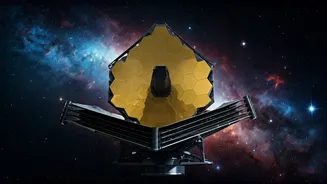
The Hubble Space Telescope, a renowned instrument for peering into the cosmos, has once again proven its prowess. The telescope has identified an unusual
phenomenon: a cloud composed of dark matter devoid of any stars. This discovery is significant because it challenges established theories about how dark matter behaves and interacts within the universe. The cloud's existence implies there could be areas of the universe where dark matter is concentrated without the presence of visible, star-forming materials, adding complexity to what was previously understood about the cosmos. These findings have the potential to change our understanding of dark matter, and further studies using Hubble will likely concentrate on the cloud's characteristics and its effects on the surrounding cosmic environment.
Dark Matter Explained
Dark matter is a mysterious substance that does not emit or interact with light, making it invisible to our instruments. It makes up a substantial portion of the universe's mass and is critical to understanding how galaxies and larger structures form and function. Although it's invisible, astronomers can infer its existence through its gravitational effects on visible matter, such as stars and galaxies. The fact that the Hubble telescope discovered a cloud of dark matter lacking any stars challenges current ideas because astronomers thought dark matter and visible matter were closely linked. Finding dark matter in isolation suggests new types of interactions or conditions may exist in the universe, which requires a broader investigation.
Implications of Discovery
The discovery has considerable implications for cosmological models. It suggests that the relationship between dark matter and visible matter might be more complicated than previously thought. The existence of a starless dark matter cloud could mean that dark matter can cluster in regions without facilitating star formation, or that there are mechanisms yet unknown that govern how visible matter interacts with dark matter. It opens the door to explore the dynamics of galaxies, the formation of cosmic structures, and the nature of dark matter itself. It prompts further exploration by researchers into the properties of dark matter and how it affects the evolution of the cosmos.
Future Research Avenues
The discovery is also fueling fresh avenues for future investigations. The Hubble Space Telescope's continued observations of the starless dark matter cloud can provide more data about its composition, distribution, and gravitational effects. Astronomers are eager to study the cloud's interaction with the environment around it and the gravitational influence it exerts on visible matter. This might assist in confirming the theoretical predictions for the behavior of dark matter. Further research could involve looking at other dark matter concentrations, probing how they relate to the presence or lack of stars, and evaluating the kinds of forces that drive their development. The study of this mysterious dark matter cloud has the potential to expand our understanding of the universe and its hidden components significantly.