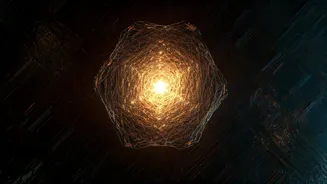








Macroscopic Quantum Marvel
In a monumental stride for quantum physics, researchers have successfully entangled thousands of atoms into a single quantum state, a phenomenon colloquially
known as 'Schrödinger's cat.' This isn't just an incremental improvement; it's a dramatic leap forward, shattering previous records for the most complex object observed exhibiting quantum behavior. Historically, quantum effects like superposition – where a particle exists in multiple states simultaneously – were primarily observed at the atomic or subatomic level. However, this new experiment demonstrates that macroscopic numbers of atoms can indeed be coaxed into this bizarre, yet fundamental, quantum reality. This achievement forces us to reconsider the boundaries between the quantum realm and the classical world we experience daily, opening up profound questions about the nature of reality itself and paving the way for unprecedented technological applications that leverage these counter-intuitive quantum principles.
Quantum Computing's Next Frontier
The implications of this quantum breakthrough are particularly electrifying for the field of quantum computing. Current quantum computers, while powerful, are limited by the fragility of their quantum bits, or qubits, which are prone to decoherence and errors. By demonstrating the ability to maintain a superposition across thousands of atoms, scientists are inching closer to building more robust and scalable quantum systems. This enhanced control over larger ensembles of quantum particles could lead to qubits that are significantly more stable and capable of performing vastly more complex calculations. Imagine processors that can tackle problems currently intractable for even the most powerful supercomputers, revolutionizing fields from drug discovery and materials science to financial modeling and artificial intelligence. The path to true quantum supremacy, once a distant dream, now appears considerably clearer thanks to this record-shattering experiment.
Rethinking Quantum Boundaries
This landmark experiment compels a re-evaluation of where the quantum world ends and the classical world begins. For decades, the transition from quantum phenomena to classical behavior was a subject of intense theoretical debate, often attributed to decoherence caused by environmental interactions. However, by sustaining a quantum state across such a large collection of atoms, scientists are providing empirical evidence that the quantum realm might extend further than previously imagined. It challenges our intuitive understanding of scale and suggests that the fundamental rules governing the universe might be more unified than we assume. This work doesn't just advance technology; it deepens our philosophical understanding of existence, prompting us to question the very nature of measurement and observation at increasingly larger scales and pushing the envelope of what we consider physically possible in the universe.