






The Terafab Vision
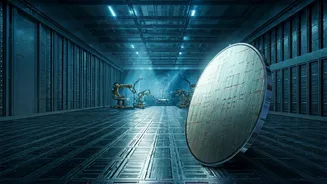
Elon Musk has put forth a visionary plan to create a dedicated semiconductor manufacturing facility, codenamed 'Terafab.' This ambitious undertaking is designed
to produce an astounding one terawatt of computing power annually. Situated near Austin, Texas, this advanced technological hub will not only cater to immediate and future needs but also pave the way for extraterrestrial applications. The scale of this project is immense, with a terawatt representing a trillion watts, a figure that approaches the total power generation capacity of the United States, highlighting the sheer magnitude of Musk's technological aspirations and his commitment to pushing the boundaries of what's currently achievable in chip production.
Addressing Demand
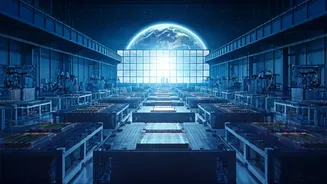
The genesis of the Terafab project stems from an anticipated surge in demand for advanced computing power that is expected to outstrip the capabilities of current global chip suppliers. Musk has expressed gratitude to existing partners like Samsung, TSMC, and Micron, but noted their limited capacity for expansion. This constraint necessitates a self-sufficient approach, with the Terafab serving as the solution to ensure the required volume of chips for Tesla and SpaceX's rapidly evolving needs. The facility is envisioned as a comprehensive ecosystem, equipped to handle every stage of chip development, from initial design and manufacturing to rigorous testing and iterative improvements.
Dual-Purpose Goals
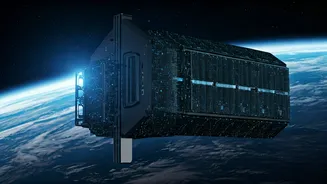
The Terafab project harbors a dual objective: to significantly boost Earth-bound computing power while also enabling large-scale operations in space. The facility aims to eventually support between 100 to 200 gigawatts of computing capacity on our planet, a substantial increase in processing capabilities. Simultaneously, it's designed to achieve a terawatt of computing power for space-based applications. This grand vision aligns with Musk's long-term aspiration to foster a 'galactic civilization,' underscoring the project's role in humanity's potential expansion into the cosmos by facilitating resource utilization across planets and stars.