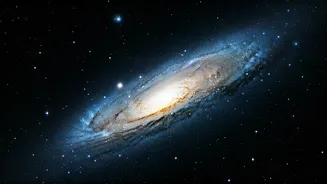







Distant Galaxy Cluster
NASA has identified the most distant and tranquil galaxy cluster ever seen in the early universe, presenting a unique opportunity to study the universe's
formative stages. Located billions of light-years away, this cluster allows astronomers to observe conditions from a time when the universe was significantly younger. The tranquility of this cluster is particularly striking, offering a contrast to the often turbulent environments seen in other young galactic structures. Its serene nature is crucial because it allows astronomers an unprecedented view of how galaxies developed in the initial billion years following the Big Bang. Detailed study of this distant cluster provides insight into galaxy evolution, the behavior of dark matter, and the overall architecture of the early cosmos. Scientists use sophisticated telescopes to analyze the light emitted from the cluster, gaining information about the cluster's composition, the distribution of matter, and its dynamic processes. The discovery of such a calm and distant structure contributes significantly to our comprehension of cosmic formation and development, presenting exciting prospects for further exploration and understanding.
Young Star's Behavior
Astronomers have decoded the mysterious actions of a young star situated roughly 1,950 light-years away. The star, still in its infancy, demonstrates unusual behavior that has challenged standard stellar formation models. Researchers used advanced observational techniques to monitor the star's light fluctuations, movements, and surrounding environment, uncovering its unique characteristics. The star's actions offer a rare window into the early stages of stellar growth, helping experts to investigate the complex processes that shape stars in their formative period. The unique behavior of this young star could provide crucial information for understanding how stellar systems, including our own solar system, develop. The study of this star enables astronomers to refine models, improving the accuracy of future predictions about stellar evolution, and helping scientists to understand the commonalities and varieties found in the star-formation procedures.
Dark Matter Mapping
Astronomers use runaway stars to map dark matter's distribution across the Milky Way Galaxy. These high-velocity stars, ejected from their original star systems, travel at great speeds, offering a distinct vantage point for tracing the influence of invisible dark matter. Scientists have observed that these runaway stars are affected by the gravitational pull of dark matter, enabling researchers to infer its distribution by observing their courses. The methodology includes detailed monitoring of star trajectories and analyzing the deviations to deduce the presence of dark matter. This methodology has offered novel insights into dark matter distribution, indicating its impact on galactic structure. By mapping the dark matter’s distribution, astronomers can better understand the universe's overall composition and structure. Mapping dark matter is critical as it plays a significant role in organizing the galactic structure, and understanding it is key to unveiling many of the universe’s unresolved enigmas.