




Cloud 9's Discovery
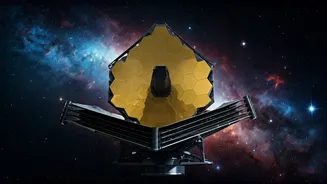
The Hubble Telescope, a celebrated space-based observatory, has once again made a monumental contribution to astronomical research. The telescope's advanced
instruments captured images of an intriguing phenomenon: a dark matter cloud completely devoid of stars. Named Cloud 9, this enigmatic entity challenges existing cosmological models. Dark matter, an invisible substance constituting a substantial portion of the universe's mass, interacts weakly with light, making its direct detection exceptionally difficult. The discovery of Cloud 9 offers a rare opportunity to study a pure concentration of dark matter, unaffected by the presence of stars and other luminous matter. This enables scientists to focus on the fundamental properties of dark matter and its behavior within the cosmos. Astronomers now have a unique 'laboratory' to analyze dark matter's effects, potentially uncovering more about how it influences galaxy formation and the large-scale structure of the universe. The Hubble’s success highlights its continued significance in probing the deepest cosmic mysteries.
Dark Matter Unveiled
Dark matter's nature remains one of the most significant mysteries in modern astrophysics. Unlike ordinary matter, it does not emit or absorb light, making it invisible to traditional telescopes. However, its gravitational effects are evident. Astronomers deduce its presence through the gravitational influence it exerts on visible matter, such as stars and galaxies. Cloud 9 provides a valuable insight into the distribution and behavior of dark matter. The absence of stars within this cloud suggests that dark matter may not always align with visible matter. This could imply that dark matter plays a different role in various cosmic structures. Further analysis of Cloud 9 could reveal important clues about the composition of dark matter, which is believed to be made up of particles that have yet to be discovered. The study of Cloud 9 offers researchers an unprecedented opportunity to test and refine existing theories of dark matter and its influence on the evolution of galaxies. This will allow for more accurate models of the universe's structure.
Cosmic Implications Explored
The discovery of Cloud 9 has far-reaching implications for our understanding of the universe's evolution. Current models of galaxy formation often assume that dark matter and visible matter are closely intertwined, with dark matter acting as the scaffolding upon which galaxies grow. The absence of stars in Cloud 9 challenges this view. It indicates that the interaction between dark matter and visible matter might be more complex than previously assumed. This discovery motivates astronomers to reassess existing simulations of galaxy formation. The findings from Cloud 9 may indicate the need for new models to explain how galaxies like our Milky Way came to be. It provides the chance to refine the way the universe's history is understood. By observing the dynamics of Cloud 9, scientists hope to learn more about how dark matter interacts with itself and with other components of the cosmos. This could lead to a better understanding of how the universe's structure evolved over billions of years.
Future Research Awaits
The exploration of Cloud 9 has just started, and future research will undoubtedly bring further insights into the nature of dark matter. Scientists plan to conduct follow-up observations using other telescopes and instruments. They aim to gather more detailed data on the cloud's properties, including its density, size, and velocity. Researchers hope to determine whether Cloud 9 is a unique entity or if it represents a more widespread phenomenon in the universe. Such extended research could involve analyzing the cloud's gravitational effects on nearby galaxies or searching for potential interactions with other dark matter structures. These studies could help create a more comprehensive picture of dark matter's distribution and behavior. The data gathered from Cloud 9 is expected to contribute to a deeper understanding of the universe's dark matter composition. This could potentially validate or challenge present theories about dark matter's role. Future observations of Cloud 9 are essential to unveil its mysteries.