








The Enigmatic Trails
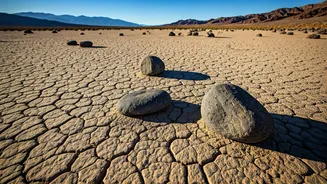
The sliding rocks of Death Valley have long been a source of wonder and speculation. Located in the desolate expanse of Racetrack Playa, these rocks leave
behind visible tracks, indicating their movement across the dried lakebed. The mystery has captivated scientists and enthusiasts alike, with many theories proposed to explain the phenomenon. The lack of direct observation further fueled the intrigue, making it difficult to pinpoint the exact mechanism behind their movement. Researchers were driven by the goal of understanding the forces behind this remarkable occurrence, which has been ongoing for many years, as well as the unique environmental factors involved, and also to determine the process that enabled the stones to move. The research, which was recently published, has revealed the precise conditions needed for the rocks to slide.
Ice and Wind's Role
The core of the scientific discovery lies in the interplay of ice and wind. According to the research, a combination of specific weather conditions is required. Thin sheets of ice form on the playa's surface during cold nights. When the sun rises, the ice begins to melt, creating a thin layer of water. Strong, but not overwhelming, winds then push the rocks across this slippery surface. This process relies on a delicate balance of temperature, moisture, and wind speed. The phenomenon only occurs under specific environmental conditions, which explains why the rocks don't move every year. The scientists found that rocks moved in short bursts, sometimes only a few centimeters at a time, highlighting the subtle nature of the process. The rocks' movement is also dependent on the size and shape of the rocks, as well as the surface smoothness of the playa.
Unveiling the Mystery
The research team's methodology included placing GPS trackers on the rocks to monitor their movement in real-time. This allowed them to capture direct evidence of the sliding. The scientists also used time-lapse photography to document the process. The project took years of observations before scientists could fully understand the mechanism involved. The combination of direct observation, and detailed environmental analysis allowed the researchers to definitively link the movement of the rocks to ice and wind. This comprehensive approach provided conclusive evidence. Their findings offer insights into geological processes that can be found in other arid environments. The discovery not only solved a long-standing scientific puzzle but also demonstrated the significance of observing and understanding nature's delicate balance.