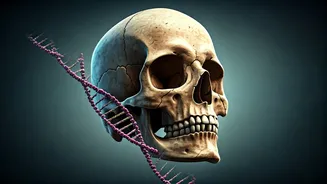







Neanderthal's Lasting Mark
Our interbreeding with Neanderthals, long considered our extinct cousins, has left a significant genetic legacy. A surprising number of people today carry
Neanderthal DNA, which isn't just a historical curiosity but actively impacts our health. These inherited genetic snippets can influence everything from our immune system's response to pathogens, making us more robust against certain infections, to affecting our skin and hair characteristics. For instance, Neanderthal genes are linked to how our skin reacts to sunlight and may play a role in our susceptibility to allergies. Furthermore, these ancient genes have been implicated in influencing our sleep patterns and even our mood. Understanding these contributions is crucial for grasping the full picture of human evolution and how our bodies have adapted over millennia, often through interactions with other hominin species. It underscores that "pure" modern humans are a myth, and our genetic makeup is a testament to ancient encounters.
Ancestral Health Insights
Recent scientific advancements have unlocked remarkable details about the health of our ancient forebears, offering a fresh perspective on human resilience and adaptation. For instance, Ötzi the Iceman, the remarkably preserved mummy discovered in the Alps, revealed he carried a high-risk strain of HPV, a common virus today. This finding highlights that some health challenges we face are ancient indeed. Similarly, studies on medieval individuals, like a Spanish knight with a rare genetic condition, and a teenage girl from Italy with a form of dwarfism, showcase the spectrum of human variation and the genetic predispositions that have existed for millennia. These cases demonstrate that while medical understanding and treatments have evolved dramatically, the underlying genetic blueprints and the predispositions to certain conditions have been with us for thousands of years, offering context to modern genetic research and personalized medicine.
Evolutionary Adaptations Unveiled
The study of ancient DNA continues to reveal surprising adaptations and evolutionary strategies that have shaped human populations. Contrary to previous assumptions, certain genes once thought to inevitably lead to blindness have been found not to do so in all individuals, suggesting protective genetic mechanisms or environmental factors at play. Research into ancient human groups, such as those isolated in southern Africa for nearly 100,000 years, has uncovered stunningly unique genetic variations, underscoring the deep divergence within our species over long periods. Moreover, the observation of same-sex sexual behavior in primates, potentially serving as a survival strategy, hints at complex evolutionary drivers that extend beyond simple reproduction. These findings collectively paint a picture of human evolution as a dynamic process, driven by diverse pressures and leading to a rich tapestry of genetic diversity that continues to influence our biology today.
Aging and Longevity Clues
New research is challenging long-held beliefs about aging, suggesting that inflammation may not be as intrinsically linked to the aging process as previously thought. This could open new avenues for understanding and potentially intervening in age-related decline. 'Aging clocks,' sophisticated tools derived from genetic and biological markers, are becoming increasingly adept at predicting an individual's risk of disease and even early mortality, offering personalized insights into biological age rather than chronological age. Brain scans are also emerging as a potential method to gauge true biological age, offering another non-invasive way to assess health trajectories. Furthermore, the heritability of lifespan is being explored, with studies suggesting that as much as 50% of how long we live could be predetermined by our genes, indicating a strong biological component to longevity, potentially influenced by our ancestral genetic makeup.
Resilience in Ancient Life
The story of life's resilience is deeply etched in our planet's history, with recent findings suggesting a remarkably rapid rebound after the cataclysmic asteroid impact that wiped out the dinosaurs. This rapid recovery underscores the tenacity of life itself. On a more human scale, research into extreme longevity, often observed in specific groups like nuns or even in organisms like jellyfish, hints at biological secrets to living longer. The discovery that having more 'brown fat' correlates with healthier cardiovascular systems, with potential explanations emerging from studies in mice, offers another clue for maintaining health as we age. These diverse lines of inquiry, from ancient planetary recovery to cellular mechanisms of longevity, all contribute to a broader understanding of survival and health across different scales of existence.