




Surprise Stellar Nursery
For a long time, the prevailing view was that massive stars, those over eight times the mass of our Sun, primarily scorched their surroundings with intense
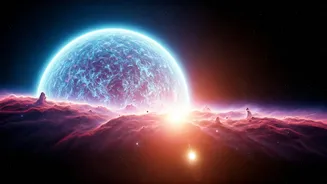
radiation, gradually consuming their local stellar nurseries. However, a groundbreaking study has overturned this notion, revealing that these colossal celestial bodies can act as cosmic midwives. Scientists have observed a particular giant star that, instead of simply radiating heat and light, has been actively firing potent ultraviolet radiation into a nearby gas cloud. This intense radiation has compressed the cloud, known as Bright Rimmed Cloud 44, to such an extreme degree that it has triggered the formation of brand-new stars within its depths. This observation indicates that the giant star is not just an endpoint for its neighborhood but is, in fact, fostering new life. The researchers identified 22 distinct stellar objects within this cloud, a testament to the star's generative power. These newly formed objects include a mix of typical young stars and the more mysterious brown dwarfs. Brown dwarfs occupy an unusual space in the stellar spectrum, being too massive to be classified as planets but too small to sustain nuclear fusion like true stars, representing a fascinating area of ongoing scientific inquiry. The existence of all 22 of these nascent celestial bodies is directly attributed to the influential presence of the nearby giant star, highlighting a profound symbiotic relationship in stellar evolution.
Dual Star Generations
The most captivating aspect of this discovery was the identification of two distinct age groups of stars within the Bright Rimmed Cloud 44. One group of these newborn stars appears to have formed concurrently with the massive star itself, indicating a shared origin from the same initial gas cloud. This suggests that the initial collapse and star formation process was robust enough to create multiple stars of similar age. However, a second, notably younger cohort of stars has emerged, and their existence is directly linked to the direct influence of the giant star. Scientists postulate that these younger stars were born as a result of a powerful shockwave emanating from the massive star. This shockwave, propagating through the surrounding gas and dust, compressed pockets of material to the point of collapse, initiating the formation of this second generation. Essentially, the giant star has managed to spawn its own successors, creating a continuous cycle of stellar birth and renewal within its vicinity. This finding challenges previous models of stellar evolution, which often depicted massive stars as solely destructive forces. The evidence suggests a more complex and dynamic interplay, where massive stars can actively drive subsequent star formation events, perpetuating the life cycle of stellar populations in their galactic neighborhoods.
Global Telescope Network
To unravel this intricate cosmic drama, the research team employed a sophisticated, multi-continental observational strategy. They utilized an array of advanced telescopes situated across three different continents, integrating data gathered from various parts of the electromagnetic spectrum. This comprehensive approach combined optical observations, which reveal visible light; infrared data, which captures heat signatures; and radio astronomy, which detects longer wavelengths. Each type of data provided a unique perspective, like layers of a narrative, contributing to a holistic understanding of the phenomenon. The optical telescopes offered clear images of the stars and gas structures, while infrared observations helped to penetrate dust clouds and identify cooler, nascent objects. Radio telescopes were crucial for mapping the distribution of gas and identifying regions of active star formation. By merging these diverse datasets from India, the United States, and China, scientists were able to construct a detailed picture of the massive star's impact. They observed how its immense energy output was not only shaping but actively compressing and triggering the birth of new celestial bodies. This collaborative, multi-wavelength effort underscores the power of international scientific cooperation in pushing the boundaries of astronomical understanding and revealing the complex processes that govern the cosmos.
Cosmic Origins Connection
The implications of this discovery extend far beyond a single star system, reaching into the very origins of our own existence. Our Sun, like all stars, was once a nascent entity, born billions of years ago from the gravitational collapse of a vast cloud of gas and dust. The specific conditions and triggers that initiated that collapse are fundamental to understanding how planetary systems, including our own solar system, come to be. This new study provides a tangible, observable model for those ancient processes. By witnessing a massive star actively compressing a gas cloud and initiating star formation, scientists gain invaluable insights into the forces that likely played a role in the Sun's birth. The very elements that make up Earth, its oceans, and indeed all living organisms, including the carbon within them, can ultimately be traced back to the cosmic events that forged our solar system. If massive stars routinely act as catalysts for new star formation, they are not merely passive participants in galactic evolution. Instead, they are crucial mechanisms that ensure the ongoing replenishment and dynamism of the galaxy. This research brings us a step closer to comprehending the intricate causal chain that leads from primordial gas clouds to the diverse and complex universe we inhabit today, demonstrating that the grand narrative of the cosmos is one of continuous creation and renewal, often driven by its most powerful actors.