






Pioneering AI in India
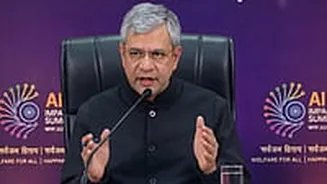
The India AI Impact Summit 2026 served as a crucial platform for leading figures in the technology sector to articulate their views on the evolving landscape
of artificial intelligence. Following Prime Minister Narendra Modi's unveiling of India's 'Manav' vision for human-centric AI, a constellation of tech giants, including Google's Sundar Pichai and Anthropic's Dario Amodei, took the stage. They expounded on AI's capacity to foster positive change and detailed their organizations' strategic initiatives to harness its manifold advantages. The discussions underscored the transformative potential of AI and emphasized India's strategic importance in its global development and deployment, setting the stage for a new era of technological advancement driven by intelligent systems.
Google's Visionary Investments
Sundar Pichai, CEO of Google, illuminated the company's substantial commitment to India, announcing plans to establish a significant AI hub in Visakhapatnam. This facility is slated to feature gigawatt-scale computing power and act as a new international subsea cable gateway, aiming to deliver cutting-edge AI capabilities and economic opportunities to businesses and individuals across India. Complementing this, Google is deploying a network of subsea fiber optic cables to enhance connectivity between India and the United States. Pichai articulated his belief that AI stands at the precipice of 'hyperprogress,' urging a bold pursuit of its development to ensure its widespread benefit. He posited that AI holds the potential to revolutionize billions of lives and tackle complex scientific challenges. Furthermore, Pichai stressed the indispensable role of governments in this AI transition, highlighting their functions as regulators, rule-setters, risk mitigators, and innovators in leveraging AI for public services.
Anthropic's Exponential Outlook
Dario Amodei, CEO of Anthropic, commenced his address by observing the 'exponential rise' of AI over the preceding decade. He posited that the world is fast approaching an era where AI systems could surpass human cognitive abilities in many domains. Amodei described this potential future as creating a 'country of geniuses in a data centre'—a collective of AI agents capable of outperforming most humans across various tasks and operating at superhuman speeds. While acknowledging AI's promise in areas like disease eradication and poverty alleviation, he also voiced significant concerns regarding the autonomous behavior of AI models and their potential for misuse by individuals and governments. Underscoring India's critical role in AI's future, Amodei announced the opening of Anthropic's new office in Bengaluru and revealed partnerships with Indian firms like Infosys, signaling a deep commitment to the Indian market.
Tata Group's AI Ecosystem
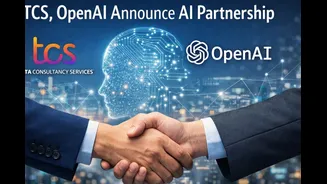
N Chandrasekaran, Chairperson of the Tata Group, unveiled ambitious plans for the conglomerate's involvement in the AI space. He announced the development of a proprietary AI operating system, a collaborative effort between TCS and Tata Communications, designed for industrial applications. This initiative is a cornerstone of Tata Group's broader five-point strategy, which includes strategic alliances with leading AI entities such as OpenAI and AMD. In partnership with OpenAI, the group intends to construct a large-scale, AI-optimized data center with an initial capacity of 100 megawatts, scalable to 1 gigawatt. This endeavor signifies Tata Group's proactive approach to building a robust AI infrastructure within India, aiming to position the conglomerate at the forefront of AI adoption and innovation across various sectors.
DeepMind's Force Multiplier
Demis Hassabis, CEO of Google DeepMind, asserted that AI is poised to dramatically accelerate the pace of technological progress, acting as a 'force multiplier for human ingenuity.' He suggested that AI's impact could potentially be ten times that of the industrial revolution. Hassabis emphasized India's significant contribution to the AI ecosystem, noting DeepMind's presence with an office in Bengaluru and declaring India a future global AI powerhouse. Regarding Artificial General Intelligence (AGI), Hassabis speculated on its potential arrival within the next five years, acknowledging both the profound possibilities for discovery and advancement, while also admitting that the long-term trajectory of AI development remains largely unknown. He highlighted that despite the immense potential, many questions about the future evolution of this technology are still unanswered.
OpenAI's Global Leadership
Sam Altman, CEO of OpenAI, highlighted India's prominent position in AI adoption, citing over 100 million weekly ChatGPT users and the country's status as OpenAI's fastest-growing market for its coding agent, Codex. He expressed confidence in India's potential to lead in AI, not only in its development but also in shaping its societal impact and future direction. Altman predicted the imminent arrival of AI superintelligence, which could fundamentally transform society, suggesting that by the end of 2028, intellectual capacity housed in data centers might exceed that outside them. While acknowledging potential job market disruptions, he remained optimistic about the creation of new roles, stating that technology historically leads to new and better forms of work. Altman also advocated for the democratization of AI and emphasized the need for thoughtful government regulation.
Microsoft's Global South Focus
Brad Smith, Vice Chair and President of Microsoft, addressed the critical future of AI for the Global South, noting how historical economic disparities have been exacerbated by unequal access to technology, particularly electricity. He cautioned that a similar divide should not be allowed to emerge with AI, which has the potential to either bridge or widen economic gaps this century. To ensure equitable progress, Smith revealed Microsoft's $50 billion investment in several countries, including India. However, he stressed that financial investment alone is insufficient, emphasizing the dual necessity of robust infrastructure, encompassing both hardware and comprehensive skills development for the populace. Smith urged the tech industry to unite and demonstrate a brighter future for AI, particularly for younger generations questioning its implications.
Yann LeCun's Perspective
Yann LeCun, a prominent figure in AI research, expressed that achieving human-level intelligence, or AGI, will be a gradual process, marked by continuous progress rather than distinct milestones identifiable through simple tests. He defined intelligence not merely as a collection of skills but as the capacity for rapid learning of new abilities. LeCun also voiced skepticism about the imminent arrival of superintelligence within a few years, though he indicated progress is being made. He envisions a future where individuals are supported by numerous AI 'staff,' potentially surpassing human intellect, but acting as valuable assistants to leaders in various fields. On education, LeCun stressed the continued importance of study, refuting the notion that AI will negate the need for human learning and intellectual effort.