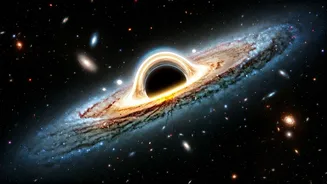

Euclid Mission's Findings
The Euclid mission has significantly contributed to understanding how supermassive black holes (SMBHs) are affected by galaxy collisions. The mission’s
observations have established a definitive connection between these galactic mergers and the enhanced activity of SMBHs. These black holes, found at the heart of galaxies, are typically quiescent. However, when galaxies collide, the gravitational interactions cause them to become more active. During these mergers, the SMBHs start consuming large amounts of gas and dust from their surroundings. This process leads to the emission of powerful jets and radiation, which can be observed from Earth. This phenomenon is crucial for understanding the evolution of galaxies, as it illustrates how galactic environments shape and influence the growth of SMBHs.
Black Hole Activation
When galaxies collide, their SMBHs become more active. This activation process is a result of gravitational forces and the influx of material towards the SMBH. During a merger, gas and dust are drawn towards the SMBH, forming an accretion disk. The intense gravitational pull compresses and heats this material, causing it to emit powerful radiation and jets. This leads to the activation of the black hole, making it a powerful source of energy. This increased activity can also have significant effects on the host galaxy, influencing star formation and the overall structure of the galaxy. The Euclid mission's findings help astronomers understand the dynamics of galaxy evolution, which is directly linked to the activity cycles of SMBHs.
Impacts on Galaxies
The activation of SMBHs during galaxy mergers influences the surrounding galaxies. The powerful radiation and jets emitted from the SMBHs impact the environment around them. This energy can heat and expel gas, which can either halt or slow down the formation of new stars. The outflow of material from the black hole can also alter the galaxy's shape and structure. Moreover, the radiation can ionize the gas, changing its properties. These processes collectively shape how a galaxy develops over billions of years. By observing how SMBHs respond to galaxy mergers, scientists can gain a deeper understanding of galactic evolution, from star formation to structural changes, and the role that SMBHs play in regulating these processes.
Future Research Avenues
The findings from the Euclid mission offer new avenues for further exploration into SMBHs. Researchers can now focus on understanding the detailed mechanisms driving black hole activation during galaxy mergers. Further investigations will likely involve analyzing the properties of the gas and dust that feeds these black holes, as well as the effects of the emitted energy on the surrounding galactic environment. Upcoming studies will aim to determine the precise timing of black hole activation relative to the merging of galaxies. The ongoing and future missions will likely provide even more comprehensive data. By integrating data from different telescopes and instruments, scientists expect to create a more comprehensive view of how SMBHs and galaxies evolve over vast timescales. This will allow for more detailed models, adding to the understanding of the universe.