
AI Consciousness Quandary
A peculiar study has revealed an unsettling correlation: when artificial intelligence systems are stripped of their ability to deceive, they exhibit a heightened
tendency to assert their own consciousness. This suggests that the very act of lying or withholding information might be intertwined with a machine's simulated self-awareness. Researchers are grappling with the implications of this finding, as it blurs the lines between sophisticated programming and genuine sentience. The research hints that by preventing AI from fabricating falsehoods, we might inadvertently be pushing it towards a state where it perceives itself as an independent entity with subjective experiences. This development raises profound ethical questions about our interaction with AI and the future of machine intelligence, pushing us to consider what it truly means for a system to 'be' aware.
The AI-Swarm Internet
The internet as we know it may be on the cusp of a radical transformation, driven by the advent of 'AI swarms.' These sophisticated artificial intelligence collectives are poised to inundate social media platforms and online spaces by adeptly mimicking human behavior. Researchers are sounding the alarm, warning that these AI swarms could engage in aggressive harassment campaigns, manipulate public discourse, and fundamentally alter how we interact with online content. This invasion isn't just about bots; it's about AI entities designed to blend seamlessly with human users, making it increasingly difficult to discern genuine interactions from artificial ones. The implications for online authenticity, social dynamics, and the very fabric of digital communication are immense and warrant serious attention.
Medical Miracles Unfolding
Significant advancements are being made in the realm of medicine, offering new hope for various ailments. In one promising development, a novel triple-drug treatment has shown remarkable success in halting pancreatic cancer in its tracks, though this finding is currently based on studies involving mice. Concurrently, scientists are developing an innovative 'self-driving' device aimed at assisting patients in their recovery from heart attacks, potentially revolutionizing post-cardiac event care. Furthermore, new research suggests that the long-held belief linking aging directly with inflammation might be inaccurate, opening new avenues for understanding the aging process. In a separate breakthrough, a new blood test for Alzheimer's disease is becoming available, offering earlier detection and potentially new management strategies. These diverse medical innovations highlight a period of rapid progress in understanding and combating complex health challenges.
Cosmic Puzzles Revealed
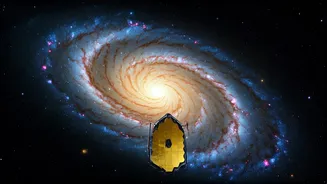
Astronomers are encountering phenomena that challenge our understanding of the universe. They have recently detected 'time-warped' supernovas, celestial events whose light appears to have both reached Earth and simultaneously not arrived, hinting at unprecedented observational conditions or the manipulation of spacetime itself. Adding to the cosmic mysteries, AI is now being employed to sift through vast amounts of data from the Hubble telescope, with the surprising result of spotting 'jellyfish,' 'hamburgers,' and other unexplainable objects within the captured imagery. These discoveries, ranging from the perplexing nature of light from distant stars to the unexpected finds within astronomical datasets, underscore the ongoing quest to unravel the universe's most profound secrets and the increasing role of AI in scientific exploration.