





Runaway Stars Defined
Runaway stars, a fascinating astronomical phenomenon, are stars that have been ejected from their original stellar clusters or binary systems at exceptionally
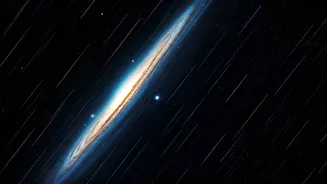
high velocities. This ejection can occur due to various dynamic interactions, such as encounters with other stars or supernova explosions in a binary system. These high-speed stars then travel through the galaxy independently, often far from their birthplaces. The term 'runaway' is apt, as these stars' trajectories differ significantly from their less-energetic counterparts, allowing astronomers to use their positions and movements to investigate the gravitational influences they experience, including those of dark matter.
Dark Matter's Role
Dark matter plays a crucial role in the structure and formation of galaxies, providing the gravitational scaffolding upon which visible matter assembles. This invisible substance does not interact with light, making it undetectable through conventional telescopes. However, its gravitational effects are observable, influencing the motions of stars and galaxies. Astronomers have observed that galaxies rotate faster than expected based on the visible matter alone, suggesting the presence of dark matter. Mapping its distribution can reveal the distribution of dark matter across the galaxy. This is achieved by observing how the stars move under the influence of the invisible substance.
Tracing the Trails
The method of using runaway stars as probes works on the principle that these stars' trajectories are influenced by the gravitational effects of dark matter. By meticulously tracking the paths of these high-velocity stars, astronomers can detect subtle deviations from their expected courses. These deviations can be used to infer the distribution of the dark matter that is exerting the gravitational pull. When the runaway stars move through different regions of the Milky Way, they experience varying gravitational forces. By measuring the distribution of these forces, it is possible to create a map of dark matter's presence. This offers an indirect but effective way to study this elusive component of the universe.
Mapping the Milky Way
Using runaway stars to map dark matter requires a multi-step process. First, astronomers identify runaway stars, often by measuring their velocities and trajectories. Then, these stars' movements are carefully modeled, accounting for the gravitational effects of visible matter such as stars and gas clouds. Any remaining discrepancies between the observed and predicted movements are then attributed to dark matter. These deviations reveal dark matter's locations, as well as its density. This method allows researchers to generate detailed three-dimensional maps showing how dark matter is spread throughout the Milky Way. As these maps improve, they provide new insights into the galaxy's dynamics and the role of dark matter in shaping it.
New Discoveries Unveiled
Using runaway stars to map the distribution of dark matter could potentially unveil some exciting discoveries about its nature. Recent studies have found that dark matter might not be evenly distributed throughout galaxies, existing instead in clumps and filaments. This method allows researchers to observe these structures, which is critical to understand dark matter and how it affects the universe. In addition, the method helps to refine the models of galaxy formation and evolution. This work is part of a larger ongoing effort by astronomers to understand this mysterious component of the cosmos. As more stars are observed and their trajectories are analyzed, our understanding of dark matter will only become more detailed.