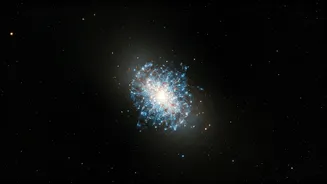








Webb's Cosmic Vision
The James Webb Space Telescope (JWST), a marvel of modern engineering, is designed to observe the universe in infrared light. Unlike visible light, infrared light can
penetrate dust clouds, allowing the telescope to see objects that are hidden from view of other telescopes. By capturing infrared light, the JWST can study the earliest stars and galaxies, as well as the atmospheres of exoplanets. The telescope's large mirror and advanced instruments allow it to gather more light and provide sharper images than previous telescopes, such as the Hubble Space Telescope. Its deployment in space and ongoing operation marks a significant leap in our ability to observe the universe and understand its origins. The JWST is stationed in a gravitationally stable orbit, far from Earth's interference, providing a clear view of the cosmos.
Cluster's Gravitational Lens
The galaxy cluster MACS J1149, located billions of light-years away, acts as a gravitational lens. Its immense gravity warps the fabric of space-time, bending and magnifying the light from galaxies that lie behind it. This phenomenon, predicted by Einstein's theory of general relativity, allows astronomers to observe distant objects that would otherwise be too faint to see. The cluster's gravity essentially acts like a giant magnifying glass, allowing the JWST to study these far-off galaxies in unprecedented detail. This effect gives scientists a unique opportunity to study the early universe. By analyzing the distorted light, astronomers can learn about the composition, structure, and evolution of these ancient galaxies, offering a glimpse into the universe's formative stages. The study of gravitational lenses is crucial for understanding the distribution of dark matter in the universe.
MACS J1149: Unveiling Secrets
The JWST's observations of MACS J1149 have revealed remarkable details about the galaxies within and behind the cluster. The telescope's infrared capabilities allow it to see through the dust and gas, providing clearer images of these distant galaxies. The data obtained are used to determine the composition, age, and distribution of elements within these galaxies. This process of analysis offers a better understanding of how galaxies evolved over billions of years. By observing the lensed images, scientists can study the formation of stars and the presence of supermassive black holes. The detailed images from the JWST are enabling astronomers to test and refine existing models of galaxy formation and the overall structure of the universe. The ability to see through cosmic dust and observe the earliest galaxies is transforming our understanding of the cosmos.
Pink Jellyfish Galaxy
Within the MACS J1149 cluster, the James Webb Space Telescope has captured a stunning image of a galaxy nicknamed the “pink jellyfish.” This galaxy displays a unique structure and appearance due to its interaction with the cluster's environment. The “pink jellyfish” gets its name from its distinctive features that are visible through the JWST. The pink color is likely caused by specific elements within the galaxy. The jellyfish structure appears because of the cluster's impact, which strips gas from the galaxy. This is called ram-pressure stripping, where the motion of the galaxy through the hot gas in the cluster removes its own gas. Analyzing this galaxy helps scientists understand how galaxies change. Studying these interactions provides insights into how galaxy shape and star formation are affected by their surroundings.
Future Discoveries
The James Webb Space Telescope continues to collect data, which will lead to more discoveries. Scientists are using JWST’s data to explore other galaxy clusters and their lensing effects. This work promises to deepen our understanding of dark matter and dark energy. The continuous advancements in telescope technology will push the boundaries of knowledge. The study of the early universe and the formation of the first stars and galaxies is an ongoing project. Future studies will explore the atmospheres of exoplanets for signs of life. The JWST's legacy is set to transform astrophysics. Each new image and data set from the JWST expands our understanding of the universe, offering exciting prospects for future research and discovery.