






Initial Space Odyssey
The realm of science fiction has long captivated audiences with its imaginative depiction of space travel, but not all interstellar journeys are created
equal when it comes to the laws of physics. Some franchises, like 'Star Trek', lean towards a more scientifically grounded approach, incorporating concepts like warp drives that bend spacetime. These concepts, though speculative, at least attempt to adhere to known physics. Other franchises, however, prioritize spectacle and narrative convenience over scientific accuracy. This often results in faster-than-light travel methods, such as hyperspace, that defy known limitations of the cosmos. Our journey will delve into how these choices influence the overall impact of each story, and how well they stand up against the tests of scientific scrutiny.
Star Wars' Hyperspace Hops
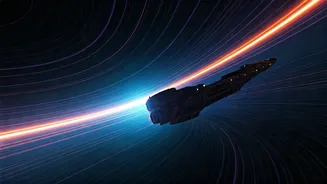
The 'Star Wars' saga famously employs hyperspace as its primary means of interstellar travel. This involves a ship entering a different dimension, a shortcut allowing near-instantaneous jumps across vast distances. While visually impressive, this method lacks a grounding in current scientific understanding. The concept of hyperspace, as a separate realm accessible to starships, is a fictional construct that bypasses the limitations imposed by the speed of light. However, 'Star Wars' cleverly integrates hyperspace jumps into its narrative, creating tense sequences where navigational errors and attacks can lead to dramatic outcomes. Though not scientifically plausible, hyperspace adds to the universe’s mystique and keeps the action moving. This approach lets the story focus on the conflicts and characters, allowing for compelling space battles and intergalactic alliances.
Star Trek's Warp Drive
'Star Trek' presents a more science-oriented view of space travel. Their core technology, the warp drive, is theoretically based on the concept of warping spacetime itself, which could allow a vessel to move faster than light without violating known physical laws. While still largely speculative, the warp drive integrates more seamlessly into current scientific thinking. The warp drive's design involves creating a 'bubble' of spacetime around a ship, contracting space in front of it and expanding space behind, thus propelling the vessel. This provides 'Star Trek' with a plausible framework for interstellar travel, fostering exploration and conflict across the galaxy. Because of its relatively grounded approach, 'Star Trek' can explore complex scientific and ethical dilemmas, which deepens the story's complexity.
Doctor Who's TARDIS Tactics
'Doctor Who' distinguishes itself with the TARDIS, a time-traveling spacecraft disguised as a police box. The TARDIS can travel through space and time, presenting a highly flexible mode of transport. The TARDIS uses a complex mix of technologies, with the potential to go almost anywhere, at any time. The narrative doesn't heavily dwell on the mechanics of time travel but prioritizes storytelling. Because the TARDIS operates outside the usual physics constraints, the show can focus on exploring historical events and fantastic settings. The TARDIS, due to its versatile nature, drives the series, allowing the Doctor to confront numerous threats across the universe and history, and the TARDIS is the ideal storytelling device.
Battlestar Galactica’s Jumps
In 'Battlestar Galactica,' interstellar travel relies on 'jump drives,' which allow ships to instantaneously travel across vast distances. This technology functions by using a precise calculation to find the optimal point to exit space, which has the effect of instantaneous travel. While this form of travel has its narrative benefits, it sacrifices realism in favor of dramatic pacing. The immediate nature of the jumps contributes to the show's tension, enabling sudden attacks and escapes. Despite not being realistic, it intensifies the drama, setting the stage for intense battles and struggles. The jump drives have contributed to 'Battlestar Galactica’s' narrative, adding to the storyline’s intensity and providing a thrilling viewing experience.
Evaluating the Absurdity
When evaluating the space travel methods, the spectrum ranges from somewhat plausible to utterly fantastical. 'Star Trek'’s warp drive, while speculative, still draws from theoretical physics, presenting a degree of scientific grounding. 'Battlestar Galactica'’s jump drives, despite being an extreme simplification, are a way to achieve instantaneous travel. On the other end, the 'Star Wars' hyperspace and the TARDIS’s ability to travel through space and time push the boundaries of known science. Each approach, while different in how they approach scientific plausibility, serves a distinct narrative purpose, shaping the story's pace and scope. By prioritizing visual spectacle, the narrative choices of these franchises shape the stories. This creates a landscape of diverse interstellar travel, each contributing its own unique element to the world of sci-fi.