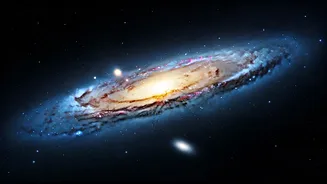

Galaxies in Sync
Astronomers have observed a fascinating phenomenon: galaxies moving in unison across an immense 50-million-light-year stretch. This coordinated movement
raises intriguing questions about the underlying forces at play in the cosmos. The synchronized motion suggests a potential connection between these galaxies, possibly driven by gravitational interactions or the presence of unseen structures. Further investigation is needed to clarify the precise nature of these cosmic connections and their wider implications for our understanding of galactic dynamics. This discovery presents a fresh angle on the interconnectedness of the universe, challenging existing models of how galaxies interact and evolve over astronomical timescales, necessitating a re-evaluation of current understandings.
Expanding Universe's Pace
New telescope data has deepened the mystery surrounding the rate at which the universe expands. Scientists are grappling with discrepancies between different measurement methods, creating significant challenges for the prevailing models of cosmology. Different approaches to measuring the expansion rate, such as using supernovae and the cosmic microwave background, have yielded conflicting results. This contradiction demands further investigation to reconcile these differences and refine our grasp of the universe's evolution. Precise measurement of this rate is essential for calculating the age of the universe, and its present inconsistencies suggest that there are things about the universe that are not yet understood.
Formation Challenges
The discovery of a misaligned exoplanet challenges our assumptions about solar system formation. This exoplanet, whose orbit doesn't align with those of other planets in its system, contradicts the standard models of planetary birth and growth. Such a misalignment requires a rethinking of the forces that shape planetary orbits and how they change over time. It suggests that a more complex set of interactions could be responsible for the formation of solar systems. This includes interactions with other celestial bodies, gravitational disturbances, and perhaps even the presence of as-yet-undetected factors, thus enriching the ongoing discourse on planetary system development.