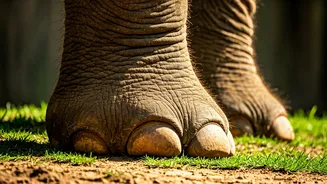

Foot's Sensory Prowess
Elephants possess an astonishing sensory apparatus centered not in their large ears, but within their remarkably sensitive feet. These appendages are more
than just structures for locomotion; they are sophisticated sensory organs that enable elephants to perceive a wide range of environmental stimuli. The sole of an elephant's foot contains a fatty, cushioning pad, crucial for weight distribution, but also riddled with nerve endings that detect vibrations and pressure changes. These signals travel up the leg to the brain, providing detailed information about the ground beneath them. This sensitivity allows them to detect approaching predators, locate water sources from afar, and even sense the footsteps of other elephants kilometers away through seismic communication. The complex network of nerves and specialized receptors transforms the foot into a highly attuned instrument for understanding their surroundings, a testament to evolutionary ingenuity. This profound connection to the earth through their feet shapes their social interactions and their navigation of vast territories, painting a picture of an animal deeply grounded in its environment.
Vibrational Communication
The ability of elephants to detect and interpret seismic vibrations through their feet is a cornerstone of their communication and survival. Unlike auditory signals that dissipate rapidly in open environments, ground-borne vibrations can travel significant distances, offering a reliable communication channel. Elephants can generate low-frequency rumbles, often below the human hearing range, by stamping their feet or by shifting their weight. These seismic signals are received by the sensitive pads of other elephants' feet, allowing them to communicate with each other across vast distances, even when visual or auditory cues are absent. This vibrational communication plays a vital role in coordinating group movements, warning of danger, and maintaining social bonds within herds. It's a sophisticated, yet often overlooked, aspect of their intelligence and social complexity, demonstrating how they 'listen' to the earth to stay connected and informed. The finely tuned perception of these vibrations is paramount, enabling them to discern the direction, intensity, and source of these subtle messages from the ground.
Evolutionary Advantage
The development of highly sensitive feet in elephants represents a significant evolutionary advantage, particularly given their massive size and the environments they inhabit. In the open savannas and dense forests where visual and auditory cues can be obstructed or unreliable, seismic sensing provides a critical advantage for survival and social cohesion. Their large bodies require substantial support, and the fatty pads in their feet distribute weight effectively, preventing injury while simultaneously acting as sophisticated receivers. This dual function of support and sensory perception is a remarkable evolutionary adaptation. It allows them to detect subtle ground tremors from approaching threats long before they are visible or audible, giving them crucial time to react. Furthermore, it aids in foraging by sensing the presence of water or vegetation, and in navigation by understanding the terrain. This refined sensory system, rooted in their feet, has been instrumental in their success and survival as one of the planet's largest land mammals.