





Webb's Cosmic Reveal
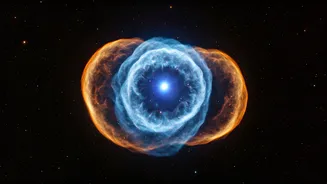
The James Webb Space Telescope has unveiled a truly spectacular infrared vista of a celestial formation affectionately nicknamed the 'Exposed Cranium'.
This captivating cloud of gas and dust, formally identified as PMR 1, is located approximately 5,000 light-years away in the southern constellation Vela. Webb's powerful infrared instruments have pierced through the obscuring cosmic veil, presenting an unprecedentedly detailed view of this stellar remnant. The observatory's capability to detect infrared light allows astronomers to observe phenomena that are hidden from optical telescopes, providing crucial insights into the universe's most enigmatic processes. This particular nebula's striking resemblance to a human skull has captured the imagination of scientists and the public alike, making it a fascinating subject for study. The new imagery offers a profound look at the complex and often violent stages of stellar evolution. Webb's data promises to deepen our understanding of how stars are born, live, and eventually meet their end, contributing significantly to astronomical knowledge.
Anatomy of a Nebula
The 'Exposed Cranium' nebula, as seen through Webb's lenses, presents a remarkably detailed structure. The imagery highlights a luminous central region often described as the 'brain,' encased within an extensive outer shell composed primarily of hydrogen gas. A distinctive dark lane bisects the nebula, thought to be the pathway carved by material violently ejected from the dying star at its core. This precise demarcation suggests a directional expulsion of stellar matter, a common characteristic of planetary nebulae. The nebula's apparent transparency allows for a clear view of these internal components, revealing the intricate layering of gases and dust. Scientists are particularly interested in this formation because its distinct shape allows for a vivid visual representation of a star's final, dramatic moments. The detailed resolution provided by Webb surpasses that of previous observations made with instruments like the Spitzer Space Telescope, offering a much richer dataset for analysis and interpretation of the star's explosive outbursts.
Star's Final Breath
The 'Exposed Cranium' nebula is a testament to the ephemeral nature of a star's end-of-life phase. It is classified as a planetary nebula, a phenomenon that occurs when stars of moderate mass, similar to our Sun, reach the conclusion of their nuclear fusion processes. These spectacular cosmic displays are relatively short-lived, typically persisting for only about 20,000 years before their constituent gases dissipate into interstellar space. The James Webb Space Telescope's remarkable imaging capabilities allow it to capture these fleeting moments in exquisite detail, providing a snapshot of a star's final evolutionary stage. The ultimate fate of the central star, depending on its initial mass, will be either a cataclysmic supernova explosion if it was significantly more massive than our Sun, or a gentler transformation into a stable white dwarf if its mass was comparable. Regardless of the specific outcome, the visually striking 'Exposed Cranium' Nebula offers a profound and colorful glimpse into the dramatic end of a star's cosmic journey.