
Galactic Oddities Revealed
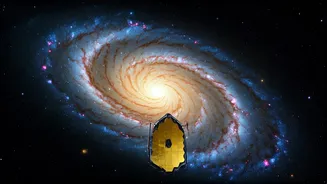
NASA's powerful telescopes, Hubble and James Webb, have recently brought to light some truly peculiar celestial objects. The Hubble telescope, a veteran
observer, has identified a dark and rare entity dubbed 'Cloud-9.' This object is categorized as a 'failed galaxy,' displaying characteristics that set it apart from anything previously documented. Its unusual nature challenges existing astronomical models and prompts further investigation into the diverse forms galaxies can take. Complementing these findings, the James Webb Space Telescope (JWST) has provided insights into galaxies that met dramatic ends in the ancient universe. One such galaxy, described as 'starved,' appears to have died through a process involving numerous destructive events, a phenomenon termed 'a death of 1,000 cuts.' This imagery offers a stark reminder of the violent and dynamic nature of cosmic evolution in the early cosmos, providing a unique window into galactic demise.
Stellar Nurseries and Supernovas
The universe is a constant theatre of creation and destruction, and our advanced telescopes are capturing these dramatic events in exquisite detail. The Hubble telescope has delivered a hauntingly beautiful image of a stellar nursery, a vibrant region teeming with newborn stars. This snapshot provides crucial data on the processes of star formation, illuminating how cosmic gas and dust coalesce to ignite new stellar furnaces. Meanwhile, the James Webb Space Telescope has achieved a significant milestone by detecting the earliest Type II supernova ever observed in the known universe. This discovery is critical for understanding the evolution of stars and the distribution of elements in the early cosmos. Furthermore, astronomers are encountering 'time-warped' supernovas, whose light exhibits a strange duality: it seems to have both reached us and not yet arrived. This phenomenon suggests complex gravitational lensing or other unusual cosmic conditions affecting light propagation, pushing the boundaries of our comprehension of spacetime.
Black Holes and Cosmic Origins
The enigmatic nature of black holes continues to be a focal point of astronomical research, with recent observations from the James Webb Space Telescope offering revolutionary insights. JWST is fundamentally altering our understanding of the universe's largest and oldest black holes, revealing they are 'not so exotic anymore' as previously thought. The telescope has provided the sharpest-ever images of the edge of a supermassive black hole, allowing scientists to scrutinize their immediate surroundings and accretion disks with unprecedented clarity. In a truly astonishing revelation, JWST has confirmed the existence of a supermassive black hole that is actively fleeing its host galaxy at an incredible speed of 2 million miles per hour. This 'runaway' black hole challenges existing theories about galactic evolution and the dynamics of black hole systems. Additionally, JWST has peered into what is colloquially known as the 'Eye of God,' finding crucial clues that may shed light on the origins of life itself, connecting the grand structures of the universe to the fundamental questions of our existence.
Cosmic Mysteries Unravelled
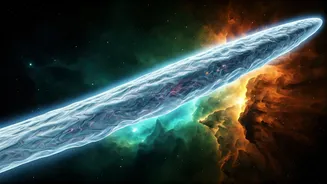
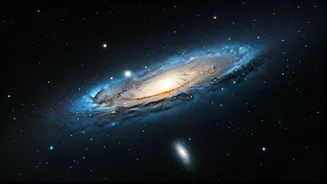
Beyond the grand structures of galaxies and black holes, celestial oddities continue to intrigue astronomers. The James Webb Space Telescope has captured images of 'monster stars' in the early universe that are leaking nitrogen, a finding that deviates from standard astrophysical simulations. This observation implies that our current models of early stellar evolution may be incomplete. Also noteworthy are the 'failed stars' spotted by JWST in a stunning cluster near Earth; these objects represent a type of celestial body that didn't quite achieve full stellar status, offering unique insights into the lower limits of star formation. The Hubble telescope, in its ongoing exploration, has provided the most detailed photographic evidence to date of the interstellar visitor 3I/ATLAS, an object that passed through our solar system. The chaotic and unexpected history of the Andromeda galaxy, mapped by Hubble, has also surprised scientists, as its evolution was 'nothing like' what computer simulations had predicted, underscoring the unpredictable nature of cosmic development. Furthermore, a mysterious, irradiated 'scar' within our own galaxy may have finally found a plausible explanation, adding another piece to the vast cosmic puzzle.