
JWST’s Cosmic Gaze
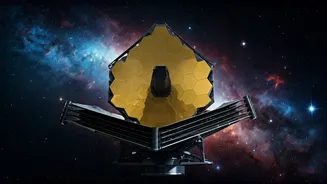
The James Webb Space Telescope (JWST) has expanded our view of the cosmos, leading to its discovery of the most ancient supernova yet. This exceptional
event is closely linked to GRB 250314A, a gamma-ray burst that acts as a beacon illuminating the distant universe. The JWST's powerful infrared capabilities are instrumental in observing the light from these early cosmic events. The telescope, with its sophisticated instruments, is capable of piercing through vast distances and time, offering us glimpses of the universe’s initial phases. This capability is providing groundbreaking data about star formation and the evolution of galaxies, as scientists delve into the mysteries of the universe's formative years. The observations mark a pivotal moment in astronomy, significantly advancing our knowledge of the universe's past.
Supernova’s Distant Signal
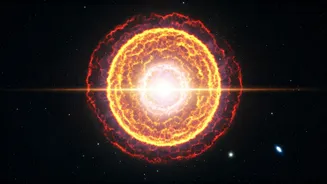
The supernova detected by the JWST represents an extraordinary opportunity to study stellar evolution in the early universe. This supernova, associated with GRB 250314A, provides information about the first generations of stars and their ultimate fates. Gamma-ray bursts, like GRB 250314A, are among the most energetic events in the universe, believed to be the result of massive stars collapsing into black holes. The JWST’s ability to observe the afterglow of these events offers insights into the composition and distribution of matter in the early cosmos. Scientists are actively studying the characteristics of the light from this supernova. Analyzing this light helps them decipher details about the progenitor star, the surrounding environment, and the supernova's explosion dynamics. These investigations are central to refining our understanding of how galaxies and stars were initially formed.
Linking to GRB 250314A
The connection between the oldest observed supernova and GRB 250314A is pivotal in understanding these phenomena. GRB 250314A, a powerful gamma-ray burst, served as a crucial marker, enabling astronomers to pinpoint the supernova’s location. Gamma-ray bursts originate from the collapse of massive stars, making them important indicators of star formation and death. The association between the supernova and the GRB allows scientists to perform a detailed analysis of the supernova’s characteristics, combining the data from different instruments. This combined approach is giving scientists a better understanding of the processes occurring at the end of the life cycles of the very first stars. The study of the supernova-GRB link is a key step towards deciphering the mechanisms that drive these dramatic cosmic events and their consequences on the evolution of the cosmos.
Impact on Astronomy
The discovery of the oldest supernova has a profound impact on the field of astronomy, prompting new avenues of exploration and research. This finding pushes the boundaries of observational capabilities and provides a glimpse into the cosmic dawn. Astronomers are now better equipped to probe deeper into the history of the universe, using this discovery as a foundation for future research. The data gathered from the JWST and the supernova will be used to improve models of star formation, galaxy evolution, and the distribution of elements in the cosmos. The capacity to see such distant, ancient events is changing how we perceive the universe, offering a novel perspective on the processes that have shaped its current form. As technology progresses, the possibilities for future discoveries in space remain virtually limitless.