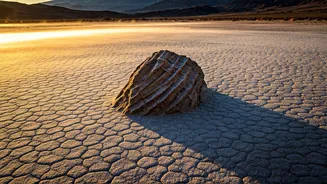

A Geological Riddle
The 'sliding rocks' of Death Valley, also known as sailing stones, have intrigued scientists for a long time. These rocks, some weighing hundreds of pounds,
appear to move across the desert floor, leaving trails behind them, without any apparent external force. The location of the sliding stones is in the Racetrack Playa, a flat, dry lakebed in Death Valley National Park. Over the years, many theories tried to explain this phenomenon, ranging from the influence of powerful winds to possible magnetic fields. However, none of these explanations fully accounted for the stones' movement. The mystery persisted, capturing the curiosity of geologists, physicists, and many other researchers. The challenges posed by the arid environment and the remoteness of the site complicated efforts to observe and document the events directly, causing the riddle to endure.
The Scientific Breakthrough
After numerous attempts to understand the movement of the rocks, scientists at last had a solution. The study focused on detailed observation and analysis of the environment. Researchers learned that the rocks' movement relies on a specific sequence of natural events. It starts with the right environmental conditions, which only occur a few times each year: the formation of thin ice sheets during the cold nights. As the water freezes, ice sheets form around the rocks. Then, the strong winds from the surrounding valley would push them forward. These ice sheets can act as a natural 'sail', lowering the friction between the rocks and the mud and allowing them to glide across the surface. This discovery provided a compelling explanation for the long-standing mystery. The scientists' breakthrough offered a clearer understanding of the forces at work.
Ice, Wind, and Motion
The key findings of the research highlighted the importance of a combination of ice and wind. These two factors work together to facilitate the movement of the rocks. The ice that forms around the stones lowers the friction, making it easier for the wind to move them. As the sun rises and the ice begins to melt, the rocks move with the wind. The precise alignment of these factors is rare. The process usually only occurs when there's a specific balance of temperature and wind. The researchers found that, under these conditions, even a modest breeze could push the rocks along the slippery ice surface. These conditions allowed the rocks to move slowly but steadily over the dry lakebed, leaving their distinctive trails behind. The interplay of ice and wind provides a good scientific explanation of the movement of the rocks.
Impact and Implications
The solution to the Death Valley sliding rocks has several important implications. Firstly, it offers a prime example of how unusual natural events can happen in extreme environments. Secondly, it serves as an example of how patience and detailed observation are important in scientific research. The discovery of the process highlighted how scientific research depends on a deep understanding of natural phenomena. Also, it underscores the importance of interdisciplinary cooperation. Furthermore, the knowledge gained from this study can apply to related areas of research, helping to further understand the behavior of geological formations. The study has also had an impact on the public, increasing awareness of the unique features of Death Valley and the importance of preserving natural environments.