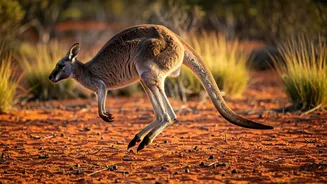

Early Ancestors Uncovered
The kangaroo's hopping journey began with its ancestors, small, tree-dwelling creatures from the Eocene epoch, approximately 56 to 34 million years ago.
These early marsupials, bearing little resemblance to the kangaroos we know today, possessed features such as flexible ankles and a relatively small body size. Over time, as environmental conditions changed and grasslands expanded, these ancestors faced new challenges. They started to venture onto the ground more frequently in search of food and to escape predators, which spurred their evolution. Natural selection favored those with slightly elongated hind legs and a tendency towards bipedalism, which ultimately became the precursors of the hopping movement we see today. Fossils reveal gradual transitions in bone structure, showcasing the progressive development of the kangaroo's distinctive skeletal system. These findings give us a clear understanding of the environmental forces that drove these early marsupials toward a hopping lifestyle.
Skeletal Adaptations: Legs
A pivotal aspect of the kangaroo's evolution is the profound transformation of its skeletal structure, most notably within its legs. The hind legs of a kangaroo are incredibly large and powerful, constituting a significant portion of its overall size and weight distribution. The femur, or thigh bone, is substantial, providing a robust anchor for the massive leg muscles required for hopping. The tibia and fibula, the lower leg bones, are elongated, increasing the stride length and efficiency of each hop. In addition, the kangaroo’s feet have evolved to possess a large, prominent central toe, which acts as the primary point of propulsion, while the smaller toes play a supportive role. This arrangement helps it to channel all its energy into the hopping motion. The overall structure is perfectly designed for bipedal movement, allowing kangaroos to cover substantial distances with minimal energy expenditure. This adaptation allowed kangaroos to flourish in their environment, escaping from predators and foraging across vast grasslands.
Tail and Pelvis Design
The kangaroo's tail and pelvic structure play pivotal roles in its unique hopping style, providing both balance and power. The tail acts as a crucial counterbalance, serving as a stabilizer when the kangaroo is in motion and as a support when it rests. When hopping, the tail helps the kangaroo adjust its center of gravity, maintaining its balance during landings and takeoffs. The pelvis of the kangaroo has also undergone significant changes during its evolution. The ilium, the upper part of the pelvis, provides a broad area for the attachment of powerful hip muscles, enhancing the kangaroo's ability to generate forward momentum. The specific shape and orientation of the pelvic bones are optimized for bipedal locomotion, allowing for an efficient transfer of power from the hind legs. These evolutionary adjustments showcase the integrated nature of the kangaroo's adaptation to hopping, revealing how every element works to achieve balance and efficiency.
Environmental Pressures at Play
Environmental factors crucially shaped the kangaroo's evolutionary path. The shift from forests to open grasslands in Australia had a profound impact, compelling early marsupials to adapt to these new habitats. As grasslands expanded, these ancestors faced new challenges. The availability of food and the need to escape predators favored those with the ability to traverse wide-open spaces quickly and efficiently. The hopping movement proved to be highly effective in grasslands, allowing kangaroos to cover ground rapidly while conserving energy. The climate change, including periods of drought and changing vegetation, put more pressure on the marsupials. This created a positive feedback loop: better hoppers could find resources more efficiently, surviving and reproducing at higher rates. Over time, those best adapted to hopping became increasingly prevalent, leading to the emergence of the kangaroo as we know it today. This underlines the powerful role of natural selection in shaping the kangaroo's unique form of locomotion.
Benefits of Hopping
The kangaroo's hopping gait offers numerous advantages that contributed to its success as a species. First, hopping is an energy-efficient mode of locomotion, particularly at moderate speeds. The elastic tendons in the hind legs store energy as the kangaroo lands, which is then released to propel the animal forward during the next hop. This energy-saving mechanism is crucial for covering long distances, enabling the kangaroo to efficiently forage and migrate across large areas. Secondly, hopping provides effective predator avoidance. The kangaroo's ability to move quickly and change direction rapidly gives it a distinct advantage when escaping predators, which can be the difference between survival and death. The upright posture also increases the kangaroo’s field of vision, helping to spot threats from a distance. Thirdly, hopping aids in reproductive success. Male kangaroos use their hopping ability in dominance displays during the mating season, proving their fitness to potential mates. These combined benefits have made hopping a very beneficial trait, shaping the kangaroo's evolutionary path.