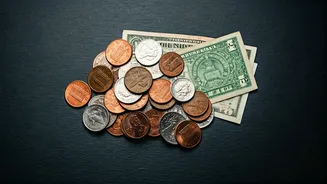








Silver Coin Hoard
Digging through your coin collection or spare change could unearth significant value, particularly if you find coins minted before 1965. These older U.S.
dimes, quarters, half dollars, and silver dollars were crafted from 90% silver, a precious metal whose value has surged. For instance, a quarter from this era is now worth approximately $13.07, more than tripling in value over the past two years. Even dimes and half dollars hold substantial silver content, valued around $5.23 and over $26 respectively. Larger silver dollars, such as the Morgan or Peace dollar minted between 1878 and 1935, contain about $56 worth of silver. Additionally, Kennedy half dollars produced between 1965 and 1970 possess 40% silver and are worth over $11 each, while Jefferson nickels from mid-1942 to 1945, identifiable by a large mint mark above Monticello, contain 35% silver and are valued at around $4.07. Detecting these silver coins is simple: they generally feel heavier than their modern counterparts and lack the distinct copper stripe visible on the rim of dimes and quarters minted after 1965. When you're ready to convert these treasures into cash, local coin dealers and online bullion buyers will offer prices close to the melt value for these circulated coins, often referred to as 'junk silver' within the industry. For example, Money Metals Exchange is currently purchasing pre-1965 silver half dollars at over $41 for every $1 of face value, representing roughly 80% of their silver content based on current market prices.
Copper Penny Power
Pennies minted before mid-1982 are a significant find for collectors and investors due to their substantial copper content. Unlike pennies made from late 1982 onwards, which are primarily zinc with a thin copper coating (97.5% zinc), the earlier ones are composed of 95% copper. With copper prices nearing $5.97 per pound, showing an increase of almost 25% year-over-year, each pre-1982 penny holds approximately 3.9 cents worth of metal. While this may seem small on an individual basis, amassing a significant quantity can lead to considerable value. For instance, a jar containing five pounds of these older cents could hold around $29 in copper value alone. However, it's crucial to be aware of regulations; the U.S. Mint prohibited the melting of pennies and nickels in 2007, with penalties for violations including fines up to $10,000, prison sentences of up to five years, and forfeiture of the coins. Despite this ban, holding onto pre-1982 pennies remains a worthwhile endeavor as their intrinsic copper value continues to grow passively. Bullion dealers frequently buy and sell these coins in bulk, often at substantial premiums over their face value, anticipating further rises in copper prices and a potential future lifting of the melting prohibition. Thus, a penny saved might not earn interest, but it can certainly appreciate in value.
Unusual Bill Serial Numbers
Beyond coins, your paper currency can also hide unexpected value, primarily through unique serial numbers. While most bills are worth their face value, certain bills command a premium from collectors. A prime example is the 'star note,' a replacement bill printed by the Bureau of Engraving and Printing when a defective note is identified and removed during production. These bills are marked with a star at the end of their serial number and appear in roughly 1 out of every 250 to 600 bills, varying by denomination and series. Crisp, modern $1 star notes can typically fetch around $30 on auction sites, with notes from smaller print runs potentially selling for even more. Collectors also eagerly seek bills with serial numbers that form recognizable patterns. Among these are 'radars,' which read the same forwards and backward (e.g., 12344321); common $1 radars often sell for $10 to $50. A rarer 'super radar,' featuring a repeating central digit bookended by different digits (like 01111110), has recently sold for $60 to $170. 'Repeaters' have the first four digits mirrored in the last four (e.g., 74627462). 'Ladders' display digits in sequential order (e.g., 12345678). The most valuable common pattern is the 'solid' serial number, where all eight digits are identical (e.g., 77777777); $1 bills with solid serial numbers can be valued between $1,000 and $4,000. Finally, bills with 'low serial' numbers, starting with five or more leading zeros (like 00000XXX), are also sought after, with the price increasing proportionally to the number of zeros.