







Tarmac Encounter
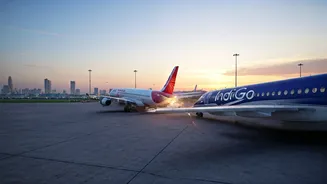
A late Monday night incident at Mumbai's busy Chhatrapati Shivaji Maharaj International Airport saw two passenger jets, one operated by Air India and another
by IndiGo, involved in a wingtip collision. The event transpired as the aircraft were taxiing on the ground, one pushing back from its gate for departure and the other joining a taxiway after landing. Fortunately, the low-speed nature of the contact meant that all passengers and crew on board both aircraft were unharmed. However, the collision necessitated immediate safety assessments, leading to both aircraft being grounded for thorough technical inspections and causing significant disruptions to flight schedules. This rare occurrence has sparked renewed attention on the coordination of ground movements within the airport's apron and taxiway areas, especially given Mumbai's status as India's busiest air traffic hub. Initial reports indicate that the Air India flight, AI 2732, bound for Coimbatore, was in the process of pushing back when its right wingtip grazed the right wingtip of the IndiGo flight, 6E 791, which was taxiing after its arrival from Hyderabad. The proximity and movement on the ground led to this unexpected contact, prompting swift action from airport authorities and airline ground staff to ensure the well-being of everyone involved.
Aircraft Grounded
Following the wingtip contact, both the Air India and IndiGo aircraft were promptly taken out of service for detailed inspections. Air India confirmed that its aircraft, AI 2732, sustained damage to its wingtip. As a standard safety protocol for such events, the aircraft was grounded to allow engineers to conduct comprehensive technical evaluations to ensure there was absolutely no compromise to its airworthiness. The airline assured that all passengers aboard its flight were safely disembarked and that alternative arrangements were being made to transport them to their intended destination as soon as possible. They also expressed regret for the inconvenience caused, reaffirming their unwavering commitment to passenger and crew safety. Similarly, the IndiGo aircraft, flight 6E 791, was also grounded for inspection. While IndiGo did not issue an immediate detailed public statement, airport officials confirmed the grounding. Even minor scrapes on the ground can trigger extensive checks, particularly concerning critical components like aircraft wings, ensuring that the aircraft is entirely safe to fly before it is cleared for operations. Passengers from both affected flights were looked after by their respective airline teams, with travel plans being adjusted accordingly.
Regulatory Oversight
The incident involving the Air India and IndiGo aircraft has been officially reported to the Directorate General of Civil Aviation (DGCA), India's aviation regulatory body. The DGCA is expected to initiate a thorough investigation into the matter, likely requesting detailed reports from both the airlines involved and the airport operator. Aviation experts anticipate that the probe will meticulously examine various aspects of ground operations, including the air traffic control instructions issued, the clearances for pushback and taxiing, the level of congestion on the taxiways, and the communication and coordination protocols between the cockpit crews and the ground handling personnel. The objective of such an investigation is to identify the precise sequence of events that led to the collision and to implement measures to prevent similar occurrences in the future. The DGCA's findings will be crucial in understanding the operational challenges at a high-traffic airport like Mumbai and in reinforcing safety standards for ground movements, ensuring the continued safety of air travel for all passengers and crew.
Operational Repercussions
While the collision between the Air India and IndiGo aircraft resulted in no injuries, it inevitably caused significant operational disruptions at the already bustling Mumbai airport. Handling hundreds of flights daily, any deviation from the normal schedule, even a minor one, can create a cascade effect, leading to delays for subsequent flights and impacting the overall operational flow. The grounding of two aircraft meant that airlines had to reallocate resources, adjust flight schedules, and manage passenger rebookings, leading to extended waiting times and revised travel plans for many. The incident serves as a stark reminder of the complexities involved in managing air traffic at major hubs and the potential for even minor incidents to have far-reaching consequences on airline operations and passenger convenience. Both airlines worked to minimize the impact on passengers, but the grounding of two aircraft undoubtedly led to a ripple effect throughout the day's operations.