



The Absolute Contender
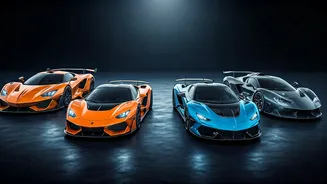
The Koenigsegg Jesko Absolut stands as a prime candidate for the title of the world's fastest production car. Engineered with an singular focus on achieving
unparalleled top speed, this automotive masterpiece from Koenigsegg is equipped with a formidable twin-turbocharged 5.0-litre V8 engine. When fueled with E85, this powerhouse can unleash up to an astonishing 1,600 horsepower, a testament to its extreme performance capabilities. Its design is meticulously crafted to minimize drag and maximize aerodynamic efficiency, essential for reaching velocities that few vehicles can even approach. The pursuit of absolute speed is the Jesko Absolut's raison d'être, making it a benchmark in the hypercar segment and a machine that consistently pushes the envelope of what's achievable in automotive engineering for road-legal vehicles.
Breaking the Barrier
The Bugatti Chiron Super Sport 300+ etched its name in automotive lore with a monumental achievement, becoming the first production-derived car to surpass the 300 mph mark. In a historic run, it clocked an incredible 304.77 mph on German soil in 2019, a feat that resonates deeply within automotive enthusiast circles. This exceptional machine is propelled by a monstrous 8.0-litre quad-turbocharged W16 engine, generating nearly 1,600 horsepower. While its speed is undeniable, the Chiron Super Sport 300+ masterfully combines raw velocity with a level of luxury and refinement that is characteristic of Bugatti's offerings. It represents a pinnacle of automotive engineering, symbolizing both extreme performance and sophisticated design, a rare blend in the world of hypercars that continues to captivate imaginations.
American Velocity Challenger
Representing a significant American entry into the hypercar arena, the SSC Tuatara is engineered to challenge European dominance in the pursuit of ultimate speed. Developed by SSC North America, this vehicle boasts a potent 5.9-litre twin-turbo V8 engine capable of producing up to 1,750 horsepower when running on E85 fuel. Its design, inspired by fighter jets, features an exceptionally aerodynamic profile, honed with the sole objective of becoming the fastest production car globally. The Tuatara has been at the center of several high-profile speed assertions and attempts, including some initial controversial claims followed by later validated high-speed runs exceeding 280 mph. Despite ongoing discussions, its placement among the elite tier of speed-focused vehicles is undisputed, showcasing cutting-edge American automotive innovation.
Tornado of Power
Named after the most powerful classification of tornado, the Hennessey Venom F5 embodies extreme performance and raw power. Hailing from Hennessey Special Vehicles in Texas, this hypercar is powered by a 6.6-litre twin-turbo V8, aptly named Fury, which churns out an astounding figure of over 1,800 horsepower. Hennessey has explicitly designed the Venom F5 with the capability to exceed 300 mph, positioning it directly in contention for the world speed record. Compared to many of its rivals, the Venom F5 emphasizes a lighter construction and an intense focus on delivering an exhilarating driving experience, deliberately prioritizing driver engagement over grand touring comfort. This dedication to pure performance makes it a formidable competitor.
Electric Speed Revolution
The Rimac Nevera R heralds a significant shift in the future of automotive speed, demonstrating the extraordinary potential of electric powertrains. Developed by Rimac Automobili, this cutting-edge hypercar utilizes four electric motors that deliver breathtaking, instant acceleration and immense torque. With a top speed hovering around 268 mph and acceleration figures that can leave nearly every internal combustion engine car in its dust, the Nevera R ranks among the fastest road-legal vehicles ever produced. Its distinctiveness lies not only in its raw speed but in the way it delivers that power – silently, instantaneously, and with remarkable consistency. The sophisticated battery technology, advanced torque vectoring, and intelligently managed dynamics create an experience that feels more akin to piloting a highly precise, computer-guided projectile than a conventional automobile.