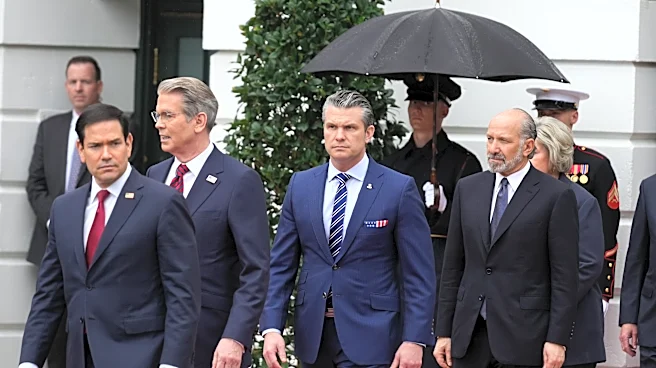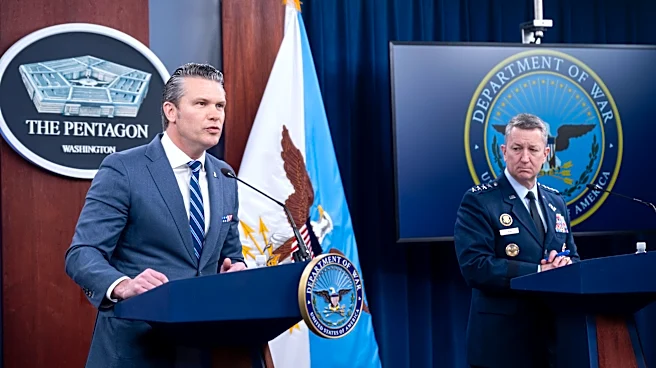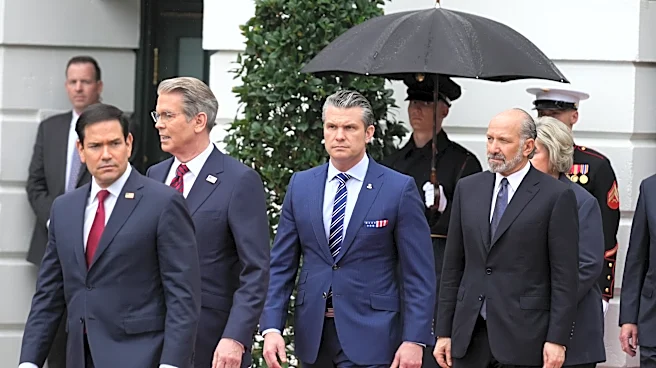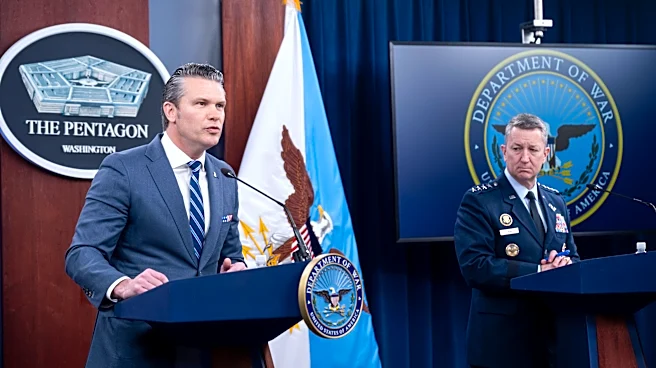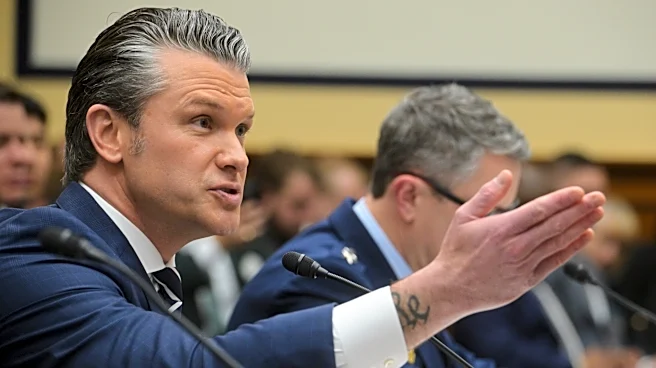

Defense Secretary Pete Hegseth and the chairman of the Joint Chiefs of Staff faced another day of grilling Thursday on Capitol Hill, with senators getting their first opportunity to confront or praise
the leaders' handling of the Iran war. The Trump administration is seeking a historic $1.5 trillion military budget for 2027.
Senators wanted to know what the Defense Department is doing to prevent civilian deaths, with one Democrat saying he has “serious constitutional concerns” about Hegseth’s claim that the 60-day legal limit for the war with Iran is on pause during the ceasefire. Gen. Dan Caine also told senators that Russia has aided Iran’s war effort, but declined to go into details publicly.
After weeks of delay, the House voted Thursday to fund much of the Department of Homeland Security, but not its immigration enforcement operations. The bipartisan package now heads to President Donald Trump to sign to end the longest agency shutdown in history and avoid another round of airport disruptions. Much of Trump’s immigration agenda, which is central to the dispute, is being funded separately.
The price of Brent crude oil briefly surged past $126 a barrel early Thursday as stalled U.S.-Iran talks raised doubts over the reopening of the Strait of Hormuz and a permanent end to the Iran war. That shock to oil supplies and prices is putting pressure on Trump, who on Thursday floated a new plan to reopen the strait.
Here's the latest:
The defense secretary is exiting the hearing room after a nearly three-hour hearing before the Senate Armed Services Committee.
Hegseth faced some tough questions from senators, especially Democrats, on a range of issues, including the Iran war, his efforts to remake military culture, the management of munition supplies and U.S. support for Ukraine.
Hegseth fired back at Democrats during several exchanges, and he emerged with a number of Republicans expressing support for his leadership.
At the hearing’s end, a solitary anti-war protester shouted her disapproval of the Iran war as she exited the room.
Hegseth is telling senators that the Pentagon needs the $1.5 trillion proposed by the Trump administration, which would be a historic boost to defense spending and increase the Pentagon’s budget by over 40% from the previous year.
Sen. Mark Kelly, an Arizona Democrat, questioned whether such an increase was really necessary and told Hegseth that “some of this stuff we either don’t need or it’s not going to work.”
But Hegseth pushed back.
“The budget reflects the realities of the world we live in and the capabilities we’re going to need,” he said.
The House on Thursday approved funding for much of the Department of Homeland Security after weeks of delays, while leaving out immigration enforcement operations.
Speaker Mike Johnson, who had previously dismissed the Senate-passed bill as a “joke,” praised the chamber for ending the longest agency shutdown in history. He acknowledged that “the process around here is cumbersome,” but said “Republicans continue to deliver for the American people.”
“Democrats got absolutely nothing for their political charades and shenanigans,” Johnson said.
He added that the week’s work shows why Republicans “are going to win the midterms so that grown-ups can stay in charge here.”
Democratic Sen. Mark Kelly is questioning Hegseth publicly for the first time since the defense secretary tried to punish the senator, a former Navy pilot, for participating in a video that called on troops to resist unlawful orders.
A federal judge in February temporarily blocked the Pentagon from carrying out Hegseth’s formal censure of Kelly.
Sen. Elissa Slotkin, a Michigan Democrat who also participated in the video, is on the Senate Armed Services Committee and questioned Hegseth as well.
They both grilled him on the war with Iran. Kelly pressed Hegseth to distance himself from a March 13 statement in which the defense secretary said there should be “no quarter, no mercy for our enemies.”
Kelly pointed out that stance would violate the Pentagon’s Law of War manual for dealing with combatants who have surrendered.
But Hegseth responded, “We fight to win and we follow the law.”
“Your response here right now,” Kelly said, “makes it clear to the American people exactly why you are not right for this job.”
The defense secretary angrily fired back at Democratic Sen. Elizabeth Warren’s questions about whether he had invested in any defense manufacturers shortly ahead of the war with Iran.
“I’ll give it to you as a big fat negative,” Hegseth retorted.
Still, Warren pressed him on what limits are put in place at the Pentagon to prevent defense officials from profiting off of their knowledge of planned military actions.
“I’m not looking for money. I don’t do it for money,” Hegseth said. “I don’t do it for profit. I don’t do it for stocks. And that’s part of the reason why I’m able to be effective in this job. Because no one owns me.”
After weeks of delay, the House voted Thursday to fund much of the Department of Homeland Security, but not its immigration enforcement operations, and sent the bipartisan package to Trump to sign, ending the longest agency shutdown in history.
The White House has warned that temporary funding Trump tapped to pay Transportation Security Administration and other agency personnel would “soon run out,” and that sparked new threats of airport disruptions.
DHS has been without routine funds since Feb. 14, causing hardship for workers, though much of Trump’s immigration agenda that is central to the dispute is being funded separately.
“It is about damn time,” said Rep. Rosa DeLauro of Connecticut, the top Democrat on the House Appropriations Committee, who proposed the bill more than two months ago.
The House swiftly voted by voice, without a formal roll call, to pass the measure.
Democratic Sen. Tim Kaine told military officials he had serious concerns about the legal justification being used to strike alleged drug boats in the Caribbean and eastern Pacific Ocean when there is not necessarily clear evidence that they are carrying narcotics.
He said that there is a “profound mismatch” between how the operations are being carried out and the legal opinion that the Trump administration is using to justify the strikes.
The chairman of the Joint Chiefs of Staff, Gen. Dan Caine, responded to the questions by saying that the military was closely following the legal boundaries of the campaign.
Yet Hegseth also jumped in to say, “There’s no willy-nilly targeting of drug boats. We know exactly who these people are affiliated with.”
The Trump administration is running up against a 60-day limit for the Iran war that is instituted by the War Powers Act of 1973. The law requires that Congress must declare war or authorize the use of force, although it does provide for presidents to have a 30-day extension to draw down hostilities if it notifies Congress.
The 60-day limit for the Iran war will be reached Friday. However, Hegseth told senators, “We are in a cease fire right now, which our understanding means the 60-day clock pauses or stops in a ceasefire.”
Democratic Sen. Tim Kaine responded, “I do not believe the statute would support that,” and added that he had “serious constitutional concerns.”
Saying she was “disappointed” to see Gen. Randy George’s retirement “hastened,” Republican Sen. Joni Ernst of Iowa noted that the officer “pulled the Army out of its worst recruiting crisis since the Vietnam era” and trimmed “nonessential” Army positions.
George is one of several top military officers to be dismissed since Trump returned to office. In early April, the Pentagon said George would be “retiring from his position as the 41st Chief of Staff of the Army effective immediately.”
George had held the post of Army chief of staff, which typically runs for four years, since August 2023.
“He had 38 years of honorable service. He achieved the greatest Army recruitment and modernization effort in a generation,” Ernst said. “So I want to thank him for his service.”
Senators wanted to know what the Defense Department is doing to prevent deaths of civilians, especially after outdated intelligence contributed to the U.S. striking an elementary school in Iran and killing over 165 people.
Democratic Sen. Kirsten Gillibrand asked Hegseth, “What is your response to targeting that has resulted in the destruction of schools, hospitals, civilian places? Why did you cut by 90% the division that’s supposed to help you not target civilians?”
Hegseth responded that the Pentagon has an “ironclad commitment” to do more than other countries to prevent civilian deaths.
Still, Sen. Mike Rounds, a South Dakota Republican, continued Gillibrand’s line of questioning. He asked Hegseth whether the Pentagon still has the resources necessary to protect civilians.
Hegseth said it has “every resource necessary” and that humans are kept in the loop when AI is involved in military decisions.
Sen. Jeanne Shaheen, a New Hampshire Democrat, pushed Hegseth and other defense officials for details on how the Pentagon plans to use $400 million that Congress has allotted for Ukraine.
Hegseth told lawmakers a day earlier that the funding had been released. His actions came after Sen. Mitch McConnell, the former Senate Republican leader, penned an op-ed slamming the delay in releasing the funds.
But Shaheen pointed out that the Pentagon has not given Congress details on how it plans to spend the money. Hegseth told her that it would also be used as part of a program to sell military equipment first to NATO allies.
Shaheen shot back that it “was not the intent of Congress in providing that $400 million.”
The Defense Department’s current budget request includes no funding for Ukraine.
The chairman of the Joint Chiefs of Staff, Gen. Dan Caine, told senators Russian President Vladimir Putin has aided Iran’s war effort.
He declined to go into details, citing the public nature of the hearing, but said, ”There’s definitely some action there.”
The chair of the committee, Republican Sen. Roger Wicker, agreed, saying “there’s no question that Vladimir Putin’s Russia is taking serious action to undermine our efforts for success in Iran.”
“As I said yesterday, and I’ll say it again today, the biggest adversary we face at this point are the reckless naysayers and defeatist words of congressional Democrats and some Republicans,” Hegseth said in his opening statement to the Senate panel.
Defending Trump’s budget request, Hegseth said the president “inherited a defense industrial base that had been hollowed out by years of America last policies, resulting in a diminished capacity to project strength.”
Similar to his Wednesday remarks to a House committee, Gen. Dan Caine said it was his duty as Joint Chiefs of Staff chairman “to ensure our civilian leadership has a comprehensive range of military options and the associated risks required to make the nation’s hardest and most complex decisions.”
Cole Thomas Allen did not enter a plea during his brief appearance Thursday before U.S. Magistrate Moxila Upadhyaya.
Prosecutors allege Allen planned his attack for weeks and tracked Trump’s movements online before he ran through a magnetometer at the Washington Hilton on Saturday night while holding a long gun and disrupted one of the highest-profile annual events in the nation’s capital.
Allen was injured during the attack but wasn’t shot. A Secret Service officer was shot but was wearing a bullet-resistant vest and survived, officials say. Prosecutors have said they believe Allen fired his shotgun at least once and that a Secret Service agent fired five shots. They have not publicly confirmed that it was Allen’s bullet that struck the agent’s vest.
▶ Read more
Chinese foreign minister Wang Yi on Thursday spoke with U.S. Secretary of State Marco Rubio and called leader-level diplomacy the “guiding star” of the China-U.S. relations, the Chinese foreign ministry said.
The call came just about two weeks before President Trump plans to travel to China for the first time since 2017 and hold talks with Chinese leader Xi Jinping.
Wang credited the “strategic leadership” by Xi and Trump for the overall stability in China-U.S. relations and said both sides should cherish it and well prepare for “high-level interactions.”
Wang urged the U.S. side to make the “right choice” over the Taiwan issue, which he said is the most risky in China-U.S. relations. Beijing considers the self-governed island part of Chinese territory and vows to seize it by force if necessary, while Washington opposes use of force in the Taiwan Strait.
A protester in a pink shirt disrupted Hegseth’s opening statement before the Senate Armed Services Committee.
The man stood, unfurled a hand-written sign and yelled, “Pete Hegseth, you’re a war criminal.”
Within seconds, he was removed by Capitol Police officers. Several other people dressed in similar pink shirts have also left the hearing room.
The committee chair, Republican Sen. Roger Wicker, continued the hearing by saying he respected First Amendment rights to free speech, but that anyone who disrupts the hearing would be removed.
Sen. Jack Reed, the ranking Democrat on the Senate Armed Services Committee, did not hold back in his opening statement directed toward Hegseth.
From the war with Iran to Hegseth’s efforts to remake military culture, Reed dressed down the defense secretary’s actions and warned they could do long-term harm.
Reed argued that the war with Iran has left the U.S. in a worse strategic position than when it was started because the Strait of Hormuz is closed and 13 U.S. military members have been killed. Many others have been injured, and equipment has been destroyed.
“The American people’s trust in our military took 250 years to build. You are dismantling it in a fraction of that time,” Reed concluded.
In opening remarks, GOP Sen. Roger Wicker of Mississippi outlined threats to the United States he said were a “growing alliance” of China, Russia, Iran and North Korea, saying the current moment represents “the most dangerous security environment since World War II.”
Saying Chinese President Xi Jinping led a “growing alliance” among the countries, Wicker said they shared a goal ”to oppose America’s interests and the interests of other like minded, democratic countries across the globe.”
“Ties have never been closer among these four dictators,” Wicker said. “Among these four dictatorships, they support each other’s aggressive endeavors.”
The Republican Florida governor told reporters Thursday he would not delay signing the new congressional map the GOP-dominated Legislature passed Wednesday at his and President Trump’s urging.
There had been some speculation that DeSantis could hold the bill for as long as possible — as much as two weeks or so depending on when the Legislature adjourns — to delay when the bill’s critics can file lawsuits challenging the measure.
The new map is intended to help Republicans gain as many as four more U.S. House seats in November, making the GOP advantage in Florida up to 24-4.
DeSantis said Wednesday’s U.S. Supreme Court decision curtailing the strength of nonwhite voters in redistricting vindicated his decision to call a special session for what he insists is a “race neutral” map.
Defense Secretary Pete Hegseth is sitting before senators in what’s expected to be another fiery hearing on the Hill.
The defense secretary’s hearing is ostensibly to discuss the Pentagon’s $1.5 trillion budget request to Congress, but it’s the first time that senators will get to publicly question him since the Iran War began nearly two months ago. Joint Chiefs of Staff, Gen. Dan Caine, is also seated beside Hegseth.
The defense secretary also appeared for a House hearing Wednesday and he drew a large crowd of anti-war protesters to the hallways of the House office building where the hearing was held.
On Thursday, things feel a bit more low-key in the Senate, although there are a handful of people in the hearing room wearing pink shirts that state “Peace with Iran.”
Chinese Vice Premier He Lifeng on Thursday spoke by video with U.S. Treasury Secretary Scott Bessent and U.S. Trade Representative Jamieson Greer, China’s state media reported, ahead of a planned state visit by President Trump to Beijing in mid-May.
The two sides had a “candid, in-depth and constructive” exchange, the state broadcaster China Central Television said. The Chinese side lodged “solemn concerns” over recent restrictive trade measures imposed by the U.S. on China, but the statement didn’t specify the measures.
Last week, the U.S. Treasury sanctioned a China-based oil refinery and 40 shippers involved in transporting Iranian oil. The U.S. Trade Representative Office this week held a hearing on the use of forced labor in foreign goods.
The president is continuing to pillory German Chancellor Friedrich Merz, who’s been increasingly critical of the U.S.-Israel war against Iran.
Trump in a social media post said Merz “should spend more time on ending the war with Russia/Ukraine” and “fixing his broken Country, especially Immigration and Energy” and less time concerning himself with the Iran war.
The latest criticism by Trump of Merz came the day after the U.S. president announced he was reviewing the U.S. military presence in Germany, a NATO ally that hosts several American military installations.
U.S. officials are appealing a judge’s order that blocks the government from cutting the number of vaccines recommended for every U.S. child.
Government lawyers on Wednesday filed the one-sentence appeal.
It was a delayed response to a March 16 order by U.S. District Judge Brian Murphy, who blocked an order by U.S. Health Secretary Robert F. Kennedy, Jr. — announced in January — to end broad recommendations for all children to be vaccinated against flu, rotavirus, hepatitis A, hepatitis B, some forms of meningitis and RSV.
Murphy’s order also stopped a meeting of a Kennedy-appointed vaccine advisory committee. The stay continues while the appeal is considered.
The Trump administration is constrained by the 1973 law, which requires several notification and approval steps meant to keep a commander-in-chief’s military powers in check.
One of its provisions is that military action authorized by the president must end after 60 days unless Congress has explicitly approved it, or has declared war. That 60-day clock runs out Friday.
One White House official said the administration is in “active conversations” with lawmakers on addressing the deadline, but did not elaborate. The official was granted anonymity to discuss private deliberations. The administration can request a 30-day extension by telling Congress in writing that there’s a continued need for military action. The White House, which has long stressed that the president is working toward a diplomatic option in Iran, hasn’t indicated publicly whether Trump will seek that extension.
— Seung Min Kim
Under the plan, the United States would continue its blockade on Iranian ports, while coordinating with allies to impose higher costs on Iran’s attempts to subvert the free flow of energy, according to a senior administration official.
Trump is weighing multiple diplomatic and policy options to push Iran to end its chokehold on the waterway, said the official, who spoke on condition of anonymity because they were not authorized to comment publicly.
— Aamer Madhani
U.S. jobless aid applications for the week ending April 25 fell by 26,000 by to 189,000, down from the previous week’s 215,000, the Labor Department reported Thursday. That’s well below the 214,000 new applications analysts surveyed by the data firm FactSet were expecting.
Filings for unemployment benefits are considered a proxy for U.S. layoffs and are close to a real-time indicator of the health of the job market.
The four-week moving average of jobless claims, which evens out some of the weekly volatility, came in at 207,500, about 3,500 lower than the previous week.
The total number of Americans filing for unemployment benefits for the previous week ending April 18 fell to 1.79 million, a decrease of 23,000.
▶ Read more
But the outlook is clouded by the Iran war.
The Commerce Department reported Thursday that gross domestic product — the nation’s output of goods and services — rebounded from a lackluster 0.5% expansion the last three months of 2025. The federal government’s spending and investment grew at a 9.3% annual rate in the first quarter, adding more than half a percentage point to growth after lopping off 1.16 percentage points in fourth-quarter 2025.
Growth in consumer spending, which accounts for 70% of U.S. economic activity, slowed to 1.6% in the first quarter from 1.9% at the end of 2025. But business investment, likely driven by investments in artificial intelligence, rose at an 8.7% pace.
Iran has blocked the Strait of Hormuz through which a fifth of the world’s oil and liquefied natural gas passes. That has driven energy prices higher, fueling inflation and hurting consumers.
▶ Read more
It’s the latest sign that the Iran war is pushing up the cost of living and delaying any interest rate cuts by the Federal Reserve.
An inflation gauge monitored by the Fed rose 0.7% in March from February, up slightly from the previous month. Compared with a year ago, prices rose 3.5%, the biggest increase in almost three years.
Excluding the volatile food and energy categories, core inflation rose 0.3% in March from February, and it was 3.2% higher than a year earlier. The annual figure is above February’s reading of 3%.
Rising gas prices have caused inflation to move further away from the Fed’s 2% target, which has caused the central bank to keep its key short-term interest rate unchanged after cutting it three times last year. The Fed typically keeps rates elevated — or even raises them — to combat higher inflation.
▶ Read more
President Trump has again threatened that the United States could reduce its military presence in Germany, a key NATO ally and the European Union’s largest economy. Europeans have heard this before.
Trump’s social media post on Wednesday followed comments by Chancellor Friedrich Merz that the U.S. was being “ humiliated ” by Tehran as it slow-walks its diplomacy over the U.S.-Israel war against Iran.
Trump has mused for years about reducing America’s military presence in Germany, and has recently repeatedly railed against NATO for the its refusal to assist the U.S. in its two-month-old war.
U.S. allies at NATO have been waiting for the Trump administration to pull troops out since just after it came to office, warning that Europe would have to look after its own security, and that of Ukraine, in the future.
▶ Read more
A divided federal appeals court said Wednesday it won’t grant a rare meeting of its active judges to hear an appeal of an $83 million verdict against President Donald Trump for defaming a magazine advice columnist over an encounter three decades ago.
The 2nd U.S. Circuit Court of Appeals’ decision to reject a so-called “en banc” hearing comes several months after Trump appealed to the Supreme Court another jury’s decision to grant $5 million the writer, E. Jean Carroll, after concluding he had sexually abused her in a department store dressing room in 1996 and later defamed her. The high court hasn’t yet decided whether to hear the case.
Lawyers for Trump did not immediately respond to a request for comment.
Carroll’s attorney, Roberta Kaplan, said in a statement that her client was “eager for this case, originally filed in 2019, to be over so that she can finally obtain justice.”
▶ Read more
Senate Democrats accused the Trump administration of abandoning the Environmental Protection Agency’s mission to protect human health and the environment at a congressional hearing Wednesday, slamming agency leadership over a proposal to cut its budget in half.
EPA Administrator Lee Zeldin’s appearance before the Senate environment committee was his last of three budget hearings this week where he argued for sharply reduced funding for the agency, which already has seen its staffing reduced to its lowest level in decades under his leadership. During much of the week, the former Republican congressman from New York took an aggressive approach, responding to Democrats in the House and Senate with his own questions and at times accusing them of being unprepared or failing to care about the EPA’s track record.
Zeldin has eliminated major climate change programs, promoted deregulatory efforts he calls the biggest in American history and canceled billions of dollars in Biden-era environmental justice grants to halt what he calls “EPA’s radical diversity, equity, and inclusion programs.”
▶ Read more
The price of Brent crude oil briefly surged past $126 a barrel early Thursday as stalled U.S.-Iran talks raised doubts over the reopening of the Strait of Hormuz and a permanent end to the Iran war.
Brent crude to be delivered in June jumped 3.3% to $121.90 after briefly soaring past $126 per barrel. Brent to be delivered in July rose 1.4% to $112.02.
Benchmark U.S. crude climbed 1.3% to $108.28 per barrel.
Before the war began in late February, Brent crude was trading around $70 per barrel.
There’s no clear path to an end to the war. The U.S. has continued its blockade of Iranian ports while the Strait of Hormuz is closed, pushing oil prices higher. Reports Thursday suggesting a possible escalation by Trump doused hopes for a quick end to the conflict.
▶ Read more