
Supreme Court Chief Justice John Roberts is allowing the White House to continue construction on President Donald Trump’s $400 million ballroom project for now. Roberts signed a temporary order on Friday
allowing work to continue while the court considers an emergency appeal from the Trump administration. Lower courts had ordered a halt to the project, finding that it must have congressional approval.
Meanwhile, the Trump administration is touting a financial campaign against Tehran, promising an “economic D-Day” against Iran. Trump announced this week that the U.S. would impose an “unprecedented” level of economic warfare and isolation on Iran.
The Latest:
Nearly 200 activists in Health Secretary Robert F. Kennedy Jr.’s “Make America Healthy Again” movement are criticizing President Donald Trump’s promotion of coal to fuel the rise of artificial intelligence data centers, according to a letter sent Friday.
The letter, signed by at least two former staffers from Kennedy’s 2024 presidential campaign, marks the first major MAHA movement mobilization over fossil fuels and the latest in a series of rifts between the diverse group of activists and the Trump administration over environmental policy.
The letter to Trump, Kennedy and various other Cabinet officials, first obtained by The Associated Press, laments a 2025 executive order that aimed to boost coal to power data centers over pollution concerns and asks the administration to consider renewable options, including solar and geothermal energy.
“We understand the importance of American leadership in artificial intelligence, national security, innovation, and economic growth,” the letter reads. “But American AI leadership should not come at the cost of a more toxic burden for American children.”
▶ Read more
Chief Justice Roberts signed a temporary order on Friday allowing work to continue while the court considers an emergency appeal from the Trump administration.
Lower courts had ordered a halt to the project, finding that it must have congressional approval. That ruling was set to take effect on Friday. Roberts signed the order because he oversees appeals of Washington-based cases.
The case comes before the nation’s highest court as Trump, a Republican, exercises unparalleled assertions of presidential power and increasingly seeks to mold the capital in his own image.
The Trump administration has scored a series of victories on the high court’s emergency docket, though the justices have ruled against some of the president’s signature policies after fuller review.
The administration has argued that the president has total authority to renovate the White House and other federal buildings as he sees fit and that the ballroom project must be completed due to national security concerns.
▶ Read more
Vice President JD Vance said he and President Donald Trump are fighting for American-born workers, while Democrats prefer foreigners.
The Republican vice president outlined a fiery midterm message during an appearance at the Middletown, Ohio, steel plant where his grandfather used to work. Republican candidates for the U.S. Senate and governor joined steelworkers in the crowd.
“Every step of the way, these Democrats have voted for foreign workers and fraudsters over American citizens and hard-paying taxpayers,” Vance said. “Who do these Democrats put first? Everyone else. You know who the Trump administration puts first? Americans.”
Vance noted that he served in the Senate alongside former Democratic Sen. Sherrod Brown, who is locked in a tight race against Republican Sen. Jon Husted.
“He was a friendly enough guy, but he was a man who claimed to represent this state, but never once raised his voice against Joe Biden’s border crisis or against the inflation that was brought on by Joe Biden underinvesting and trying to destroy American industry,” Vance said.
“I’m going to serve for one more term, and then I’m going to go home because these shouldn’t be jobs forever,” Moreno said at an event in Middletown, Ohio, on Friday before Vance was scheduled to speak.
Moreno, a Republican and Ohio’s first Latino senator, was elected in 2024, when he defeated incumbent Democrat Sherrod Brown.
Moreno is up for reelection in 2030. If he abides by his pledge Friday to serve only one more term, he’d be in office until early 2037.
Moreno’s remark follows an intense period of scrutiny involving his daughter Emily’s former marriage to U.S. Rep. Max Miller. Moreno publicly called Miller unfit to serve.
Spokesperson Reagan McCarthy said Moreno had always said he would serve only two terms.
Brazilian President Luiz Inácio Lula da Silva and Donald Trump had an 80-minute phone call on Friday amid pressure from Washington ahead of Brazil’s October elections.
Lula’s presidency said in a statement that the two leaders discussed trade, organized crime and global conflicts. Brazil’s president, who has insisted he has a friendly relationship with Trump, has blamed U.S. Secretary of State Marco Rubio for several recent sanctions against his country, including the revocation of the visa held by Brazil’s ambassador to the U.S.
Lula’s rival in the elections is Sen. Flávio Bolsonaro, whose family has long been allied with Trump.
Brazil’s presidency says the two leaders agreed to keep negotiations on tariffs open. The U.S. has imposed new tariffs on Brazilian exports that could add up to 37.5% in some products.
Lula has said that move was politically motivated to help Flávio Bolsonaro, a son of former President Jair Bolsonaro.
The former South Carolina governor and congressman said on social media Friday that Norman “holds the best shot at holding the line on government spending, our debt and its accompanying deficits,” all of which are Sanford’s signature issues.
Sanford was the fourth place finisher in the Aug. 11 primary. He applauded Norman’s “experience in legislative circles, matched by a conservative voting record and conservative stands.”
Norman and Sen. Darline Graham face voters in a GOP primary runoff Tuesday to replace the late Sen. Lindsey Graham.
The administration asked the U.S. Supreme Court last week to allow the White House to continue building Trump’s $400 million ballroom project while it appeals a lower court’s order to halt the work.
A divided federal appeals court panel ruled earlier this month that construction must stop because Congress hasn’t approved the project. That order to halt construction is set to go into effect Friday.
The Supreme Court has options. It can allow construction to continue while the case plays out. It can also leave the lower court ruling in place — meaning ballroom construction would have to stop — during the litigation.
The U.S. Capitol Police briefly evacuated the agency’s Washington headquarters Friday morning and blocked off neighborhood roads when officers spotted what they called a “suspicious” vehicle in the same block as the headquarters.
The evacuation ended and roads reopened quickly after authorities checked out the vehicle without incident. The agency said it was a routine suspicious vehicle check that ended up being nothing.
Roads are closed and a swath of the National Mall is fenced and blocked off and the security level is heightened throughout D.C. because of the weekend’s Freedom 250 Grand Prix. The FBI did not immediately respond to a question about the current threat level in the city.
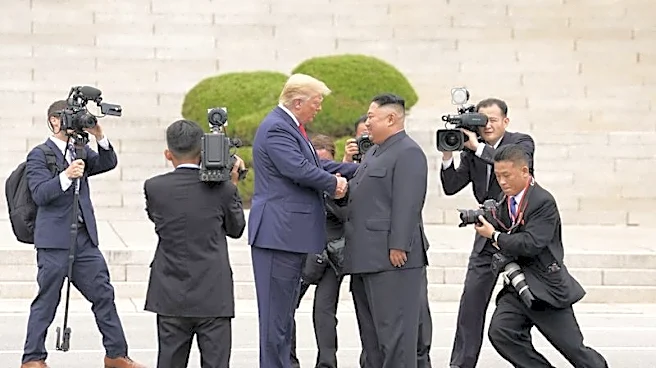
The U.S. and South Korean militaries ended their annual drill six days earlier than initially scheduled Friday in a conciliatory gesture toward North Korea.
Trump had earlier abruptly ordered the Pentagon to “substantially reduce” the Ulchi Freedom Shield exercise just before it began Monday. Trump cited what he described as a good relationship with North Korean leader Kim Jong Un and South Korea’s refusal to support him over the war in Iran.
The end of the drill comes after North Korea said such a step isn’t enough to persuade it to return to talks.
On Thursday, North Korea fired about 10 short-range ballistic missiles toward the sea, apparently following through with its previous threat to respond to the drills that it views as an invasion rehearsal.
In a social media post Friday, the president said his administration will allow more beef to be imported into the U.S. without triggering a higher tariff rate that would otherwise go into effect.
The agreement, Trump said, allows up to 300,000 metric tons of ground beef to be brought into the U.S. for the next 90 days without activating an “out of quota” tariff.
The president said he had a commitment that the beef would be sold at 25% below current market rates, making beef cheaper for American consumers.
Trump did not say who the deal was with or what countries the beef will be imported from. The White House did not immediately respond to a request for more details.
An out-of-quota tariff is a higher tax that goes into effect once a certain quantity of that product enters the U.S.
Trump said the agreement would help rebuild the U.S. beef herd and ultimately help American ranchers. But the American cattle industry has in the past balked at Trump’s plans to import more foreign beef, such as his effort last year to bring in more beef from Argentina.
Trump is scheduled to travel to South Carolina on Friday to make a last-minute appeal for Sen. Darline Graham, his chosen candidate to replace her brother, the late Sen. Lindsey Graham, ahead of a Republican runoff next week.
Voters will decide Tuesday whether Graham or Rep. Ralph Norman will be Republicans’ nominee on the November ballot.
The Myrtle Beach rally is the sort of campaign trail occasion that Trump hasn’t done as much of this year, compared with past midterms, making it a signal of the importance Trump is placing on a win for his pick.
It’s also an opportunity for the president to wade into friendly territory ahead of the midterm elections that leave his party’s control of Congress hanging in the balance. South Carolina hasn’t elected a Democrat statewide in decades, its House delegation has only one Democrat and Trump’s own victory in the 2016 presidential primary here helped propel him toward the nomination and ultimately the White House.
▶ Read more
Justice Department investigators have sought to interview law enforcement officials related to the FBI search of Donald Trump’s Mar-a-Lago estate as part of a Florida-based inquiry aiming to establish a conspiracy against the Republican president, multiple people familiar with the matter said Thursday.
The requests for interviews, made in recent weeks, suggest a conspiracy investigation that had mostly appeared focused on the decade-old question of Russian interference in the 2016 presidential election is also examining a more contemporary event — the 2022 search of Mar-a-Lago that resulted in the FBI seizing top secret documents from the president’s Palm Beach estate.
The requests for voluntary interviews were not made through subpoenas, said the people, who spoke on condition of anonymity to discuss an ongoing investigation with The Associated Press.
It is not clear when or if prosecutors might seek to bring charges, or for what, but investigating conduct that occurred in Florida might give the Justice Department the legal hook it needs to try to anchor a prosecution in the state.
— Eric Tucker and Alanna Durkin Richer
▶ Read more
World shares were mixed Friday after a retreat on Wall Street as a U.S. Treasury Department plan to boost its government debt buybacks appeared to have only limited capacity to calm markets.
The futures for the S&P 500 and the Dow Jones Industrial Average were up 0.3%.
The Treasury Department announced Wednesday that it will at least double the size of its planned purchases of longer-term government debt, while Treasury Secretary Scott Bessent signaled Thursday that the repurchase program could be larger.
The announcement temporarily brought down government bond yields, which have been elevated under concerns about high inflation partly caused by the war in Iran and rising U.S. government debt. Higher yields tend to slow the broader economy because of increased borrowing costs across the financial system and can undercut stock prices.
▶ Read more
Nearing the six-month mark of the Iran war and facing diminishing stockpiles of key weapons, the Trump administration is touting a crushing financial campaign against Tehran, promising an “economic D-Day” against a country that has so far withstood nearly five decades of punishing American sanctions.
With sparse details, President Donald Trump announced this week that the U.S. would be imposing an “unprecedented” level of economic warfare and isolation on Iran, aiming to force its leadership to cave to demands to end its nuclear program and fully reopen the crucial Strait of Hormuz to oil and natural gas tankers.
It reflects the dire reality Trump faces with an increasingly unpopular war he can’t seem to end just months before pivotal midterm elections that will decide whether his Republican Party keeps control of Congress. Whether out of desperation or strategy, the president is refocusing America’s might on bringing Iran to its knees through an accelerated sanctions campaign against one of the most economically penalized countries in the world.
▶ Read more