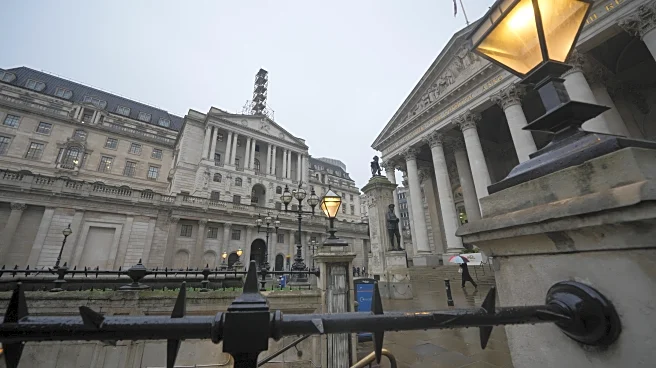




LONDON (AP) — The Bank of England held its main interest rate at 3.75% on Thursday in the wake of the oil and gas price hikes following the start of the Iran war.
The decision was widely anticipated after the United States and Israel started bombing Iran less than three weeks ago. All nine members of the Monetary Policy Committee voted to keep borrowing costs on hold.
Until the war erupted on Feb. 28, it was a seen as nearly certainty that the Bank
of England would cut interest rates as inflation in the U.K. was expected to fall towards the 2% target in the coming months.
“We have held interest rates at 3.75% as we assess how events unfold,” Bank Gov. Andrew Bailey said. "Whatever happens, our job is to make sure inflation gets back to its 2% target.”
The Iran war has done much to upend those predictions as well as the wider global economic forecasts, not least in how it will affect prices.
The longer the Iran war and the associated closure of the Strait of Hormuz go on, the greater the economic pain will be. A fifth of the world’s crude oil goes through the strait.
The most tangible impact has been in oil and gas markets, with prices rising sharply higher since the start of the war. That has already had an impact on prices at the pump and will, if sustained, lead to higher domestic energy bills.
“War in the Middle East has pushed up global energy prices," Bailey said. “You can already see that at the petrol pump and, if it lasts, it will feed into higher household energy bills later in the year.”
With these new inflationary pressures stalking the global economy, central bankers are having to reassess their projections in 2026, both for inflation and growth.
On Wednesday, the U.S. Federal Reserve also held its key interest rate and cautioned about the increasingly uncertain outlook.
For the Bank of England, it's likely to mean that inflation will not fall to its target rate of 2% as soon as expected and will lead to a higher price profile for the rest of the year — hardly the backdrop for further interest rate reductions anytime soon.
Keeping interest rates higher than they otherwise would have been can help keep a lid on inflation. High interest rates weigh on the economy by making it more expensive for businesses and consumers to borrow, thereby bearing down on economic activity and consequently price pressures.