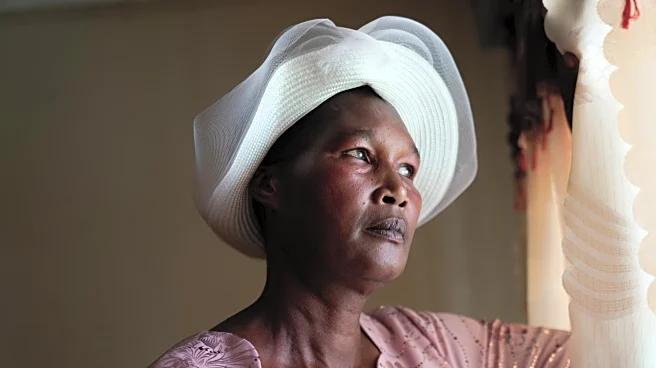




SIAYA, Kenya (AP) — Rebecca Anyango stood outside the house she has called home for 26 years, wondering how long it will remain hers.
As a widow, she’s been threatened with eviction for years by her late husband's family, who claim she has no inheritance rights. This year they filed a lawsuit, and the 70-year-old Anyango has no legal representation.
She pointed out where her husband is buried, a few steps from the door.
“Where do I take the grave?" she
asked softly.
Anyango is among thousands of widows in western Kenya who face losing everything after their husbands die. They are often in rural areas and with little education, unaware of their rights.
In the Luo, Luhya, and Kisii ethnic groups, widowhood can come with certain cultural expectations that can be considered illegal. One is “sexual cleansing,” in which a widow is made to have sex with another man, often a brother of her late husband, in the belief that the “dark cloud” of widowhood will lift.
Another is “wife inheritance,” in which a widow is taken in as a wife by her late husband’s brother.
Those who refuse, like Anyango and others who spoke with The Associated Press, are often isolated and stripped of their land, a violation of Kenya's constitutional guarantee of the right to land ownership for all citizens.
“If the woman is not aware of what protects her, then she will be disinherited,” said Simiyu Waddimba, who teaches anthropology at the University of Nairobi and authored a paper on wife inheritance.
But in November, the local assembly in Siaya County, where Anyango lives, unanimously passed a Widows Protection Bill. If signed by the governor, it will criminalize forced disinheritance or forced remarriage.
The legislation was championed by county legislator Scholastica Madowo, herself a widow and one of four elected women in the 42-member local assembly. She said the “atrocities that the women go through” inspired her to act.
“Those cultural practices are actually a violation of their rights unless the woman does it willingly,” she said.
While Madowo wasn't forcibly disinherited or remarried, she faced opponents' insinuations about her widowhood during her campaign for office, including allegations that she had killed her husband.
Her bill would establish welfare committees to help widows access legal aid to challenge disinheritance.
In neighboring Kisii County, Anne Bonareri was stripped of her home and her commercial property, which had been in her late husband's name.
Within hours of her husband's death in 1997, her in-laws also took his possessions, including photos and clothes. Bonareri was left with three young children and another on the way.
“They took everything, and I was left with one photo of the father,” the 60-year-old recalled, her voice catching.
The day after the burial, she said, her husband’s elder brother came to claim her as a wife. When she refused, armed men were sent to attack her.
Bonareri said she later worked three jobs to buy a small piece of land and build a new house.
Her daughter, Emma Mong’ute, founded the Amandla MEK Foundation in 2019 to help women in such circumstances by offering legal advice and connecting them to pro bono lawyers. She said they have had some success in helping women retain land.
Banned like her mother from their land, and unable to visit her father's grave there, Mong’ute said the disinheritance of widows creates a cycle of poverty for hundreds of thousands of children in Kenya. She said her organization would consider pushing for a bill like the one in Siaya County.
Some widows elsewhere in Africa face similar pressures. In southern Africa, there is tension between general and customary law, which dominates inheritance cases.
“While the general law protects the inheritance rights of surviving spouses and children, customary practices still allow different ethnic groups to administer estates according to their traditions, often to the detriment of widows,” said Misheck Dube, a former associate professor at the University of Limpopo in South Africa who has researched widowhood.
Most widows are disinherited because they don't understand Kenya's land succession laws, which recognize widows and children as the true inheritors, said Easter Okech with the Kenya Female Advisory Organization in Kisumu County.
She now offers legal training for women so they can represent themselves, and some are doing so in ongoing cases. She also encourages people to write wills — many people in rural areas don't make one — and have a neutral executor.
Some widows in western Kenya have fought back on their own.
Marie Owino, a 87-year-old former teacher, said she knew her rights under the law. She said her confidence and financial independence meant her in-laws “didn't dare” to disinherit her after her husband died 33 years ago.
She still lives in the brick house she and her husband shared on their 100 acres, its manicured gardens a symbol of the boundaries she laid down long ago.
“Once you have established yourself that you can, then I’m telling you all those people will give you respect," she said.
___
Associated Press journalist Farai Mutsaka contributed from Harare, Zimbabwe.
___
For more on Africa and development: https://apnews.com/hub/africa-pulse
The Associated Press receives financial support for global health and development coverage in Africa from the Gates Foundation. The AP is solely responsible for all content. Find the AP’s standards for working with philanthropies, a list of supporters and funded coverage areas at AP.org.