







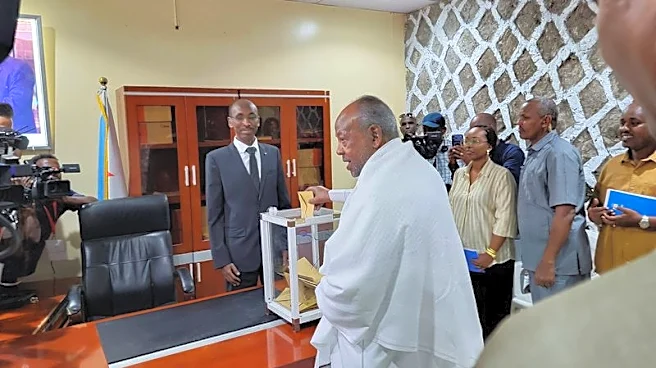
COTONOU, Benin (AP) — Benin Finance Minister Romuald Wadagni won the country's presidential election held Sunday with over 94% of votes, according to election officials, fulfilling the expectation he was the anointed successor after President Patrice Talon's decade in power.
The outcome was based on more than 90% of votes counted with voter turnout of 58.75%, Sacca Lafia, head of the West African country’s independent electoral commission, announced
on national television late Monday.
The final results must be confirmed by Benin's constitutional court and are expected in the coming weeks.
Paul Hounkpè, the sole opposition candidate who received 5.95% of votes, conceded defeat ahead of the announcement Monday.
Wadagni, 49, was considered the chosen heir to Talon, who is stepping down at the end of May after serving in office from 2016 to 2026. Analysts had predicted a sidelined opposition would result in Wadagni’s win.
Talon leaves a mixed legacy of economic growth, a growing jihadi insurgency in the north and the suppression of opposition critics. While Benin has historically been among the most stable democracies in Africa, opposition leaders and human rights organizations have accused Talon of using the justice system as a tool to sideline political opponents.
Amnesty International and Human Rights Watch denounced a sustained crackdown on dissent under Talon, citing arbitrary detentions, tighter restrictions on public demonstrations and mounting pressure on independent media outlets.
In a parliamentary election in January, the opposition failed to cross the threshold of support from 20% of registered voters in each of the country’s voting districts before standing for election, leaving Talon’s two allied parties with control of all 109 seats in the National Assembly.
Renaud Agbodjo, leader of The Democrats, the main opposition party, was barred from competing in Sunday's vote after failing to secure enough parliamentary endorsements, which critics say is a threshold engineered to keep out rivals.