





The final of the Eurovision Song Contest got underway Saturday with tight security and rainy weather failing to dent the enthusiasm of the fans — or that of the critics who think Israel shouldn’t have been invited to the party.
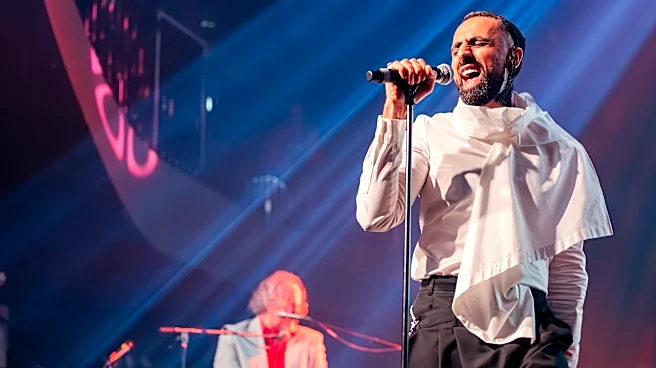
After a week’s buildup, acts from 25 countries took the stage at the Wiener Stadthalle arena in Vienna to battle for the continent’s pop crown. Millions of viewers around the world will cast judgment on a fiery Finnish violinist,
a Moldovan folk rapper, a Serbian metal band and many more at Eurovision’s 70th anniversary event.
The contest has been clouded for a third year by calls for Israel to be excluded over its conflicts in Gaza and elsewhere, with five longtime participants — Spain, the Netherlands, Ireland, Iceland and Slovenia — boycotting in protest.
Here is the latest:
At the start, a filmed opening montage showcased Austria’s majestic scenery as a paper boat made its way to Vienna — a reference to 2025 Eurovision winner JJ’s storm-tossed performance of “Wasted Love.”
The show opened with a performance by last year’s winner, the operatically trained Austrian singer JJ, and an Olympics-style flag parade of the 25 finalists. Then it was on to performances by the musicians, who have just 3 minutes to win over millions of viewers who, along with national juries of music professionals, pick the winner.
The hosts for the extravaganza on Saturday are Michael Ostrowski, an Austrian actor best known for German-language comedy films, and Victoria Swarovski, a model, singer, TV presenter and heir to the Swarovski crystal and luxury goods business.
The head of the Eurovision Song Contest has urged viewers to put politics aside and enjoy the “brilliant, wonderful, heartfelt show” that is the competition’s grand final.
As the contest turns 70 with calls for Israel to be kicked out over the conduct of its war in Gaza and a five-country boycott, Eurovision director Martin Green said the contest is a chance for a few hours to “close the curtains to the outside world and dream that something else is possible.”
He told a news conference that for 70 years Eurovision has given “voice to the voiceless” and celebrated marginalized communities.
“Here’s to the next 70 years,” he said.