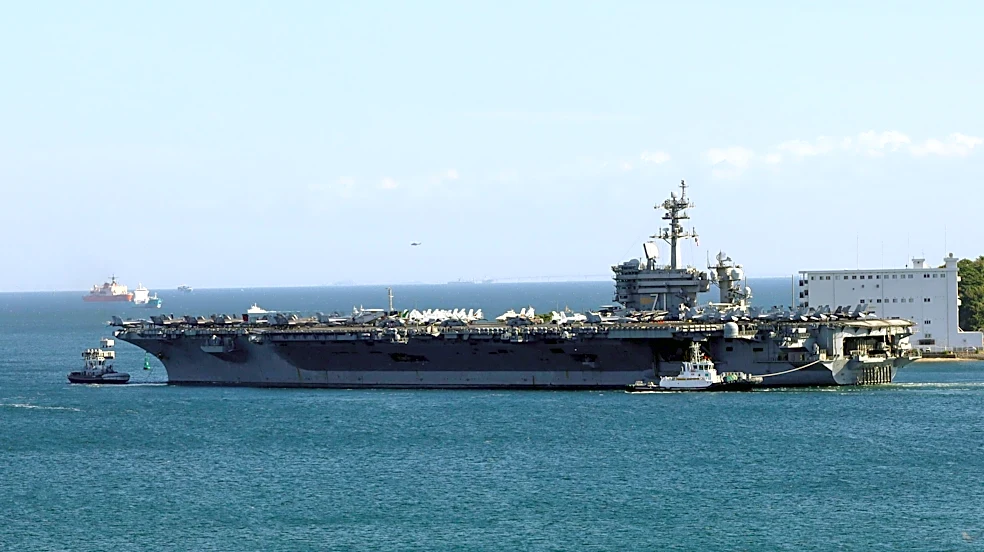








TOKYO (AP) — Japanese and U.S. troops on Monday kicked off one of their largest joint exercises focusing on the defense of Japan's southwestern islands and showcasing advanced weapons systems in the face of growing tension in the region.
About 45,000 Japanese troops and 12,000 American service members are participating in the biennial Keen Sword 27.
Seven other nations from the Indo-Pacific region and Europe are also taking part in some elements of
the exercises, five of them — France, Germany, the Netherlands, New Zealand and the Philippines — for the first time, according to Japan's Joint Staff.
During the exercises, which run through Oct. 29, the Japanese and U.S. militaries will largely focus on defending Japan's southwestern islands and waters around its northern coasts as the country faces growing tension from China, North Korea and Russia.
Japan considers China’s rapidly growing military activities in and around Japan, including in the Pacific Ocean, as a threat and has fortified its southwestern region with longer-range missiles and interceptors in recent years.
The drills include amphibious landing, air and missile defense, mine sweeping, as well as intelligence gathering, logistics and resupply and casualty evacuation on several remote islands, including Tanegashima.
One of the key locations for the exercise is Yonaguni, Japan’s westernmost island just 110 kilometers (68 miles) east of Taiwan, a self-governing island that Beijing calls its own territory.
Japan's Self-Defense Force has introduced its first long-range Type-25 land-to-ship missile to Yonaguni during the drill, though no test-firing is planned. The missile has a range of about 1,000 kilometers (620 miles) and is capable of reaching mainland China.
NMESIS, a U.S. ground-based offensive anti-ship missile system, and MADIS, a short-range surface-to-air system, are also deployed to Yonaguni for the first time for the exercise. A mobile rocket launching system, HIMARS, has been deployed on the nearby island of Ishigaki.
Gen. Hiroaki Uchikura, Chief of Staff of the Joint Staff, denied that the exercises target a specific country.
At an opening ceremony on Ishigaki, Japan's Maritime Self-Defense Force Adm. Tateki Tawara said that what they are trying to defend is not just the territory but the peaceful lives of the people, according to Japan's Joint Staff. “In order to do so, it is essential to be fully prepared and cooperate with our allies and partners to prevent the crisis."
On Monday, Japanese and U.S. troops were to conduct live fire exercises at a firing range on Oki-Daito, a small uninhabited island in the Pacific Ocean about 500 kilometers (310 miles) southeast of Okinawa.
Japan's ties with China came under strain following Prime Minister Sanae Takaichi’s comment a year ago, when she said Chinese military action on Taiwan could justify Japanese involvement. Her remarks angered China and led to tensions that have spilled over into the economy.
Japan has also raised concern over China's gradual escalation of its military activity around remote Japanese islands in the Pacific Ocean.
This year's exercises come at a sensitive time, just weeks after the arrest of a U.S. Marine in connection with the murder and robbery of a Japanese woman on Okinawa, where thousands of U.S. troops are stationed.
The case has renewed anti-U.S. base sentiment on Okinawa, where residents have long complained about noise, pollution and crime related to U.S. bases. The majority of about 50,000 American troops in Japan under the bilateral security pact are on the small but strategically important southern island.
When the aircraft carrier USS Theodore Roosevelt briefly entered the U.S. Navy base in Yokosuka last week before joining the exercise, local mayor Katsuaki Kamiji requested Japan's Foreign Ministry to convey to the U.S. military the importance of crew members complying with Japanese rules.