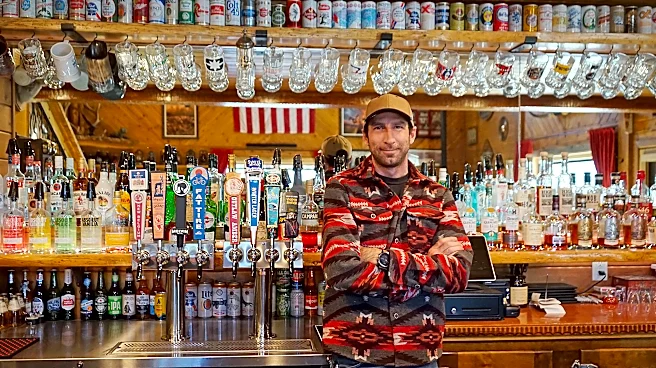




The barstools were all occupied in the Rock Shop Inn Saloon as area locals traded news under the gleam of bottles. Others gathered with beers near the warmth of an antique pot-bellied stove. A man came in with a dozen eggs to deliver to a friend and a silky black puppy even made an appearance — eliciting much oohing and ahhing. The front door chime tinkled as another party entered, and the house was nearly full.
This Saturday night scene in February
played out like so many weekend watering hole tableaus. Except this watering hole sits amid rock outcroppings and wind-warped pines at around 7,000 feet elevation. Tucked alongside the banks of Willow Creek in a crease in the landscape, it’s easy for vehicles flying by on Highway 28 to miss the Rock Shop Inn.
Despite the unlikely locale, the establishment that began as a humble one-room gem store grew into a popular local spot for beer and live music in the ’70s and ’80s. It expanded with a restaurant that served breakfast and burgers to many hunters, snowmobilers and passersby, and outdoor lovers could camp on the property, offering close proximity to trails, creeks and bouldering crags of the southern Wind River Range.
In recent decades, however, the restaurant shuttered, and subsequent private owners closed the 5-acre property to the public.
These days, the Rock Shop is again drawing guests and building up local patronage thanks to Anthony Prate, who has worked with his father since 2019 on a multi-year makeover to produce a well-appointed saloon complete with antique furniture, custom art and a restored player piano. Prate has also overseen the renovation of all five guest cabins into downright luxurious lodgings. Guests and locals can use the property to access cross-country ski trails, snowmobile tracks and hiking paths.
Now, he’s working on bringing back one element that old-timers seem most keen on — the restaurant.
Even without the food service, the Rock Shop is becoming an increasingly popular spot to stop in for a beer, spend a weekend or hold an event like a wedding. Year-round residents of South Pass or Atlantic City are happy to see it come back to life, they say.
John Mionczynski is an ethnobotanist and naturalist from Atlantic City who played shows at the Rock Shop decades ago with his former band, The Buffalo Chips. With the saloon back open, he now makes regular appearances to catch up with friends, and often ends up performing spontaneous piano concerts.
Prate has managed to find the ineffable balance between tasteful decor and an unpretentious spirit, Mionczynski said — tapping into some of that same magic it held in the old days.
“It’s beautiful,” Mionczynski said. “I think it’s going in a really good direction to be a permanent sort of hangout for the locals. But also being on one of the highways to Yellowstone, once he gets a restaurant in there, I can almost guarantee it’s going to be a popular place.”
Growing up in Illinois, Prate learned construction skills at a young age from his father, who owns a roofing company. After high school, Prate joined the U.S. Marine Corps, where he served five years in a reconnaissance unit.
As he was transitioning out of the service around 2019, Prate said he figured he would eventually take over the roofing company. But his father, Michael, had another future in mind. He asked his son to take a road trip out west, where the elder Prate had discovered a property he thought had potential as a family enterprise.
It was dark when father and son arrived at the Rock Shop, and Anthony Prate said they nearly drove past it. Upon further inspection the following day, he could see it was a little beat up, he said. “But I saw the potential immediately.”
They stayed for a few days to tour and explore the property. As they did, Prate’s father outlined a vision for reviving the business, he said.
“He knew that I was kind of an outdoors guy, and I grew up roofing with him and was good at it,” he said. “I think in his heart, he knew I’d been happy out here. So he kind of offered this opportunity for me, like, ‘Hey, you want to make a go at this family legacy?’”
Before that trip, Anthony Prate had never been to Wyoming. He was taken with the state’s big landscape and small towns, as well as the notion of reenergizing the Rock Shop.
The Prates purchased the property from the former owners, who had used it as a private hunting lodge. They returned to Illinois, where Anthony packed up his life and prepared to move to the mountains.
“The property needed loving and attention to make it presentable as well as safe for the public,” Prate said. “So that was my first priority, along with cabin remodels.”
Once he cleaned up the land, Prate removed “no trespassing” signs and took down gates that had closed it to the public. He started on the cabins, figuring that by having rentable units, he could start generating income, and began pouring work into the saloon. Though he did most of the initial work alone, his dad visited frequently to deliver pieces from his extensive antique collection or help with projects.
Meantime, Prate said, he knew he had to get the word out. He started patronizing the two restaurants in Atlantic City, where he slowly got to know the regulars.
“A lot of it was just working on reversing the reputation that this place had, trying to tell people that, ‘Hey, we’re bringing this back to the public,’” he said.
In that endeavor, Prate had to win over local denizens, a hardy and self-reliant bunch who opt for starry skies, piles of snow and rugged country over city amenities like big box stores and restaurant delivery. If somebody comes in making big promises, said Atlantic City resident Bob Townsend, he or she faces a healthy level of skepticism.
But when Prate invited him to come see the progress on the cabins, Townsend agreed. “I went over and he had gotten one of the cabins finished, and the others were in various stages of renovation,” Townsend recalled. “And when he took me into the one that was finished, I looked at him and said, ’You’re gonna out-Jackson-Hole Jackson Hole.”
Except without the Jackson Hole prices, Prate told him. “And I think he has achieved that,” Townsend said.
The cabin decor is a mix of warm wood, custom furniture heavy on logwork and shed antlers, western artworks and antiques like old skis or lanterns set just so. Kitchens are fully stocked, bathrooms are modern and features like locally made ceramics in the cabinets illustrate carefully considered details.
That vibe carries into the saloon, with its intricate wood stove, cloudscape-dominated artworks by Mark Maggiori and hulking log-cabin-style pool table. The interior was previously unfinished wood, and Prate and his crews sanded it until the floor resembled a desert and the walls gleamed. A copper installation on the bathroom hallway depicts the Wind River Range. A local welder provided metal latticework for bannister accents. A bear trap is inlaid under thick glass in the entry. Prate even installed his German uncle’s historic beer can collection on a small shelf above the bar.
Upstairs, antique upholstered furniture, card tables and the piano lend more of a decorous atmosphere.
The understated quality, warm colors and lack of televisions are all purposeful, Prate said. The point is to welcome all to a space where they can engage with one another.
“We cater to everybody,” he said. “I don’t care if you are a muddy, bloody hunter coming out of the field, or you are a New Yorker coming for a mountain stay in our cabins.”
As an avid patron of bars himself, Prate said there is a certain quality that a good watering hole has, whether it’s a rough-around-the-edge dive or upscale destination. That’s what he’s trying to create.
The lodgings are dog-friendly, and Prate offers discounts to veterans and other public service workers.
Being proprietor of a far-flung outpost known to get snowed in during notorious blizzards is not for everyone. Prate seems suited for it. He enjoys lonely spells behind the bar with a book equally as much as tending a full bar of garrulous customers, he said. He is detail-oriented and enjoys finding just the right spot for just the right knickknack or artwork.
“It’s the little things,” he said.
Prate has high standards without being stuffy, Townsend said. He is not one to rent out a cabin or open his saloon until it’s up to his exacting standards. Because of that, it might be some time yet before the restaurant opens, Townsend said, but “I have every confidence that it is going to be the most beautiful restaurant in the state of Wyoming.”
Though construction is underway on the kitchen and dining room, the closest Prate would get to committing to an opening date was to say, “soon.” It’s the same answer he’s been telling people for years, he says with a chuckle.
The intention he and his father agreed on at the outset, after all, was to create something lasting and meaningful.
“We’re not just going to turn and burn this place,” Prate said. “This is going to be our legacy forevermore. This is very much a labor of love.”
___
This story was originally published by WyoFile and distributed through a partnership with The Associated Press.