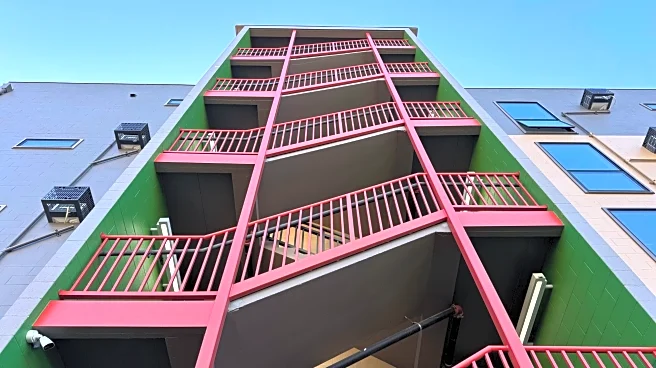

At a blessing to celebrate the opening of city-subsidized affordable housing, Mayor Rick Blangiardi stood behind a podium bedecked in lei to talk about the value of adding 29 new rental units to the city’s
urban core.
“This is exactly what we know we need to create,” he said last April in Makiki. “It is absolutely on the money, at the right time, incredibly needed.”
PenseMetro, at the corner of Pensacola Street and Lunalilo Street, was among the first to start construction under Honolulu’s Bill 7 program, which offers developers incentives to build a new generation of low-rise rental apartments.
Almost 10 months after the mayor’s speech, nobody has moved into the building as it awaits final permitting sign-off. Some nights, homeless people sleep in its ground-floor parking area.
“It is incredibly frustrating,” Makiki Neighborhood Board chair Nathaniel Char said. “We had the blessing April of last year … and it’s sitting empty.”
Now the program behind PenseMetro itself is under scrutiny, with some council members proposing essentially gutting the program while others advocate for increasing subsidies.
Bill 7 relaxed zoning standards for low-rise rentals in areas of Oʻahu set aside for apartments and mixed-use development, as long as at least 80% of units were reserved for people making no more than the area’s median income. For a person living alone, that’s about $106,000.
To sweeten the deal, the program also exempts for 15 years the buildings from property taxes and things such as wastewater system charges and building permit fees. In addition, the City Council recently started offering developers grants of up to $50,000 per unit before construction and up to $12,000 per unit after construction.
Six projects have been completed and received certificates of occupancy since the program started in 2019, according to Department of Planning and Permitting spokesperson Davis Pitner, adding 189 units to Oʻahu’s housing stock. Another 16 projects are under construction and 41 are under review.
The program would be gutted by a bill introduced last month by council members Esther Kiaʻāina and Scott Nishimoto in response to constituents pushing back against the projects because they don’t align with local building height limits and bring more activity into their neighborhoods.
Under that proposal, fee exemptions would be halted, maximum building height would follow the underlying zoning and the program’s repeal date — which a few years ago was extended to 2030 — would be shortened to 2027.
The goal of Bill 7 was to temporarily “accelerate the construction of affordable rental housing,” Kiaʻāina and Nishimoto’s proposal says, and the “extended repeal date may exceed the period of time needed to accomplish that goal.”
Developers, housing advocates, the Hawaiʻi Government Employees Association, AARP Hawaiʻi and over a dozen others testified against those changes during a tense council meeting in January, saying it would slow housing production at a time when the island is projected to be short about 25,000 housing units by next year.
Even U.S. Sen. Brian Schatz, who usually stays out of local legislation, weighed in to oppose it.
“Oʻahu residents face an acute and worsening housing crisis, and people need all the help they can get from their government,” Schatz said in written testimony. “That’s why I’m writing to express my deep concern regarding bills which would make it harder to build housing and make our existing housing crisis worse.”
Council members Matt Weyer and Tyler Dos Santos-Tam voted against the bill during its first round of voting, an exceptionally rare move at the council.
“I have to vote against moving it forward,” Weyer said during the meeting, “because ending the program next year puts a lot of projects on the line.”
Kiaʻāina is not fixated on revising the program’s repeal date, she told Civil Beat after the vote. Her main concern is that affordable rental projects are allowed to be up to 60 feet tall, which her Kailua constituents oppose because that’s taller than the underlying zoning. She also questions the value of increasing subsidies to developers, which Weyer and council member Val Okimoto proposed in a different bill last month.
A larger omnibus bill to revamp the affordable rental housing construction program is coming soon, council member Andria Tupola said during the meeting. It will incorporate feedback from lots of concerned parties, she said at the January meeting, adding, “I’m going to be very clear that my stance is not to kill Bill 7 projects or to end the program.”
None of the changes now on the table would be likely to address the reasons behind PenseMetro’s delays.
It began with construction, which started in 2021 and took about four years to finish — much longer than the nine months it took to construct a similarly sized Bill 7 project around the corner on Ernest Street.
Today’s empty building is the culmination of many surprises, said Don Huang, who developed the project as principal of Collaborative Seven Companies in partnership with ADW Hawaii.
He mentioned a few examples: power lines had to be moved because they hung too close to the outside stairwell; a transformer for the building’s electricity took a long time to order; a smoke curtain for the elevator wasn’t put in and had to be ordered and installed before the elevator inspection, which in turn took a long time to schedule because of vacancies at the state’s Boiler and Elevator Inspection Branch.
“It just got delayed,” Huang said. “I can’t point fingers at anybody right now.”
Even with all of his own project’s woes, he considers Bill 7 a successful program since it incentivizes small- and medium-sized developers like him to build housing.
Char, the neighborhood board chair, said he appreciates how quickly housing has been built under the program — PenseMetro notwithstanding — but he questions whether it results in truly affordable housing.
For instance, the monthly rent for a studio at PenseMetro was projected to be around $1,400 as of late 2022, Huang told Hawaii News Now at the time. Now, taking into account inflation and construction challenges, the projected rent has gone up to $1,900.
“I’m not going to defend myself on that,” Huang said. “It is the price.”
PenseMetro awaits the final building inspections before receiving its certificate of occupancy, which Huang expects will come in the next week or two. He said residents should be able to move in very soon after that.
___
Civil Beat’s reporting on economic inequality is supported by the Hawaiʻi Community Foundation as part of its work to build equity for all through the CHANGE Framework; and by the Cooke Foundation.
___
This story was originally published by Honolulu Civil Beat and distributed through a partnership with The Asds