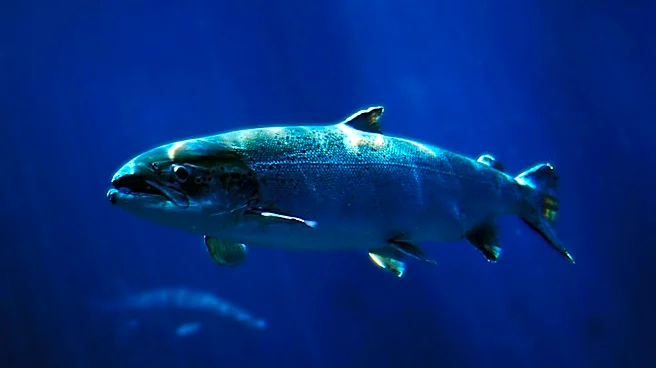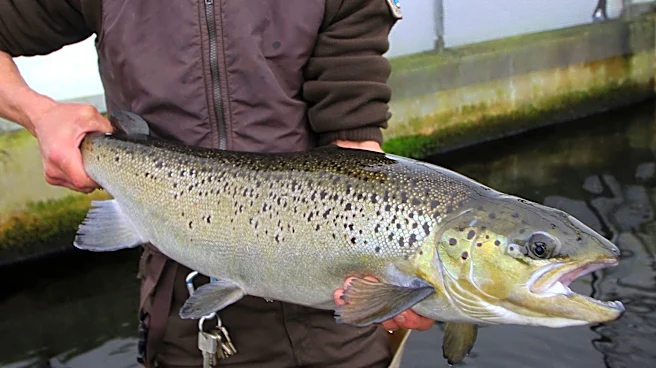





On a recent canoe trip to the remote upper reaches of the Narraguagus River, Ellie Mason saw prime Atlantic salmon habitat everywhere.
Though small, the river and its tributaries are some of the wildest in Maine, largely undeveloped and surrounded by forest. There are shady refuges for fish on hot summer days, and the rocky river bottom offers plenty of nesting spots for eggs.
But the salmon are missing.
The Gulf of Maine’s Atlantic salmon are listed
as endangered under the federal Endangered Species Act. In recent decades, only about 25 wild adult salmon have returned to the Narraguagus each year to spawn.
The main stem of the river runs about 40 miles from its source in the downeast lakes to its head-of-tide in Cherryfield, where an ice-control dam that stood for more than 60 years has just come down. It’s being replaced with a “nature-like” set of stair-stepping pools that will still slow down the ice jams that used to flood Cherryfield, but shouldn’t slow down salmon, river herring, shad and other migrating fish. Construction began in June and is set to wrap up by November.
Mason, a 29-year-old habitat restoration project manager at the Downeast Salmon Federation, is running the show day to day. She fields calls from government agencies about permits one minute and answers questions from engineers the next.
Although Mason grew up nearby on Mount Desert Island, she had never seen an adult salmon until last year.
“The thing about growing up here is there are no salmon,” she said. “I think there’s really little understanding of what a river of this scale actually historically held.”
Scientists estimate that in centuries past, before their decline — caused largely by dams and log driving on rivers — hundreds of thousands of salmon would return to Maine’s waters each spring to spawn. These days, only about 1,000 come back to the state from the sea each year.
Mason and other young conservationists are the latest of multiple generations of people in Maine and Canada who have pitched in to help these fish. Some have dedicated their whole lives to the cause, including many in downeast Maine.
“This fish gets under your skin,” said Christopher Federico, the executive director of a regional coalition of landowners and conservationists called Project SHARE, which stands for Salmon Habitat and River Enhancement.
The group has been working for more than two decades to improve habitat on the Narraguagus River. As a result, the Cherryfield dam was the only remaining barrier for sea-run fish on the main stem of the Narraguagus.
The rest of the river is ready and waiting. But there’s no guarantee Atlantic salmon will come back. Other challenges remain.
These endangered fish have been dying in large numbers at sea. Researchers have different theories, but many of them fall “under the broad brush of climate change,” said Rory Saunders, a fisheries biologist with the National Oceanic and Atmospheric Administration.
Maine’s remaining salmon population has also become dependent on hatcheries, which produce eggs and juveniles that humans then stock in rivers to prop up the wild population. While the hatchery system has helped keep Atlantic salmon from extinction, it hasn’t succeeded in growing their numbers, according to Saunders’ NOAA colleague James Hawkes, who recently co-authored a study on the salmon in the Narraguagus.
In order for Atlantic salmon to be reclassified from endangered to threatened, Maine would need to see at least 1,500 wild adult salmon returning to its rivers each year for multiple years, among other criteria. In order to be delisted entirely, at least 6,000 wild adults would need to return annually, spread over different watersheds from the Androscoggin up to the Dennys; their offspring would need enough suitable habitat; and the population would need to be growing.
Whether Atlantic salmon and the people who care about them will reach those goals remains an open question.
Before the salmon were officially listed as endangered in 1999, the people and companies who own much of the land Downeast — working forests and blueberry barrens — saw the writing on the wall. They wanted to avoid repeating what Federico described as a debacle between the timber industry, conservationists and the federal government that followed the listing of the spotted owl in the Pacific Northwest.
So a group of these landowners — including regional giants American Forest Management and Wyman’s — formed Project SHARE. They got involved in the conversation about how to help Atlantic salmon, and eventually they got involved in the work.
In the early 2000s, the group identified 61 culverts on the Narraguagus River that were blocking the passage of fish and began replacing them one by one. They also began working with the state to “chop and drop” large trees into the river, aiming to make the river narrower, deeper and cooler once again.
Ernie Atkinson, a fisheries biologist with the Maine Department of Marine Resources, said his agency is “in the connectivity business.” Clearing the way for salmon and other sea-run fish to move freely up rivers is the first priority. After that, the goal is to rehabilitate the habitats the fish will find along the way.
While people can’t restore the river back to wilderness, they can rehabilitate it so it functions as a healthy coldwater habitat again, Atkinson said.
The U.S. Army Corps of Engineers built the main barrier on the Narraguagus, the Cherryfield dam, in 1961 to hold back ice jams that used to flood the town.
The dam had a fish ladder on one side, which alewives navigated relatively well. Some salmon passed through, but fisheries officials often saw adult salmon schooling on the side without the ladder, unable to find their way. Shad are even more sensitive, and few got through.
The dam held back the ice for decades, but inspections over the years revealed it was aging.
“Something had to be done,” said Cherryfield selectman Corey Smith.
But the town couldn’t afford to fix it. That’s when a group of conservation organizations — the Maine Coast Heritage Trust, the Downeast Salmon Federation, the Atlantic Salmon Federation and The Nature Conservancy — approached the select board with a proposal. They had been kicking around the idea of replacing the dam with a nature-like fishway and were now in talks with the federal government about potential funding.
First, Cherryfield would need to take over the dam from the Army Corps — requiring a town vote and then an act of Congress. At a special meeting in 2023, residents voted to take over and then take down the dam.
“It was unanimous. Nobody voted against it,” Smith said.
Shortly afterward, Congress voted to de-authorize the dam. The project received $9.1 million from NOAA’s Restoration Center as part of the Bipartisan Infrastructure Law, and work got underway.
The new fishway will maintain the former dam’s ice and flood control functions, which was the town’s top concern. The project is also revamping a park next to the dam that was barely used before, adding bathrooms, an amphitheater, electricity and even a floating dock requested by local children.
Scientists will try to measure the project’s success by using shad as a proxy for salmon and other sea-run fish. Shad are present in greater numbers than salmon but are also more sensitive to barriers in rivers. They are collecting samples of water above and below the dam site and sending them to the University of Maine in Orono to test for the presence of shad DNA.
Researchers took baseline samples this spring before the dam was removed and found there was indeed more shad DNA below the Cherryfield dam than above. They will repeat the process next summer, and hope to see similar concentrations of shad DNA below and above the new fishway.
“This has been the major impediment for so many of these species,” said Catherine Morse, a habitat restoration project manager and Mason’s counterpart at the Atlantic Salmon Federation. “We’re really intrigued to see what we can do here.”
Maine is at the southern edge of Atlantic salmon’s range, and the Narraguagus is warmer than other rivers in that range.
Atlantic salmon begin to get stressed above 68 degrees Fahrenheit — a temperature the Narragagus easily reaches during the summer. And those summers are only getting warmer and longer, said Valérie Ouellet, vice president of research and environment at the Atlantic Salmon Federation.
To find out where the Narraguagus is warmest and coolest, two summers ago Ouellet and other scientists flew a helicopter over the river with an infrared camera, mapping the temperature variations. They are still analyzing the data but confirmed that the Narraguagus runs warm on most of its main stem.
“But it’s not necessarily all gloom and doom,” Ouellet said.
She also saw that the river had colder tributaries, where there are known to be salmon, and said the Cherryfield dam replacement should give more fish better access to those colder spots.
The future survival of Atlantic salmon depends on how much the climate changes, and how fast. There’s some potential for the species to adapt to a warmer world, according to Ouellet. For that to happen, the population needs to be large enough that there’s genetic diversity, including fish with traits that might help them tolerate heat better or swim longer distances to find cooler habitat.
By improving their habitat, conservationists are buying some time. But making sure there’s enough diversity in the population to adapt also requires playing a numbers game.
“All these restoration activities are fantastic. But we need fish, right?” said Hawkes, the NOAA biologist.
Right now, those fish are coming largely from human-run hatcheries rather than from wild parents.
The federal government operates two Atlantic salmon hatcheries in Maine, and the Downeast Salmon Federation has two more. These facilities hatch salmon in captivity, producing large numbers of eggs and young fish that can be released into rivers. If these salmon are released young enough, they are more likely to survive and are still considered part of the wild population for the purposes of the endangered species recovery plan.
State and federal officials stock the Narraguagus with hundreds of thousands of freshly hatched salmon juveniles each year. Scientists estimate that an average of about 1,700 survive to become smolts, the life stage when salmon leave the river and migrate out to sea. Of those, just a couple dozen at best come back as adults — less than 1 percent.
For now, the hatcheries are a life support system.
“If we decide to close that valve, extinction would be a pretty real possibility,” Hawkes said.
The federal government’s official Atlantic salmon recovery plan, updated in 2019, provided what it described as an “unavoidably speculative” estimate that the Gulf of Maine population’s recovery could take 75 years — 15 generations of salmon — and cost more than $800 million.
Ouellet emphasized that this money would also improve the overall biodiversity of the watersheds where Atlantic salmon live.
There’s a growing understanding among scientists that salmon evolved alongside the other species in their ecosystems, according to Saunders from NOAA, such as the rainbow smelt that salmon eat or the schools of river herring that provide cover from predators.
“Salmon are the endangered ones. They’re sort of the poster child,” he said. He added, “It’s becoming more and more obvious that we’re not going to get to salmon recovery with just salmon in the rivers.”
The same is true in the ocean, which is still “kind of a black box” for salmon scientists, and an area where more and more research is being done, said Morse from the Atlantic Salmon Federation. One theory for why so many salmon are dying at sea is that plankton and other marine food sources may be declining.
“If all their food disappears because of warming waters, there really isn’t a human intervention that could fix that,” Morse said — unless people can stop, and then reverse, the course of climate change.
The daunting task of saving Maine’s salmon has been and will continue to be a multi-generational project.
Atkinson from the Maine Department of Marine Resources has studied salmon on the Narraguagus since 1993, when he was an intern at a now-defunct state agency called the Maine Atlantic Salmon Commission. He doubts the fish will make a comeback during his remaining career.
But his protégé, Federico of Project SHARE, who began working with salmon as an intern under Atkinson, promises to keep trying.
“My intention is to keep working here until we throw our hands up and say we can’t do any more,” Federico said. “Or until we actually make a difference.”
The effort requires the involvement of not just scientists but also entire communities such as Cherryfield.
Jacob van de Sande, associate director of land protection at the Maine Coast Heritage Trust, has been a bridge between conservationists and the community. He moved to Cherryfield in 1995 to study Atlantic salmon, tending a trap at the top of the dam’s fish ladder. It was the end of an era.
At the time, people in town still caught salmon. A dedicated rack for fly rods stood at Cable Pool Park, where construction is happening today, and van de Sande used to see up to 20 anglers taking turns fishing. The town had become a destination for sport angling after World War II, even boasting three motels where anglers would stay.
“Salmon were the king of sport fish, so there was a real draw,” van de Sande said. And it wasn’t just tourists who were drawn in. “The local community really took their salmon fishing very seriously.”
On the Fourth of July, locals caught and grilled salmon, and ate it with fresh peas from their gardens.
All this ended just two years after van de Sande came to Cherryfield.
At 37, selectman Smith just missed his town’s craze for Atlantic salmon before the recreational fishery closed. He’d love to see the population rebound to the point where recreational fishing could happen again, he said, bringing with it an economic boon for Cherryfield.
“I might not see it in my lifetime,” Smith said, “but maybe my kids will.”
___
This story was originally published by The Maine Monitor and distributed through a partnership with The Associated Press.