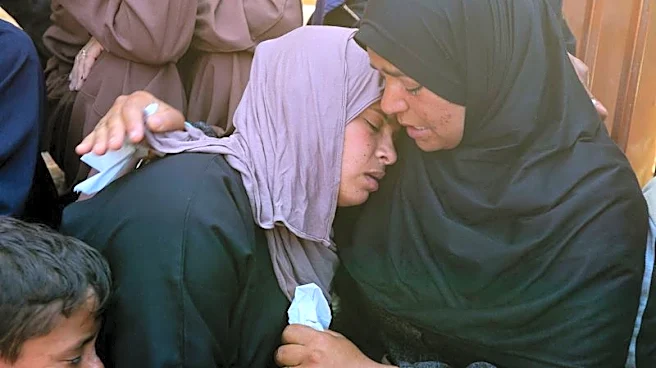








RAMALLAH, West Bank (AP) — Mourners carried the body of a teenager killed by Israel’s military through the hills of the West Bank ’s largest city on Thursday, the latest victim in a surge of violence this month.
Ibrahim Al-Khayyat died after being shot and wounded in his chest and abdomen in Hebron, according to the Ramallah-based Palestinian Ministry of Health and the Palestinian Red Crescent Society. Relatives told The Associated Press he was heading
to a minimarket when he was shot on Wednesday.
Israel’s military said soldiers had fired on Palestinians during an operation in Hebron after Palestinians hurled rocks toward them.
Mumtaz Shabaneh, al-Khayyat’s schoolteacher, said the killing reflected a wider pattern of violence against Palestinians in Gaza and the West Bank, describing it as an attempt “to break our will and undermine our perseverance to remain steadfast on this land.”
Al-Khayyat was the second Palestinian to be killed on Wednesday. The Palestinian Health Ministry said Abdulhalim Hamad died during an Israeli raid in Silwad, northeast of Ramallah. WAFA, the official Palestinian news agency, reported Hammad, 37, was killed at home by Israeli soldiers.
The two deaths add to the more than 40 Palestinians to have been killed by Israeli settlers and soldiers in the occupied West Bank so far this year, according to the U.N. Office for the Coordination of Humanitarian Affairs. Teenagers have borne a large share of the violence, with three killed last week.
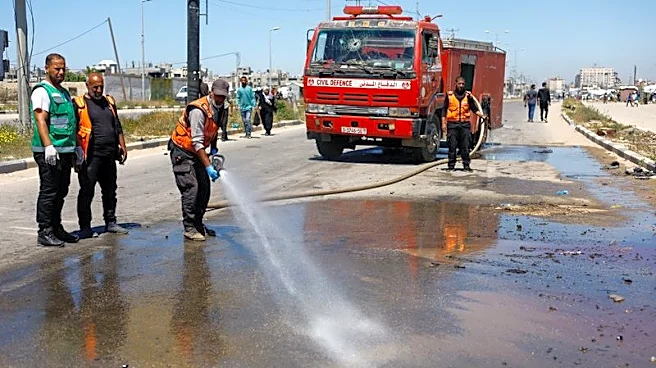
A drone strike hit Gaza City, killing three people, according to health officials at Shifa Hospital, which received the bodies. The Israeli military did not immediately respond to a request for comment about the strike.
While large-scale fighting across the enclave has eased since a shaky ceasefire between Israel and Hamas in October, Israel has carried out near-daily strikes across Gaza, where more than 820 Palestinians have been killed, according to figures from Gaza Health Ministry. Part of the Hamas-led government, the ministry maintains casualty records that are seen as generally reliable by U.N. agencies and independent experts. But it does not give a breakdown of civilians and militants.
___
Associated Press writers Toqa Ezzidin in Cairo and Koral Saeed in Abu Snan, Israel, contributed to this report.