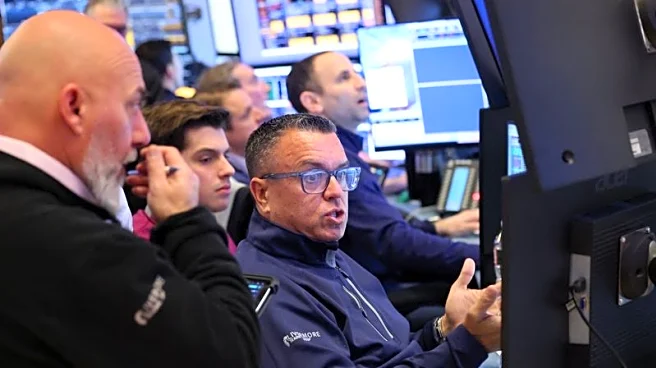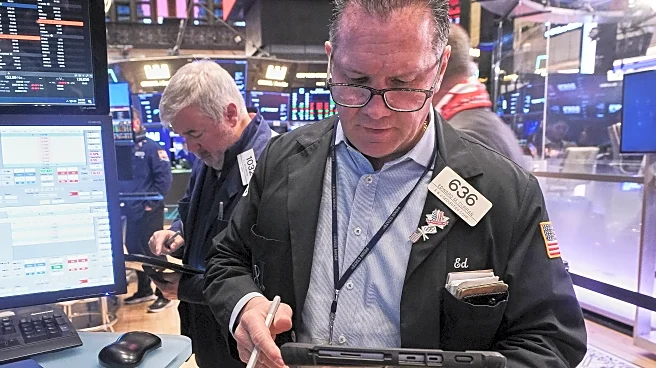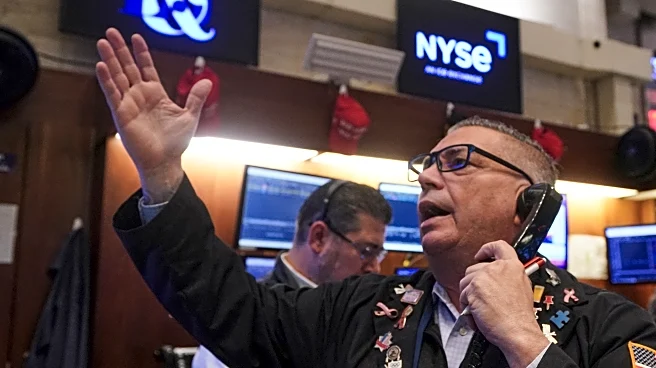

NEW YORK (AP) — U.S. stocks are rising on Thursday following an encouraging report on inflation that could help the Federal Reserve keep cutting interest rates next year. A strong profit report from Micron
Technology also helped AI stocks halt their sharp slides, at least for now.
The S&P 500 rallied 1%, coming off its fourth straight loss. The Dow Jones Industrial Average was up 352 points, or 0.7%, as of 9:35 a.m. Eastern time, and the strength for tech stocks had the Nasdaq composite up a market-leading 1.4%.
Some relief came from a report showing that inflation was less bad last month than economists expected. That could soothe some nerves at the Fed, which is responsible for keeping inflation low and for keeping the job market strong.
Inflation is of course still higher than anyone would like, at 2.7% last month, but if it creeps closer to the Fed’s target of 2%, Fed officials could feel more free to cut interest rates to help a slowing job market. Wall Street loves lower interest rates because they can boost the economy and prices for investments, even if they may also worsen inflation.
To be sure, some along Wall Street said Thursday’s inflation update may not move the needle much given how noisy economic reports have been following the U.S. government’s earlier shutdown. Next month’s update on inflation could be a better gauge of what’s actually happening. But a better-than-expected report on inflation is nevertheless better than the alternative.
Also helping to prop up the U.S. stock market was Micron, the seller of memory and storage for computers, which climbed 15.9% after reporting stronger profit and revenue for the latest quarter than analysts expected. CEO Sanjay Mehrotra said each of the company’s business units enjoyed stronger revenue and made more in profit off each $1 of that revenue.
Micron also gave encouraging forecasts for upcoming financial results, and Mehrotra credited its position as an “AI enabler,” among other things.
Billions of dollars are flowing into artificial-intelligence technology, which helped superstar stocks like Nvidia lead the market for years.
But questions have been rising about whether those stock prices shot too high and whether companies are spending so much on AI that they won’t get a good-enough return on their investment through bigger profits and productivity. Worries are also weighing on companies that are borrowing lots of money to pay for their investments.
Oracle and Broadcom have been at the center of such worries, and their stock prices have been falling sharply since last week even though both reported better profits for the latest quarter than analysts expected. But on Thursday, Broadcom added 1.4%, and Oracle rose 2.8%.
Nvidia, the chip company that’s become Wall Street’s most influential because of its immense size, added 1.4%.
Another winner as Trump Media & Technology Group, which jumped 23% to carve into some of its steep loss for the year so far, which came into the day at 69.3%. The company, which began with President Donald Trump’s Truth Social platform and then moved into cryptocurrencies, is now moving into nuclear power.
It’s merging with TAE Technologies in an all-stock deal, where no cash will trade hands, and each company will own half of the combined business. The companies said the deal would pair TMTG’s ability to raise money by attracting investors with TAE’s technology. They hope to get TAE’s nuclear reactors running commercially.
Cintas rose 3.1% after the provider of work uniforms and cleaning supplies reported stronger profit for the latest quarter than analysts expected, while also announcing a program to send up to $1 billion to shareholders by buying back its own stock.
In stock markets abroad, indexes were flat in London, while rising 0.3% in France and 0.4% in Germany. The reactions were relatively muted after the Bank of England cut its key interest rate and the European Central Bank kept its steady.
Asian indexes were mixed, with stocks falling 1.5% in South Korea but adding 0.2% in Shanghai.
In the bond market, Treasury yields sank following the encouraging report on U.S. inflation.
The yield on the 10-year Treasury fell to 4.11% from 4.16% late Wednesday.
___
AP Business Writers Matt Ott and Elaine Kurtenbach contributed.