


WASHINGTON (AP) — Secretary of State Marco Rubio is in France to meet his Group of Seven counterparts Friday after President Donald Trump attacked NATO countries over a reluctance or refusal to take part in the Iran war, a conflict that some of America’s closest allies have met with deep skepticism.
Rubio will have a hard time trying to sell the other top diplomats from G7 countries on the U.S. strategy for the Iran conflict, to which almost all nations
have raised objections. Trump’s vitriolic comments about NATO during a Cabinet meeting Thursday will make it an even tougher task. Of the G7 nations — besides the U.S. — Britain, Canada, France, Germany and Italy are members of the transatlantic military alliance. Japan is the only one that is not.
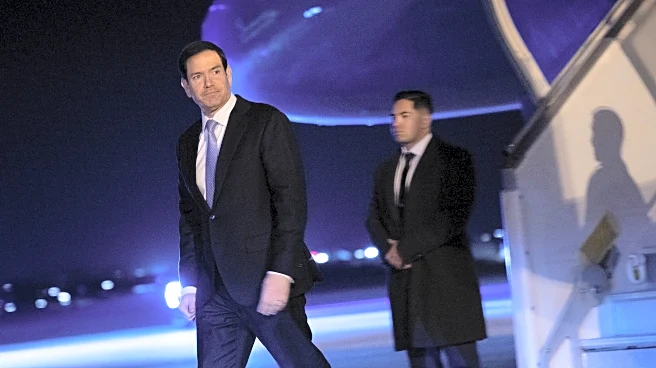
Rubio left Washington for the G7 meeting outside Paris just hours after Trump complained bitterly about NATO countries not stepping up to help the U.S. and Israel in the Iran war.
“We are very disappointed with NATO because NATO has done absolutely nothing,” Trump said.
Rubio has work to do to smooth things over with allies like those in Europe that have faced criticism or outright threats from Trump and others in his administration. The Europeans are still smarting over Trump's earlier demands to take over Greenland from NATO ally Denmark and are concerned about U.S. support for Ukraine in its war with Russia. The conflict in the Middle East has added another point of tension.
“Frankly, I think countries around the world, even those that are out there complaining about this a little bit, should actually be grateful that the United States has a president that’s willing to confront a threat like this,” Rubio said at the Cabinet meeting.
Asked by reporters about the reception he was expecting to get, Rubio said before his flight to France that he was looking forward to gathering with his G7 counterparts and that “we’re going to have great meetings.”
He later posted on X that he would be meeting in France with "world leaders about the security concerns we share around the world and opportunities to address the situation in the Middle East and the Russia-Ukraine war.”
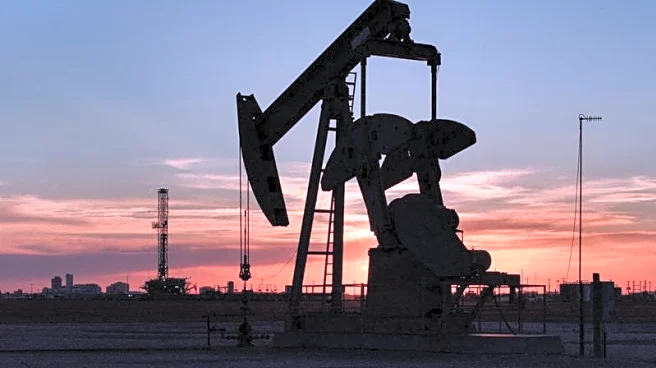
Trump has complained that he has not been able to rally support behind his war of choice in Iran and that NATO and most other allies have rejected his calls to help secure the Strait of Hormuz, where Iran's chokehold has disrupted oil shipments and pushed up energy prices.
“We’re there to protect NATO, to protect them from Russia. But they’re not there to protect us,” Trump said Thursday. He later added: “I never thought we needed them. I was more doing a test.”
Before the U.S. leader's comments, NATO Secretary-General Mark Rutte reiterated the increase in defense spending by alliance members — which Trump has urged — saying Europe and Canada had been “overreliant on U.S. military might” but a “shift in mindset” has taken hold.
Rutte said NATO has been clear that Iran cannot have a nuclear weapon and has “long recognized the threat Iran’s missile program posed to allies and their interests. And what the United States is currently doing is degrading those capabilities, both the nuclear and the missile.”
France is hosting the G7 meeting at a historic abbey near Versailles and has been highly skeptical of the war. The chief of the French defense staff, Gen. Fabien Mandon, complained this week that U.S. allies had not been informed about the start of hostilities.
“They have just decided to intervene in the Near and Middle East without notifying us,” Mandon said. “We acted immediately, surprised by an American ally, who remains an ally, but who is less and less predictable and doesn’t even bother to inform us when it decides to engage in military operations. This affects our security. This affects our interests.”
However, 35 countries joined military talks hosted by Mandon on how to reopen the Strait of Hormuz “once the intensity of hostilities has sufficiently decreased,” France’s Defense Ministry said in a statement.
Rubio said that with Iran threatening global shipping, countries that care about international law “should step up and deal with it.”
Similar sentiments to Mandon's have been expressed by other allies that also worry about the U.S. commitment to Ukraine as the Iran war closes in on four weeks.
“We must avoid further destabilization, secure our economic freedom and develop perspectives for an end of and the time after the hostilities,” German Foreign Minister Johann Wadephul said Thursday. “Our joint support for Ukraine ... must not crumble now. That would be a strategic mistake with a view to Euro-Atlantic security.”
Wadephul said he expected “that we can define a joint position” on the Middle East.
“Of course, this is about ending this conflict as quickly as possible, but also ending it sustainably, and that means bringing about security in the Strait of Hormuz and ensuring overall that the Iranian regime, which in the past has behaved negatively enough, is also curtailed in the future,” Wadephul said.
___
Associated Press writers Lorne Cook in Brussels, John Leicester in Paris and Geir Moulson in Berlin contributed to this report.