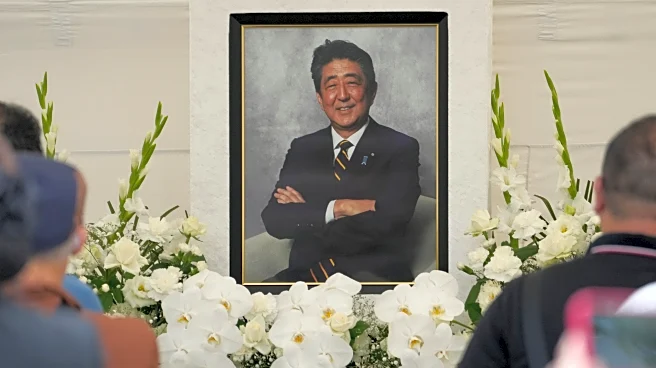

TOKYO (AP) — A Japanese court on Wednesday will sentence a man who's admitted assassinating former Japanese Prime Minister Shinzo Abe, a case that revealed decades of cozy ties between Japan’s governing
party and a controversial South Korean church.
Abe, one of Japan’s most influential politicians, was serving as a regular lawmaker after leaving the prime minister's job when he was killed in 2022 while campaigning in the western city of Nara. It shocked a nation with strict gun control.
Tetsuya Yamagami, 45, pleaded guilty to murder in the trial that started in October, and Wednesday’s ruling will determine how long he'll spend in prison.
Yamagami said he killed Abe after seeing a video message the former leader sent to a group affiliated with the Unification Church. He added that his goal was to hurt the church, which he hated, and expose its ties with Abe.
Prosecutors have demanded life imprisonment for Yamagami, while his lawyers have sought a sentence of no more than 20 years, speaking of his troubles as the child of a church adherent.
The revelation of close ties between the ruling Liberal Democratic Party and the church caused the party to pull back from the church. It also prompted investigations that ended with the church's Japanese branch being stripped of its tax-exempt religious status and ordered dissolved.
The killing has also led to officials working to increase police protection of dignitaries.
Abe was shot on July 8, 2022, while giving a speech outside a train station in Nara. In footage captured by television cameras, two gunshots ring out as the politician raises his fist. He collapses holding his chest, his shirt smeared with blood. Officials say Abe died almost instantly.
Yamagami was captured on the spot. He said he initially planned to kill the leader of the Unification Church, but switched targets to Abe because of the difficulty of getting close to the leader.
Yamagami’s case has also brought attention to the children of Unification Church adherents in Japan, and influenced a law meant to restrict malicious donation solicitations by religious and other groups.
Thousands of people have signed a petition requesting leniency for Yamagami, and others have sent care packages to his relatives and the detention center where he's being housed.