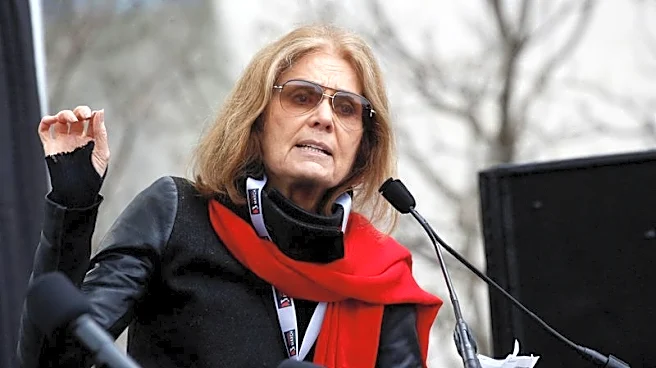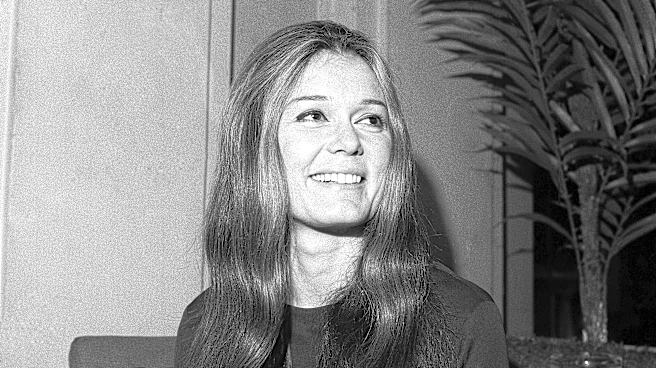




EDITOR'S NOTE: Gloria Steinem, who died Wednesday, was a freelance journalist who had not yet founded Ms. Magazine when she invited The Associated Press into her apartment for a feature on a life that found her equally comfortable at high-society dinners and in tenement halls.
The April 5, 1970, feature written by then-AP writer Lynn Sherr, headlined “Making It Like, Wow,” ran with a photograph of Steinem — and her cat — at home, which doubled as her workplace.
It carried its own editor's note introducing Steinem:
“She’s a writer who is almost as much written about as she writes. She’s as beautiful as the Beautiful People she records. She’s a name among name droppers. And she’s Everygirl’s answer to whether Cinderella can ever find success and happiness in the big city.”
As the AP looks back on Steinem's life and career, it is making that early profile available for readers. The story has been edited for typographical errors, but maintains the AP style — and mores — of the day.
___
Making It Like, Wow
By LYNN SHERR
NEW YORK (AP) — It sounded like the bash of both decades. A New Year’s Eve party at Gloria Steinem’s!
Gloria who?
Gloria Steinem: the writer-activist-antiwar-gorgeous bachelor girl who was pictured with Henry Kissinger in Time and Life and who helped keep the cool in Harlem with Mayor Lindsay and who almost has a permanent guest swivel chair in Carson and Cavett’s TV studios and who nearly ran on the New York mayoralty ticket with Norman Mailer and Jimmy Breslin and who once let Ali MacGraw share her apartment—I mean, wouldn’t her party be crawling with names? I mean, didn’t she practically run New York?
And so Marty and Jeff, two journalism students in search of the Jet Set, crashed.
As it turned out, they’d have found more celebrities fox-trotting to Guy Lombardo. Steinem’s brownstone on that last day of 1969 yielded just six Black Panthers, four Long Island migrant workers, assorted interesting but unheard-of people and a doctor named Mortimer. No Lindsay, no Mailer, no Breslin, not even one Kennedy.
“Jimmy’s at home with his wife and Norman’s out in the country,” she apologized kindly.
“That’s what real life is like.”
Well, maybe. New Year’s Eve may have been all cold turkey on the table and ice cubes in the bathtub, but Gloria Steinem, 34, free-lance magazine writer and contributing editor to New York and Glamour magazines, hardly ekes out your basic subways-and-supermarkets existence as an Upper East Side Single.
A humbly born Midwesterner-turned-Manhattanite whose showgirl legs have not yet been hidden beneath a maxicoat and whose perfect-for-a-Pucci-dress body stays slim with Slender and Fresca, Steinem is Everygirl’s dream of Making It.
There was that party on the West Side, for instance. when the show-biz folk got to playing parlor games imitating famous people. “Well, I know about a thousand girls who would like to be Gloria Steinem,” joked one participant.
And then there was that press briefing in Washington, when Defense Secretary Melvin Laird was asked by Pentagon reporters about his alleged annoyance with the policy interference of White House foreign affairs adviser Henry Kissinger. “No. I don’t worry about Kissinger,” Laird answered, grinning over the bachelor adviser’s well-gossiped social life. “Not since I found out Gloria Steinem is going out with other men.”
Or there was that article in a Canadian newspaper, describing Gloria Steinem as possessing “the body of Raquel Welch, the brains of Eric Sevareid.”
“Eric Sevareid?” protested the real Gloria Steinem in her slightly nasal sotto voice. “Eric Sevareid is much too conservative.”
Thus, Gloria Steinem.
A political radical who has helped bail Black Panthers out of jail, she made Cesar Chavez a Name to Drop by organizing a fund-raising party for the grape-pickers on Long Island, at which Ethel Kennedy chose to make her first postassassination public appearance.
During the 1968 campaign, she worked—hard—first for Eugene McCarthy, then for Robert Kennedy, then for George McGovern, the South Dakota senator who is still a close friend. Steinem says he’d be one of two people she would name as references on a college application.
The other would be Harvard economist John Kenneth Galbraith.
Her datebook, a pocket-sized black leather, records in felt-pen scribblings the highlights of several social seasons: the New York Shakespeare Festival Benefit in 1965—to which she wore a chinchilla-ringed dress designed by Estevez; Truman Capote’s Masked Ball—to which she wore a silver mask with peacock feathers designed by her artist ex-roommate; summer days in the Hamptons and city nights at Elaine’s, the literary set bar. It is a world where people just know each other; where she happened to meet the Galbraiths at a lecture in Cambridge and then met McGovern at a weekend at their (“Kitty and Ken’s”) country home; where, after meeting Truman, he insisted that she interview Lee Radziwill and so she did, and then stayed with the Radziwills at that.
The datebook also records items that don’t make the gossip columns: treks to Lower East Side welfare projects, meetings for West Side day-care centers, concern for Vietnam veterans in outlying hospitals. Steinem moves, graceful, between both worlds—monied sophistication and tenement poverty—turning up at both in microshort clingy dresses and tall boots.
“She’s all together, she can make anything relevant,” explains Arnaldo Segarra, a handsome young Puerto Rican who grew up playing stickball in the sewers of El Barrios and who used to be an aide to Mayor Lindsay. “We even made her an honorary Puerto Rican. And not too many white Anglo-Saxon females get that.”
At a dinner for Herman Badillo in the Americana Hotel. Steinem slips in late wearing a slinky brown velvet dress with a train that settles on the floor like a puddle behind her. “It was my thrift shop bargain,” she says—“$15. I’m afraid to have it cleaned.”
Her blue-tinted aviator glasses—without which she cannot distinguish a Black Panther from a white Bircher—fit over a few strands of blonde-streaked brown hair and then disappear into the long, soft mane.
After the speech, Steinem waits in the lobby while the assemblyman friend who paid for her dinner retrieves her short brocade coat from the checkroom because she does not have 35 cents.
The dinner is a rare night out for Steinem that week. Most of her other engagements—including invitations from sought-after editors and glittering movie premieres—she has cancelled to meet story deadlines, and sits hunched over the typewriter at her roll-top oak desk.
That, for Gloria Steinem, is also Real Life.
What irks her is how it always comes out more Lively than Real.
Like that Sunday morning in a snowstorm, when she pulled on boots and a sheepskin coat—“the only good thing from the Rockefeller trip”—and trudged up to the Spanish Methodist Church on East 111th Street to lend support to a group of Young Lords in confrontation with the police. A local newspaper columnist the next week sniped that “Gloria Steinem was there in a fur coat.”
Or that item in Time, turning a party photograph into a tryst with Kissinger and calling her a “Gucci liberal.” “Henry’s real girl friend must have gotten angry,” she laughed. “Anyway, I don’t even own a pair of Gucci shoes.”
Stretched out barefoot in her multiprint living room, she wore a brown see-through shirt tucked into wide-legged brown denim pants with an Indian belt strung through the loops. Brown Swedish klogs rested beside the undulating benches of pink and purple. With a pearl-gray cat settled languidly on her lap, its tail stroking her slim waist, Steinem gently dismissed the myths of her rich girl image.
“Say that I have always worked for a living, my own living, that I buy my dresses off the rack,” she pleaded. “I have never been to Acapulco and I don’t go away for ski weekends.”
She assigned to her answering service the nonstop ringing of her unlisted telephone in the other, the working room of her apartment: a book-lined den with posters of Che Guevera (a Mailer-Breslin button had been pinned on it), Robert Kennedy (“Whenever I have a problem or have to face something bad. I think of Bobby, because he was always in over his head”) and La Causa.
Back in the living room, where a Spanish-speaking maid had just finished vacuuming, Steinem reached for an occasional cigarette. On the wall, American chintz ran into Oriental prints. A zebra skin covered the floor. A sleeping balcony jutted out from one corner.
“I know I’m doing the right thing by writing,” Steinem laughed, in her characteristic sociopolitical way of speaking in capital letters, “because it’s the only thing I do that doesn’t make me feel guilty.”
Not that she was born with a silver typewriter in her crib. Growing up in house trailers until age 11, then the slums of Toledo, Ohio, she tap-danced for a few dollars a night and learned to recognize bill collectors.
After a Phi Beta Kappa key at college (Smith, on scholarship), two years on a fellowship in India, then some work on Youth festivals in Cambridge, Mass., Steinem headed for New York.
Her first publishing job in 1960 was with Help, a political satire magazine. A boy friend at Esquire, an appreciative features editor—“Hell, I just wanted to meet her,” said Clay Felker—and good ideas landed her a first bylined piece in that magazine.
But it took more than good looks to get second assignments. Steinem worked hard, organized furiously. For Show magazine, she stuffed herself into a mini-cottontail suit and did an “I Was a Playboy Bunny” expose. It wowed the readers and earned the author—who would have preferred writing about politics—“offers to be a hooker on 57th Street, to commit myself to prison, all those things. I have it in the Mistake Section of my Anthology I’m putting together.”
Careerwise, it was no mistake. “A Bunny’s Tale” sent Steinem soaring into print with stories that sliced to the core of everyone from Jackie Kennedy to James Baldwin—articles which were sometimes trenchant, sometimes pedantic, but about which she is disarmingly frank. “If Forster, Dinesen and Proust are writers,” she once wrote, “then I must be something else.”
Steinem’s current choice of subjects—and the fact that she has been able to make that choice—sets her apart from all the other pretty girls who come to New York to find the Glass Slipper. “Here you are with a college degree and what does it mean?” she joked. “You write about lipstick and bunnies.”
Then, after some thought: “During the Kennedy administration you could go to discotheques because the world wasn’t coming to an end, Panthers weren’t getting shot in the next room. I’m happier not going to parties any more. Maybe that’s because I’m secure enough not to care.”
What she does care about, she is writing about: politics, urban sociology, women’s liberation.
One of her favorite TV talk show lines goes, “Men will be much happier, too, when they no longer have to deliver on a silver platter an identity to a lady.”
That goes for her own identity, as well. Felker, now editor of New York, says of her: “She is the ideal woman—beautiful, involved, and free to choose whatever she wants.”
Ladies like her too. The wife of a prominent journalist said, “If my husband were to leave me for Gloria Steinem, I would only consider it a further extension of his good taste.”
In her New York magazine article on “Women and Power”—now part of a book—Steinem quoted Jacqueline Kennedy Onassis as having said, “There are two kinds of women: those who want power in the world and those who want power in bed.”
“When Clay gave me a copy of the book, he inscribed it, ‘To the Third Kind,’” Steinem said, only half-smiling.
“That means I want both.”