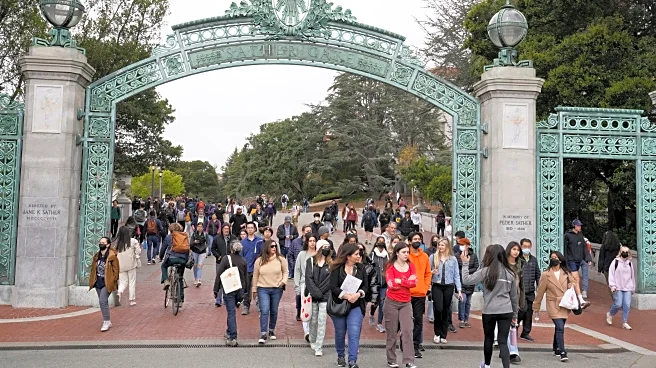




UC Berkeley’s ability to draw international students appears little affected by the national political scene.
New international student enrollment grew by 43% at UC Berkeley this school year to 2,363, according to University of California data released Thursday, despite a federal immigration crackdown that has deterred some foreign students from studying in the U.S. Enrollment of undergraduates from California also increased, as the university welcomed
46,151 students, its largest-ever student body, up from 45,882 last year.
The growth in new international students stands in sharp contrast to a 17% decrease among that group at campuses nationwide, according to a November report from the Institute of International Education. UC-wide, the number of new international students grew by about 5%.
“If you go back to the beginning of the summer, there was a real worry about whether international students would get visas, and whether they would want to come,” said Jesse Rothstein, director of UC Berkeley’s Center for Studies in Higher Education. “And those worries didn’t materialize.”
“There may be fewer who want to come to the U.S., but those that want to come would rather go to the best public university in the country,” he added.
Overall international student enrollment held steady at Cal, at about 6,000, with China sending by far the most, followed by India, South Korea and Canada. New U.S. students from outside California increased by 29%, with total nonresident domestic enrollment up by about 6%, to 4,732.
UC Berkeley spokesperson Janet Gilmore said the university intentionally sought to increase the number of new students who were not California residents to compensate for a dip the previous year and a large number of nonresident students graduating. Those students tend to pay higher tuition than California residents.
Californians nevertheless make up the vast majority of UC Berkeley’s student body, with California undergraduates reaching a record high of 26,670 this year.
That mirrors a systemwide trend: Under a compact with Gov. Gavin Newsom, the University of California has gradually enrolled more California residents over the past few years in exchange for the promise of predictable annual 5% budget increases from the state. But last year, the state deferred that increase in order to close a budget gap, and it’s unclear whether lawmakers will restore it this year.
“The challenge will be going forward to ensure we continue to provide slots for California students who want to go to UC,” said Hans Johnson, a senior fellow at the Public Policy Institute of California.
UC Berkeley’s voracious growth has sometimes been a source of tension with city residents, and the university has been building new dorms in an attempt to solve its chronic housing crunch, with the aim of guaranteeing every student two years’ worth of on-campus housing by 2027. Limited housing stock has constrained how much the university was able to grow enrollment, Rothstein said.
“You need to do it very gradually so you can build out the services you need,” he said.
Women still outnumber men among UC Berkeley students, 52% to 44%, and engineering remains the most popular undergraduate major for those who have declared one.
The number of UC Berkeley undergraduates identifying as American Indian increased incrementally but steadily each year since 2021, when UC launched its Native American Opportunity Plan, covering tuition and fees for students enrolled in federally recognized tribes. Adam Hillier, director of strategic initiatives in UC Berkeley’s undergraduate admissions office, said that while the program was one factor in the uptick, the university has also boosted outreach to Native American students and worked with campus affinity groups to recruit and retain them.
The University of California system overall surpassed 300,000 students for the first time this school year, the data show. In releasing the fall enrollment numbers, UC officials touted the value of a UC education, while also sounding the alarm about federal and state funding cuts.
“A UC degree, that has proven to pay dividends, is the gold standard for public higher education,” said Han Mi Yoon-Wu, associate vice provost for Systemwide Undergraduate Admissions. “We want every Californian to know that a UC degree is possible for them.”
___
This story was originally published by Berkeleyside and distributed through a partnership with The Associated Press.