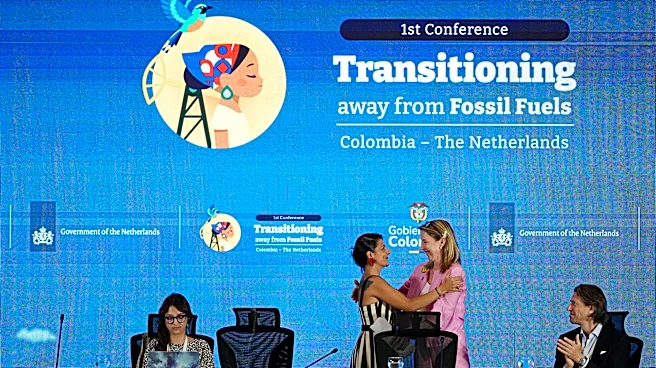




SANTA MARTA, Colombia (AP) — High-level talks to accelerate the shift from fossil fuels got underway Tuesday at a global conference in Colombia’s Caribbean city of Santa Marta, as countries push for faster action on climate change.
The two-day segment of ministers and senior officials marks the political centerpiece of the First Conference on Transitioning away from Fossil Fuels, where more than 50 countries have been discussing how to move away from oil,
gas and coal — the main drivers of global warming — toward cleaner energy.
“The conclusion is unavoidable, we must transition away from fossil fuels — not just because it’s good for climate, but because it strengthens our energy independence and security,” said Stientje van Veldhoven, minister for climate policy and green growth for the Netherlands, which is co-hosting the conference with Colombia.
The meeting reflects growing frustration among some governments and advocates that decades of U.N. climate negotiations have failed to directly address fossil fuel production, prompting the Santa Marta summit to push the issue outside formal talks. Recent negotiations have acknowledged the need for a transition, but countries remain divided over how to implement it and how to finance the shift.
Security protocols at the Santa Marta hotel venue were tight Tuesday as ahead of Colombian President Gustavo Petro's arrival in the afternoon to address attendees. Leftist Petro has positioned Colombia as a leading voice calling for a global shift away from fossil fuels, while pushing for a gradual transition at home that balances climate goals with economic realities.
Outside the conference venue, members of a mining union protested against Petro and the event, chanting through megaphones and holding signs that read: “I arrive at the conference by plane to criticize the oil industry,” “More oil, less Petro,” and “Defend your oil barrels.”
With elections in a month's time, outgoing Petro kept his pledge since taking office to halt new oil and gas exploration and steer the country toward a post-fossil fuel economy, even as the Andean nation remains heavily dependent on oil and coal exports.
Colombia’s Environment Minister Irene Vélez Torres framed the gathering as a key moment for international cooperation.
“Let this conference be the moment when ambition becomes solidarity and when cooperation becomes the path toward a future beyond fossil fuels,” she said on Tuesday morning. “Let’s make this a turning point in history.”
Yuvelis Morales Blanco, a 25-year-old activist from Puerto Wilches, Colombia, spoke at the opening plenary and called for urgent action and a transition rooted in communities.
“We are called to make real the world we have imagined,” she said, urging governments to take “direct and concrete actions” to move away from fossil fuels and protect nature. “We demand energy justice, climate justice and justice for youth and children.”
Discussions in Santa Marta so far have highlighted the central challenge of funding the transition, particularly for developing countries facing high borrowing costs and limited access to capital.
Van Veldhoven of the Netherlands said access to affordable financing would be critical to ensuring the transition can happen globally, particularly for developing countries facing high debt and limited fiscal space.
Participants have also debated the role of policy tools such as carbon markets and government subsidies, as well as how to ensure the transition does not repeat patterns of land use and resource exploitation that have harmed communities in the past.
Organizers say the conference will not produce binding agreements, but that it is intended to build political momentum and bring together countries willing to accelerate the transition outside the formal U.N. process. It is also seen as a steppingstone toward upcoming global climate negotiations, where financing and timelines for reducing fossil fuel use are expected to remain key points of debate.
On Monday, Tuvalu, a tiny, low-lying Polynesian island nation in the South Pacific Ocean, announced it will host the next conference on transitioning away from fossil fuels. Small island nations are highly susceptible to climate change, with Tuvalu expected to be submerged by 2100 due to rising sea levels, according to scientists and the U.N.
___
The Associated Press’ climate and environmental coverage receives financial support from multiple private foundations. AP is solely responsible for all content. Find AP’s standards for working with philanthropies, a list of supporters and funded coverage areas at AP.org.