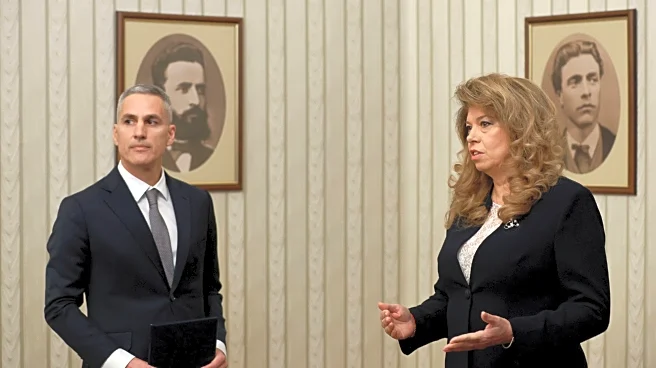

SOFIA, Bulgaria (AP) — Bulgarian President Iliana Yotova moved Thursday to quell the country’s chronic political instability by appointing a senior central bank official as interim prime minister until
national elections in April.
Andrey Gyurov, deputy governor of the Bulgarian National Bank, will lead a caretaker government whose main task will be to organize a free and fair vote in a country that is holding its eighth election in five years.
The political uncertainty that has plagued the EU and NATO member state during this period has eroded public trust in institutions, created an opening for populist and nationalist groups, and paved the way for Russian hybrid influence.
President Yotova, who announced the appointment, said that she expects Gyurov to propose the members of his cabinet within seven days. She would then have to approve the proposal and set the election date, which she had previously indicated would be April 19.
Gyurov, 50, holds a bachelor’s degree in economics from Truman State University in Missouri and a Ph.D. from the University of Vienna in Austria. Having held senior positions in academia and European financial institutions, he was appointed deputy governor of the central bank in Sofia in 2023. Before that he was also a lawmaker and floor leader of the reformist “We Continue the Change” group in parliament.
Nationwide protests erupted at the end of 2025, sparked by public anger over corruption, injustice, and perceived oligarchic influence, forcing the resignation of the governing coalition led by the center-right GERB party. Several subsequent attempts to form a new government within the current fragmented parliament have failed.
According to Mario Bikarski, senior Eastern and Central Europe analyst at the risk intelligence company Verisk Maplecroft, Gyurov’s appointment suggests that the president sought a figure who is not affiliated with GERB or DPS — the two main parties targeted by the street protests in December.
“The appointment will empower the opposition ahead of the upcoming snap election and will also dispel doubts about the policy priorities of the presidency,” Bikarski added in emailed comments.
Bulgaria joined the zone of countries using the euro currency at the beginning of this year. Picking a central bank representative as premier suggests macroeconomic stability has been sought amid the ongoing single currency adoption, Bikarski said.
However, he argued that the upcoming election is unlikely to resolve the prolonged political crisis.
“The election will likely produce three roughly equally sized blocs in parliament, with smaller parties at risk of falling below the parliamentary threshold (of 4% of the vote). Electoral consolidation is unlikely to restore stability, however, as all three political blocs will struggle to wrangle a majority,” he added.