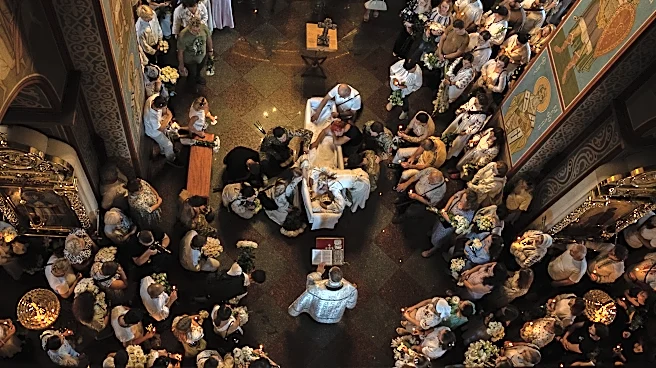




KYIV, Ukraine (AP) — Hundreds of mourners dressed mostly in white walked through central Kyiv on Tuesday behind the open casket of a university student killed at the weekend by a Russian strike as she helped people wounded in an earlier attack.
The farewell for 20-year-old Vitalina Yarovenko began inside St. Michael’s golden-domed Cathedral, where clergy read prayers over the casket and relatives and friends approached her body to say goodbye.
Her family
said they had asked mourners to wear white or traditional Ukrainian embroidered shirts instead of black, so that Vitalina “would not feel too sad.”
Although Yarovenko was a civilian, her mother asked that she be given the kind of funeral procession used in Ukraine to honor fallen soldiers. Several hundred people followed her casket from the cathedral downhill toward Independence Square.
Traffic stopped for several minutes to allow the procession pass. Drivers stepped out of their cars and stood silently. Some knelt on one knee, while others placed a hand over their heart.
Yarovenko, a fourth-year psychology student at the National University of Kyiv-Mohyla Academy, had been an instructor at a military training school affiliated with the university.
In July, she began volunteering with the Hospitallers, a Ukrainian medical organization which is mostly focused on delivering frontline medical aid and whose teams travel to the sites of Russian attacks to treat and evacuate the wounded.
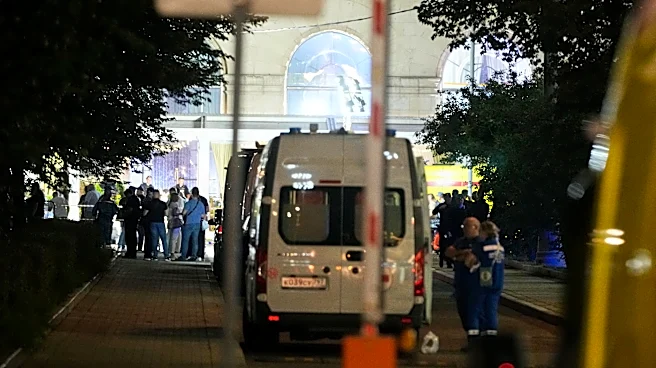
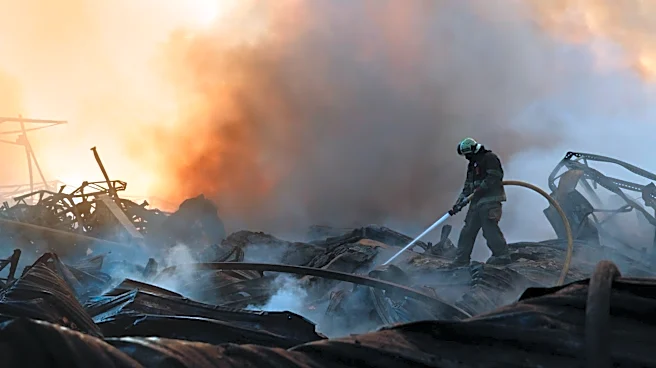
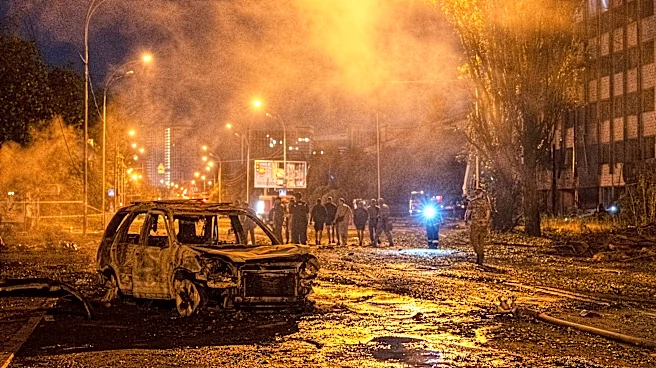
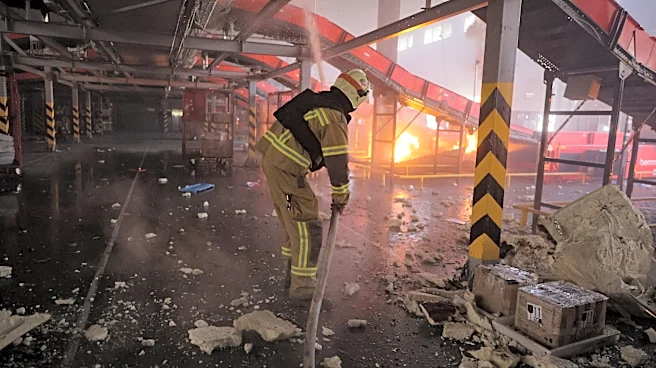
Early Saturday, Yarovenko rushed to the scene of a Russian missile strike that hit Kyiv’s Darnytskyi district. As she and other volunteers were at the scene, another strike hit the same location, according to her relatives and friends.
Ukrainian officials have previously accused Russia of targeting rescue workers by hitting residential buildings with two consecutive missiles — the first one to draw crews to the scene and the second one to wound or kill them. The tactic is called a “double tap” in military jargon.
At Independence Square, the crowd observed a minute of silence for those killed while defending Ukraine.
Yarovenko’s mother, Nataliia, stood holding a microphone in her right hand and a large portrait of her daughter in her left. Crying, her voice shaking, she said she was giving up the most precious thing she had.
“I have given up the meaning of my entire life, but I am immensely proud,” she said. “I don’t want a hero at home. I want my child at home. But this was her path.”
Beside her stood another mother, also named Nataliia, whose daughter, 25-year-old Eva Royce, was working alongside Yarovenko and was also killed.
Royce had not yet been buried because her remains were severely burned and the identification of recovered body parts was still underway. Her mother did not speak during Yarovenko’s ceremony as she mourned her own daughter.
Yarovenko had planned to enlist after completing her fourth year at university, said her friend Anastasiia Alieksieieva.
“Her decision to volunteer and help people in Kyiv after the attacks showed how committed she was to that plan,” Alieksieieva, 21, said. “She did not even make it to graduation.”
Another close friend, Anna Donets, 19, said Yarovenko had raised money for Ukraine’s military, volunteered at a military hospital and helped organize military training for youth.
“There are not many people like her, and she was going there to help people,” Donets said. “People like her shape the future, and others should follow them. But unfortunately, Russia kills them.”
Donets described Yarovenko as exceptionally funny and someone whose presence could lift those around her.
“We were remembering her humor yesterday and laughing because she was always teasing everyone. It was never boring with her,” she said. “At 8 in the morning on teaching days, when everyone else was exhausted, she would arrive as if she were stepping onto a runway. She was so beautiful — simply a queen.”
Serhii Beskrestnov, a family friend and a presidential adviser on defense technology development, struggled to find words.
“We understand that there is a war, that men and women are dying,” he said. “But when it happens away from the front, to people who are helping ... I don’t know. I have no words right now.”
Russia launched 220 aerial weapons across Ukraine that night, including 35 missiles and 185 drones, Ukraine’s air force said. Twenty-seven missiles were ballistic Iskander-M missiles or missiles fired from S-400 systems. Ukrainian defenses intercepted only one of them, along with one guided air-launched missile.
At least nine people were killed and 33 were wounded in Kyiv that night, according to Ukrainian authorities. The attack underscored Ukraine’s critical shortage of Western-supplied defenses against ballistic missiles. Ukraine relies heavily on U.S.-made Patriot systems, but interceptor missiles remain in short supply.
At the end of the ceremony, mourners approached Yarovenko’s casket one by one, laying white flowers beside her. She was later buried at a military cemetery in Kyiv, a distinction rarely granted to civilians.
Her mother spoke of the future she had imagined for her daughter — and the future she said Ukrainians must still defend.
“We must withstand this war so that this land remains for our Ukrainian children,” she said. “Unfortunately, my child will now lie in this earth. I would have very much liked to give her a beautiful wedding, but today that is no longer possible.”